
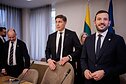


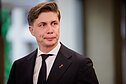



The issue of exemptions for Belarusian fertilisers was not raised at the European Council’s summit on Thursday, Lithuanian President Gitanas Nausėda said after the meeting.
“Mr. António Guterres, secretary-general of the United Nations, did not raise the issue of Belarusian fertilisers,” the president told reporters in Brussels.
“Well, maybe we dramatised things a little, as if predicting that such a topic could be raised, but I think that knowing that the Lithuanian president is sitting at the table, as are the leaders of other like-minded countries, they probably did not want to bring up the idea [because] it certainly would not have been supported,” he said.
EU sanctions on Belarusian fertilisers, the country’s principle export, were imposed in several rounds before Russia’s invasion of Ukraine in February 2022.
Belaruskali products made up the bulk of Belarusian fertiliser exports and were shipped abroad by rail through Lithuania and then via its seaport of Klaipėda.
The transit was stopped in February 2022, citing international sanctions and risks to national security as the reason.

In January, however, the European Commission started consultations on amending the sanctions on Belarus to include an exemption for fertilisers, sources have told BNS. The concern is that dearth of fertiliser may negatively affect food security, especially in developing countries.
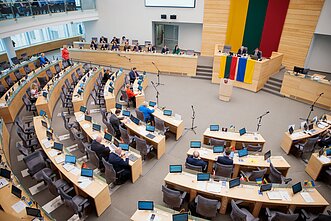
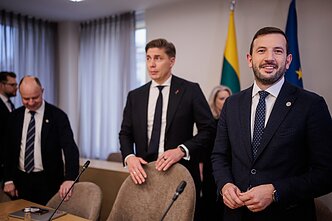
“I think that today we can state that Lithuania’s position at all levels, from the president to the Seimas [parliament] committees, is absolutely unanimous and very strong, and we will use all possibilities, including the right of veto, to prevent these decisions from being passed and implemented,” said Nausėda.
In a joint statement on Wednesday, the Lithuanian parliamentary Committees on European Affairs and on Foreign Affairs said that “the food crisis argument used for lobbying purposes is a reflection of Russian propaganda aimed at blackmailing the international community, when in fact the impact of potash fertilisers on food security in African countries is very limited”.
The committees “strongly oppose any compromise that would ease the sanctions previously imposed on Belarus and leave the possibility of exemptions for Belarusian fertiliser oligarchs or companies”.
There were concerns that the debate might heat up with the arrival of UN Secretary General António Guterres in Brussels on Thursday, as the UN says that a sharp drop in Belarusian fertiliser exports has led to a surge in food prices in developing countries.
Further reading
Nausėda, however, rejects the argument.
“This [argument] is completely unjustifiable, especially since the so-called food issue is being addressed in other, alternative ways,” said the Lithuanian president.
He said that that he had “preventively” spoken out at the summit against possible exemptions from the sanctions, arguing that this would be “a decision contrary to all our principles”.
According to the president, exemptions would weaken the sanctions and increase possibilities to circumvent them, which would make their implementation more difficult, and allow Russia and Belarus to generate additional revenue.
Politico has reported that “Vilnius is backed by the other Baltic capitals and Warsaw, a group of sanction hawks that believes squeezing Russia and Belarus is crucial to ending the war in Ukraine – no matter the cost”.

Newsletter
Every Friday morning.