
















What has prompted part of the Lithuanian population to believe that their elected government is working against them? How to talk to those who believe in conspiracies, and can their ideas have a significant impact on upcoming elections?
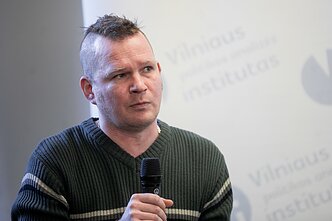
Sociologist Karolis Jonutis has been studying populism, but recently turned his attention to conspiracy theories. In an interview with LRT.lt, he discusses what gives rise to unsubstantiated beliefs and whether arguments on social media can be effective.
What is there for scholars in studying conspiracy theories?
For me, it’s a natural transition, my dissertation was about populism. Conspiracy theories are not always, but in many cases, linked to populism. What we have seen in the pandemic is that conspiracy theories are not the occupation of insignificant, small groups, but part of the daily communication of a very large part of society. When experts and scholars had to refute conspiracy theories in public, we saw that they were very deeply rooted in society.
What are your observations about vaccine-related conspiracy theories?
I wanted to see how Covid conspiracy theories were used to construct a certain image of the enemy. The enemy, naturally, are the people in power who are making policies to manage the pandemic. Conspiracy theories were used in various ways, starting with accusations of corruption: that things were done to make money. Clearly, the company producing vaccines wants to make a profit, and they allegedly also want to harm the public, because there is no real need for vaccines.
I have been researching social media. Conspiracy theories have tended to become more abstract and broader. The image of the enemy was changing, it was incorporated into bigger, global conspiracy theories.
They alleged that our elites may be part of the great reset or are controlled. The image of the enemy has moved from a very concrete one, of someone doing something for profit, to a completely abstract one, someone who wants to change the system of governance in Lithuania and the world.

How to measure conspiracy theories and the extent of their spread and influence on society? How do we know if people are simply interested in unusual ideas because they are curious, or whether we should be concerned?
Conspiracy theories have been around since ancient times, with examples in ancient Rome and Greece. It can be concluded that they are common in any society. When do they go beyond the ordinary? When societies are in crisis. The pandemic crisis was probably one of the biggest, because it affected everyone’s life to some extent.
Conspiracy theories, in addition to spreading disinformation and constructing enemies, simplify things in a psychological sense. It is easier to live when someone is specifically responsible for problems and for crises. For example, some Freemasons have created a virus to cut the plant’s population.
These are concrete accusations and people believe that if you uncover [the conspiracy] and the society wakes up, the problem will be solved. It is time-consuming to delve into the economic, social processes of managing a pandemic, and not everyone is able or willing to do it. The more uncertain people feel, the more they live in a risk society, the more they believe in conspiracy theories.
In the US, at least 50 percent of people believe in at least one conspiracy theory – this is not some marginal phenomenon that affects inadequate people. Unless we think that half of our society is inadequate, which we probably don’t want to think.
There are many things that make a society feel insecure, socio-economic factors, people are not sure about their future, so they tend to fall for conspiracy theories.

Will this surge in conspiracy theories change politics in Lithuania, perhaps influence future elections?
Apparently, the cycle of protests and conspiracy theories about Covid-19 has already run its course. I have been researching conspiracy theories related to the Istanbul Convention, decriminalisation of drugs. They are less relevant to everyday life and generate less interest. They work longer, because if you believe in them, you can go very wide. But they are weaker than pandemic conspiracy theories.
Will this have an impact on elections? In the broadest sense, they are not going anywhere. I think they may unravel similarly to the Way of Courage party or maybe not even that.
[The Way of Courage was a party that resulted from a movement inspired by a case of alleged child abuse and claims of widespread paedophilia among the elites. It got into parliament in 2012 with over 8 percent of the vote but collapsed soon afterward.]
Read more: Moral panic of the decade: former judge's extradition rekindles 10-year-old story
Once you get into the parliament, things get out of hand very quickly, because it is very difficult to continue from the inside with the same hard line about Freemasons supposedly ruling the parliament. I do not think that we will reach the level of the US, where groups are accusing each other of paedophilia, of running conspiratorial networks, although in the case of the Way of Courage, it was similar. […]

Conspiracy theories, in my opinion, only exacerbate [existing tensions], allow to construct the image of the enemy as total evil doing covert harm. Which is very much like elementary populism, and it is not going anywhere unless we can avoid crises. That is not, however, possible.
The groups that I’m studying now do not claim that the war [in Ukraine] is fake. They do say, however, that the government is using the war to impose control, to push through the Istanbul Convention, and the control will be permanent even once the war ends.
What then is the future of populism?
I think that, to a certain extent, populism is inherent in democracy. Conspiracy theories are certainly not going away. The principle of both populism and conspiracy theories is similar – they simplify the world, link things that are not connected, and present a much simpler version of reality. All democratic parties are somewhat populist, otherwise they would not be able to mobilise voters.
It probably all depends on the stability of our life. If it is stable, if there are no economic crises, populism tends to fizzle out. But it does not happen on its own, it depends on the traditional parties: whether they offer alternatives, whether they are different from each other, whether they appear to represent the same elites. […]
On the other hand, many conspiracy theories are related to migration issues, there’s talk about the “great replacement” of the white race. We have had a relatively mild version of this, though […].

Observers here often point to Russia as the origin of conspiracy theories. Many also think that people who believe in conspiracy theories should be educated and informed, metaphors of struggle are often invoked. What do you think about efforts to fight conspiracy theories?
If you tell someone that they are stupid, they will not say: “Oh, I really am, I’m sorry, I’ll stop.” I think people need to be trained to sift through information. But conspiracy theories work because they do not depend on evidence. You can always say that evidence is part of the conspiracy. You cannot appeal to the goodness or badness of information.
I wouldn’t say that the “struggle” against conspiracy theories is pointless, but I think it should go hand in hand with socio-economic reforms. […]
Personally, I think that the point of many fights [on social media] is not so much to change someone’s mind or to convince them, but to show that they are stupid. That does no good. In my opinion, a democratic society must be divided to some extent. What would happen if we were all the same? […]
On the other hand, I do see the point of refuting [misleading] information in the case of the Covid-19 conspiracy theories, such as the manipulation of the statistic that vaccines kill people. If a person still wants to read something, maybe it will have an effect. But this is fake news rather than conspiracy theories, the latter are difficult to fight because any counterarguments are part of the conspiracy.
It is trite to say that education is important in the fight against conspiracy theories. There is much focus on critical thinking. But it’s wrong to think that those who believe in conspiracy theories have mental issues. A lot of people believe in them – and some conspiracy theories turn out to be true. […]
Have you yourself ever gotten into arguments with conspiracy theorists? What strategies work?
First of all, you shouldn’t get worked up, although of course the natural reaction is to say: “What lizard people, you stupid?” Try to reason, hope that they will listen. […]
On the other hand, if people don’t believe that Americans landed on the moon, what can you do? Thankfully, here in Lithuania conspiracy theories have not led to violence, except for the riot outside the parliament [in August 2021]. Although it is quite common for people who believe in conspiracy theories to try to deal with the presumed conspirators in reality. The case of Anders Breivik is a case in point and we cannot ignore it. We need to talk with all people.


Newsletter
Every Friday morning.