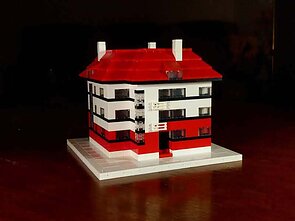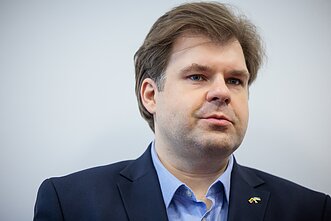
















Rokas Mikšiūnas is a scientist during the day, but his free time is dedicated to two of his passions – architecture and Lego.
The 31-year-old works in Vilnius, although his inspiration now mostly comes from Lithuania’s other city, Kaunas, and it’s early twentieth century architecture.
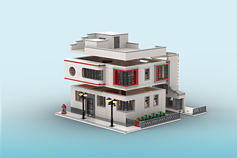
One of his Lego designs – representing a Kaunas landmark, the modernist Iljinai House – has been submitted to the Danish toy manufacturer in a bid to make it an official Lego set.
Read more: Lithuanian designer builds iconic Kaunas building in Lego
From architecture to construction toys
“I visited Liepaja [in Latvia] in the eighth grade, and it was the structure of the buildings that caught my attention. My parents also contributed to my interest: they encouraged me to go, look and pay attention to the buildings. Then, I remember, I started taking pictures of the buildings with an amateur camera. From then on, when I had time, I became interested in architecture and its styles,” says Rokas.

As he developed an interest in architecture, Rokas discovered his favourite architectural style – Art Nouveau – and has been fascinated by it for a long time. He then set up an account on Instagram, where he started posting photos of architecture and later his Lego designs. This broadened his field of interest.
He received a Lego set in 2018 and since then, he says, he has been hooked.
“The bricks were like a tool to help me create the modernist buildings that I liked so much at the time,” he shares.
Inspired by Kaunas
Rokas was born and raised in Vilnius but found inspiration elsewhere, in Kaunas.
“I discovered this city in 2017. I learned about Kaunas modernist architecture and those curved, beautiful shapes, and then I said to myself: Wow, how cool modernism is, how cool Kaunas is,” he says.

While Vilnius is best-known for its curvaceous Baroque, Kaunas prides on its architecture from the 1920s and 1930s, which better lends itself to being reproduced in Lego bricks.
Rokas visits Lithuania’s second city regularly.
“I usually go when there is an interesting exhibition or when I visit friends. I have already explored Kaunas well, but every time I go to the Kaunas Central Post Office, the Palace of Progress or the Dairy Centre,” he says.
Workshops for kids and art installations
Several years ago, Rokas approached the organisers of Kaunas European Capital of Culture 2022. He said he was fascinated by the city’s modernist buildings and wanted to reproduce them in Lego bricks. The organisers offered him to hold workshops for children.
“I was interested in this idea: it was easy to work with the children and they were interested,” he says.
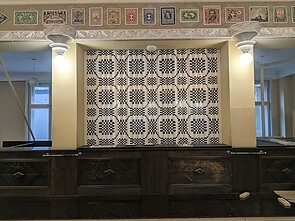
Later, another opportunity presented himself: he was commissioned to construct a giant art installation, a 2.5m by 3.5m Lego curtain, in one of the city’s modernist landmarks, the Central Post Office.

“A lot of people were fascinated by the curtain. It was a very impressive experience: I learnt how to construct, how to organise the work, because I required the help of other people,” says Rokas.
This led to other art projects.
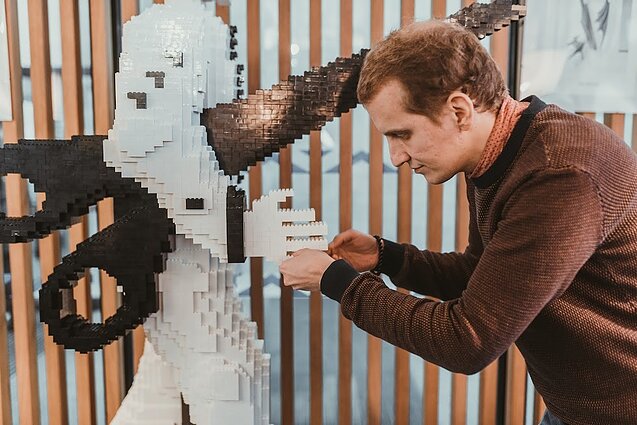
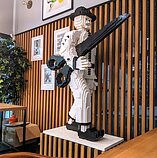
“The last project was for Kaunas 2022, I was asked to construct a Palangos Juzė sculpture out of Lego bricks,” he says, referring to a literary character known for his wits and tailor skills.

The bid to Lego
Rokas’ current big project is his bid to have one of his Lego designs accepted and manufactured as a set.
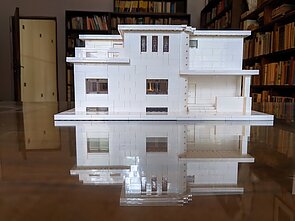
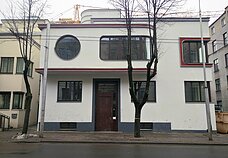
For it, he picked a modest but recognisable piece of Kaunas modernism, the 1930s Iljinai House (also known by its last owner, Aleksandra Iljinienė).
“It was a long search, but I had several buildings in mind and I wanted a residence-sized building, so I chose from private houses. There are many private houses in Kaunas, but only a few are so well-known: the Sugihara House, the Japanese Consulate, Stasys Kudokas’ Villa and, of course, the house of Aleksandra Iljinienė.”

The design of that house is “very Kaunas”, optimistic, with a round window, he says. “It resembles a ship, which must have been a great source of inspiration for the architects of the time.”
The model consists of around 2,600 bricks and also has rooms with authentic period furniture and a piano.
Rokas uploaded the design to LEGO Ideas, a special website for such bids.

Not registered visitors of the site can vote for submitted designs. When a project gets 10,000 “likes”, the company considers it for a set.
At the moment, Rokas’ submission has around 7,500 likes. The final decision, however, is up to the company.
“I think there are certain criteria, but they decide everything internally,” says the Lithuanian. Lego judges the models in May and September, and presents the results in September or January of the following year.

Newsletter
Every Friday morning.