
















Strato, a Vilnius-based start-up developing construction technologies, is slowly approaching its goal of designing and building the first house in Lithuania using a 3D printer.
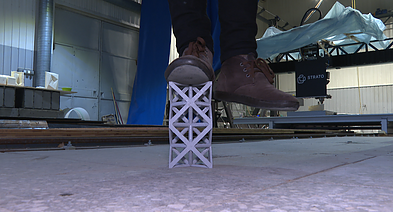
“Here is, in effect, an equivalent of a house carcass printed in engineering plastics in an effort to make the structure itself as light as possible and using bionic principles," says Jokūbs Vaišvila, chief technology officer at the start-up Strato, as he climbs and jumps on a small plastic part.
"It is used in other areas in order to lighten objects, such as NASA making aeroplanes, wheels in cars, pedals in racing cars. We’re trying to adapt it in the construction industry,” he adds.

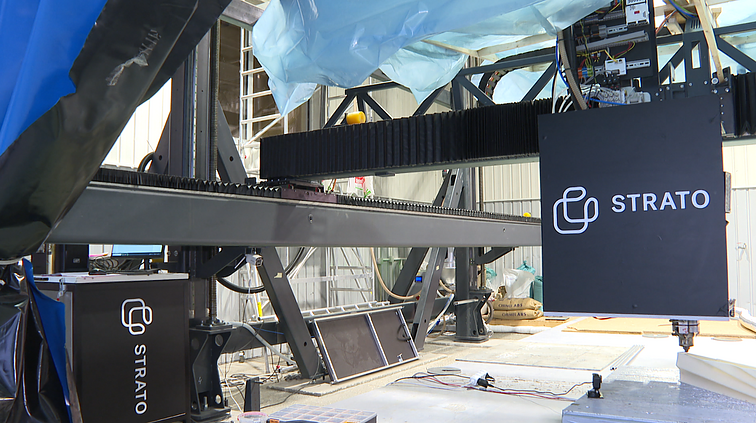
Just a few months ago, Vaišvila and his team set up a crucial piece of equipment in their new premises, a large 3D printer. With it, the firm plans to accomplish an important milestone, the first 3D-printed house in Lithuania.
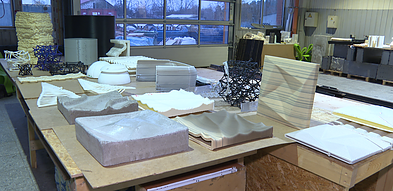
But until then, the team has to design it, so there are plenty of experimental designs on their desks.
Vaišvila shows one prototype, a wall fragment. It’s made of a hollow structural part and a geopolymer filler, a substitute concrete mix. “This is an idea for low-rise construction,” he says.

The Strato team are also developing panels that can serve as internal partitions – an opportunity for architects and designers to let their imagination run wild.
“There is a mould into which another material can be cast. We are currently working with concrete plants to test the technology itself, that is, a printed formwork or mould is cast in concrete,” says Vaišvila. “It can be used externally as a façade finish, but it can also be used internally, say for partitioning, creating sound-reflecting panels, and so on.”
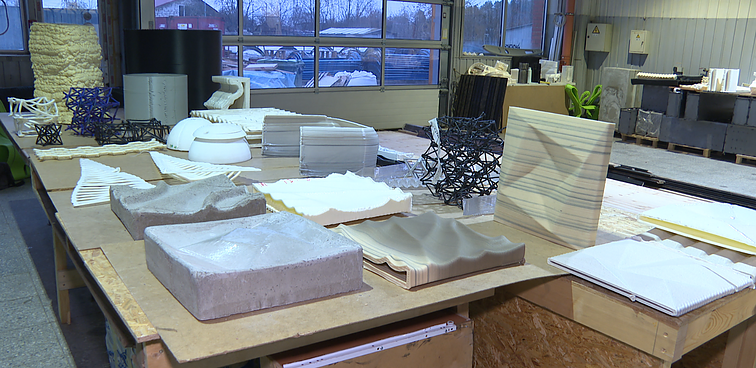
His team are also experimenting with new eco-friendly materials, both for building structures and insulation. Printing an environmentally friendly production process, because builders can make what they need on site and don’t need to waste anything.
“We are now working with wall structures, we are going to print custom walls for a building, we are talking with concrete manufacturers about making stairs, producing custom facades,” says Strato’s technology manager. “We are going step by step through each element of a building, trying to adapt it, come up with a method to make it faster than our manufacturing competitors on the market.”
Technology for urgent needs
Around the world, 3D-printed houses are seen as an alternative to traditional construction, both because of its efficiency and cost. This is especially relevant in places with acute housing shortages.
Sam Ruben, who has set up a printed homes business in California, Mighty Buildings, says the technology is already proving its worth.
“One of our biggest strengths is that we can deliver complete homes faster and cheaper than traditional homes,” he says. It takes between four and six weeks to go from design to a finished home.
“It means that the homeowner spends less money and gets an exceptional home,” says Ruben.
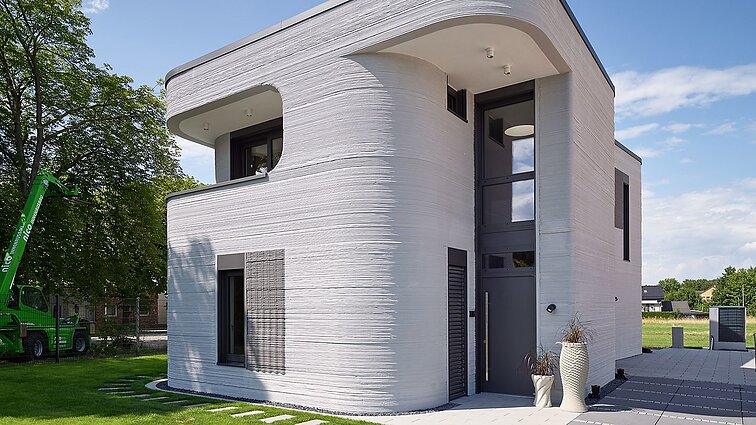
In Germany, the first 3D-printed house was completed two years ago in Beckum. It took eight months to complete a 160-square-metre home.
Interestingly, the house is not built from individual printed components, but printed in full on the site from a cement mix. The walls are three-layered, hollow and filled with insulation material, while stronger reinforced concrete structures were used for the floor slab.
Until now, the house has been a showpiece and the first residents are due to move in soon.

Newsletter
Every Friday morning.