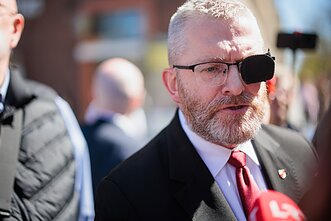






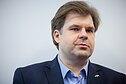


Much like in Lithuania, the Ukraine war has sparked discussions in Estonia about what to do with its Soviet-era monuments and memorials. While some politicians are eager to demolish all traces of the hated past – and score political points along the way – Estonian cultural historian Marek Tamm argues it is a wrong approach.
In an interview with LRT.lt, Tamm, a professor at Tallinn University, says that sensitivities about Soviet symbols are understandable, but demolishing monuments will not erase the past but can instead impoverish present and future generations.
“The war in Ukraine will be over one day […]. We will have a new generation of Estonians without any experience of the Soviet regime. And we should also take into account their perspective,” Tamm says.
What is the general situation in Estonia concerning the Soviet symbols and their treatment? Were there any heated debates on the Soviet-era sculptures and symbols in Estonia, both now and in the first years of independence?
The situation in Estonia in the late 1980s and early 1990s was not very different from the situation in Lithuania. There was a series of removals of the main high-profile Soviet monuments, initiated often from below by local people, not from the top by the government. Like in Lithuania, the first “victims” were the monuments of Lenin and other prominent Soviet leaders. The most significant ones of these monuments are nowadays part of the Estonian History Museum’s open-air exhibition.
The restoration of the Republic of Estonia was accompanied by the removal of Soviet monuments and the restoration of Estonian monuments, primarily the monuments of the War of Independence. This reshaping of the mnemonic monumental landscape was an important part of the nation-building in the late 1980s and early 1990s.
In 2007, we had a rather unexpected “monumental conflict” around the so-called Bronze Soldier, the informal name of the Soviet World War Two war memorial in Tallinn’s city centre. Most Estonians considered the Bronze Soldier a symbol of Soviet occupation, while for the Russian speaking population it symbolised not only Soviet victory over Germany in the so-called Great Patriotic War, but also their claim to rights in Estonia.

The monument has been a source of heated discussions for many years, but when in April 2007 the newly elected right-wing government started preparations for the reburial of the remains and relocation of the statue, this led to mass protests and riots among local Russians that lasted two nights, the worst Estonia has seen. However, the conflict was resolved rather quickly and ever since the Soviet monuments have not played a particular role in Estonian society.
But most recently, due to the Russian war in Ukraine, the Soviet monumental heritage has made a return to the public debate. Besides the war, some political parties have also played an important role in re-actualizing this Soviet material heritage. Particularly the leaders of the Conservative Party Isamaa (Fatherland) have been very active in supporting the systematic removal and demolishing of all Soviet monuments and symbols in the public space.
This summer, a special commission was established by the government. This commission collects information on grave markers and war memorials that bear symbols of occupying powers and makes propositions for removing such markers and memorials. In their recent report, the commission identified 322 Soviet monuments, memorials, and war graves of which 244 have to be removed, in their opinion, while 74 can stay, because these are considered sufficiently neutral. In the case of three important monuments or memorials, it was decided that these require further discussions before any decision can be made.

What were the criteria that the government commission used to decide which monuments are up for demolition and which need further discussion?
The work of the commission has remained mostly hidden and the criteria are not fully clear. Even the members of the commission are classified, except for the chair, with an argument that their security needs to be protected. We haven’t had access to the deliberations of the commission, only the succinct summaries of the gathered information have been made public. In the report, short assessments, one or two sentences, are given, without any serious explanation.
As a professional historian, I am not particularly happy about this kind of procedure – to establish an anonymous commission to judge our common cultural heritage, without any public discussion and without any responsibility to the society.
I imagine the reaction to the monuments is motivated by the fear of war and that they can be used as tools for Russia’s propaganda. What would you say to that? Why is it important not to make rash decisions even amid war?
I would have to say, first, that there is a quite widely shared understanding in the Estonian society that something needs to be done with the most striking Soviet monuments and memorials in public spaces. Because the war in Ukraine is often waged under the same Soviet symbols and same ideological slogans. But I’m quite confident that most of the population doesn’t support the rush in these decisions and would prefer a more thorough analysis and a more thorough involvement of experts in art history and cultural heritage in decision making.
Read more: Vilnius completes removal of Soviet sculptures from Antakalnis Cemetery

There seems to be a very simple reason why the government has been so hasty and active in these matters. We will have parliamentary elections in Estonia next March and there is a strong desire among certain politicians, especially from right-wing parties, to mobilise their voters with the help of this campaign against Soviet monuments and symbols.
I’m quite confident that in the longer perspective the new generations will regret some of these very rapid decisions because we are talking about our collective memory, about material heritage and sometimes also about quite remarkable artistic achievements.
Many argue that it’s better to get rid of all the fragments of the Soviet occupation and thus of the Soviet past. Why it is important to keep some of the reminders of the Soviet Union in public spaces?
Unfortunately, there is never a possibility to get rid of the past. We can never demolish everything that might trigger fear of past traumatic experiences. We can of course remove and demolish all monuments, memorials and war graves, but these are not the only traces of the Soviet past, we are still surrounded by many Soviet-time buildings, landscapes, etc.
Read more: Why are people in Lithuania affected by Soviet nostalgia?

But I don’t want to argue that all Soviet monuments should remain in place. I simply would like to see that these decisions are based on serious expertise, on serious discussions, and with a longer time perspective in mind. The war in Ukraine will be over one day, Ukraine will be sovereign again. We will have a new generation of Estonians without any experience of the Soviet regime. And we should also take into account their perspective.
In Estonia, as well as in Latvia and Lithuania, we have a very complicated history, riddled with different occupations, different regimes, and it would be unimaginable to erase all material traces of these various occupations and regimes. Germany was considered for centuries as one of the country’s “historical enemies” and German cultural heritage (manors, etc.) had a very strong negative connotation. Nowadays this German historical legacy is fully integrated into the Estonian culture and it doesn’t create any fears or tensions.
One big difference between Lithuania on the one hand and Estonia and Latvia on the other is that you have a big Russian speaking minority. Does that affect discussions about either Soviet monuments or culture?
Presence of a significant Russian speaking minority, up to 30 percent of the population, is indeed a very important factor in understanding these discussions on Soviet monuments. As we know, monuments don't speak, they are silent and immobile. Monuments need people do make them speak. Monuments can be used as triggers for political actions.
As mentioned before, we have an experience from 2007 when the so-called Bronze Soldier monument triggered massive riots in the streets of Tallinn, led by some activists of the Russian speaking community. Most likely this experience was one of the main reasons why the government decided to act very quickly this summer and remove a tank monument in Narva which started to attract local people who wanted to express their discontent with government policies.

However, while we can agree that certain highly symbolic monuments can become a certain security risk, we should not securitize all monuments and turn them into a security threat. More than 90 percent of the Soviet monuments are never visited and have fallen into complete oblivion. It is my argument that if we bring by political means these monuments into limelight, we risk to re-actualise them and trigger inadvertently new tensions.
In a recent interview to Estonian television, you said that “it requires quite a vivid fantasy to imagine that a single five-pointed star on a roof or wall of a building could pose a security risk. Rather, I perceive the justice minister looking to please her voters as a greater security risk.” Could you explain this a little more?
This comment reacted to a recent interview given by our minister of justice [Lea Danilson-Järg of the Isamaa party] who initiated new law amendments to make possible the removal all Soviet symbols from buildings, monuments and war graves. Her main argument was that this law amendment is needed for the reason of national security threat.
In my opinion, this is a highly exaggerated statement. This is part of what I call the “securitization of history”, turning history into a security threat and limiting a free discussion about our past.
I should emphasise again that this does not mean that we shouldn’t remove some high-profile or aggressive Soviet monuments, this is very reasonable, but to erase all Soviet symbols from public buildings, monuments and war graves is a very different matter.

Many of those symbols are part of architectural decoration and from an art historical perspective it is very naïve to remove Soviet symbols from a Stalinist building, while leaving the building itself in place. To follow this logic of national security threat, we should definitely demolish all Stalinist buildings in Estonia. But this sounds too radical even for our conservative politicians. So they prefer to appeal their voters by fighting only with symbols.
Being myself trained as a semiotician, next to history, I know that signs are defined by their use. Symbols never have stable, fixed meanings. Soviet symbols can signify different things for different people in different times. I’m rather confident that in 100 years’ time these symbols will not be interpreted as a security risk but as signs of a difficult past, in the same way that the symbols of German dominance in Estonia are no longer interpreted in the same negative way as 100 years ago.
You used the term “politicisation of the past” in your TV interview. What are the problems of this tendency? Is it the same term as the securitisation of history?
The securitisation of the past is one element of the politicisation of history. I had particularly in mind the context of upcoming elections. As an academic historian, I am rather worried how certain politicians are using history for winning votes and pleasing their constituency.
Our minister of justice, when she was asked whether it is correct to make political decisions that are motivated by the idea of pleasing the voters, said that it is the duty of the politician to please the voters. In my opinion, this is not true. The duty of the politician is to make decisions for the sake of the country and its people, not to please a particular constituency.

Estonia’s minister of justice has said that “Soviet iconography in public space is a weapon of information war”. Do you agree?
This statement is yet another example of the securitisation of the past. While I do agree that we are waging a war of information with Russia, this has been going on for at least ten years or more, so it’s not a recent phenomenon. But I don’t believe that we can win this war by adopting the same methods that Russia is using.
The only effective answer to a war of information with an authoritarian power is to be a successful democratic state. Not to start politicising and securitising our history in the fear that maybe Russia can use monuments or symbols for their propaganda.
We have plenty of examples of how Russia will never miss an opportunity to launch new propaganda campaigns. To remove all Soviet monuments and symbols doesn’t mean that this will be the end of Russian propaganda. Actually, it can bring new fuel to this propaganda war, provide Russian media with great visual materials of how Estonian nationalists are destroying war graves of Russian national heroes, etc.
In your TV interview, you also said that Estonia does not have an official version of history and does not need one. Could you elaborate on that?
As a professional historian and member of a democratic society, I cannot accept the idea that there can be an institution, an anonymous commission or something similar, which decides how we should talk about our history or deal with our cultural heritage. Needless to say, there are certain cases which belong to the sphere of justice, for instance, violations of human rights, crimes against humanity, etc. But as a general rule, it’s not up to politicians or officials to decide what interpretation of the past is the correct one.
This is exactly what makes us different from authoritarian and totalitarian regimes. Thus, it is against our own interest to cherish an idea to impose by legal or other means a single correct version of Estonian history, believing that this will help us in our fight with Russian propaganda. In my opinion, exactly the opposite is true – as long as we have an open and free discussion about our past, we can remain strong against any hostile informational operations.

Newsletter
Every Friday morning.