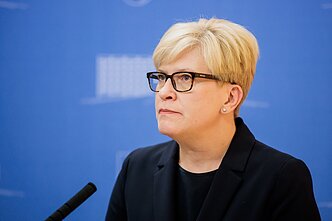














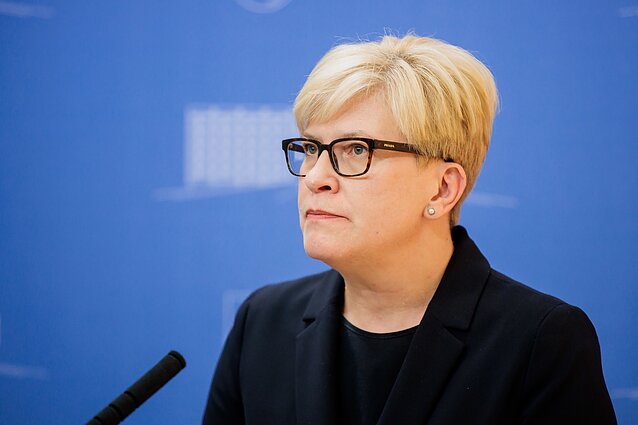
Prime Minister Ingrida Šimonytė has proposed that the Lithuanian government set up a 37-million-euro fund to compensate the Jewish community for private property expropriated during World War Two.
The fund would be a complement to a previous initiative, launched a decade ago, which has paid out a similar amount of money to Lithuania’s Jewish community in compensation to expropriated communal property.
Under the existing Law on Good Will Compensation, which was adopted in 2011, Lithuania committed itself to paying over 37 million euros over a decade in compensation for the property of Jewish communities expropriated by totalitarian regimes.
In the new bill, initiated by PM Šimonytė, the government is adding a provision that compensation will also be paid for the property of Jewish individuals who lived in Lithuania before or during World War Two.
The draft law provides for allocating an additional 37 million euros for this purpose.
“This symbolic sum is intended to restore at least partial justice and to ensure the fostering of Lithuanian Jews, their culture and heritage,” the bill's explanatory note reads.
If the bill is adopted, the money will continue to be spent through the Good Will Foundation.
However, the new wording will allow the foundation to allocate 5 million to 10 million euros to meet individual requests for compensation for lost property.
The draft law has yet to be approved by the cabinet and will then go to the parliament for adoption.
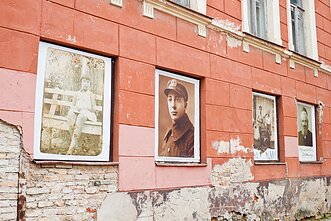
Around 90 percent of Lithuania’s pre-war Jewish population of around 208,000 were killed between 1941 and 1944.

‘Moral debt’
“This is also a moral debt that should be acknowledged and, as far as possible, not one hundred per cent, resolved,” Šimonytė told reporters on Tuesday.
She noted that her proposals had been coordinated with the Lithuanian Jewish community and some foreign Jewish organisations.
“We have a working agreement with the Lithuanian Jewish community and the American Jewish Congress. These discussions have been going on for a long time, and [...] I’ll try to submit this draft to the parliament for adoption,” the prime minister said.
“I believe that this is an issue that Lithuania needs to resolve; it arises very often, in diplomatic discussions, bilaterally, multilaterally,” she added.
Šimonytė said the issue of expropriated private property had been raised by Lithuanian and international Jewish communities with previous governments, but it “was left hanging in the air”.
“We have had a couple of years of intensive discussions on how this issue could be dealt with, given that it is very difficult to identify all the lost assets, where they are, what their value is, who the legitimate descendants are in each case and who should be compensated,” she said.
According to the prime minister, it was agreed to use the Czech experience of “symbolic compensation”, because it is impossible to establish the exact value of the lost property and identify “each addressee very accurately”.

Test for the country
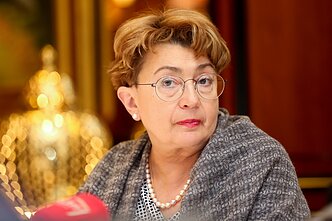
Faina Kukliansky, chairwoman of the Lithuanian Jewish Community, has welcomed the prime minister’s proposal, saying that adopting the bill will be a test for the parliament and the country as a whole.
Kukliansky acknowledged that the proposed 37-million-euro restitution phase is a compromise, but added that the community welcomes it.
“We appreciate it very much. I think there will be criticism from everywhere. Lithuania is probably the least likely to criticise [...], but perhaps people will be unhappy, too, that big capital has not recovered and will not recover its money, because it is only a symbolic amount that the state can repay today. I mean criticism from former owners,” the chairwoman told BNS.
“But this is a kind of test for the state as to whether the law will be passed or not,” she added.
According to Kukliansky, the 37 million euros planned to be disbursed to the Good Will Foundation by mid-2030 will not be a big financial burden for Lithuania, but will have a positive impact on its international image.

Newsletter
Every Friday morning.