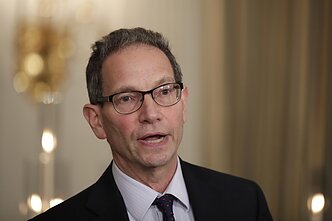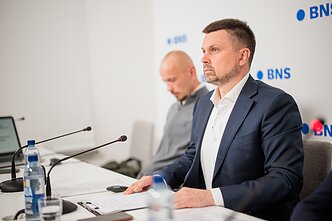













Western-backed Ukraine should seek a ceasefire and negotiate a truce with Russia. This would not be an appeasement of Moscow, but a sensible move, since Kyiv’s negotiating position may be weaker in six months, argues Charles A. Kupchan, a professor at Georgetown University and a senior expert at the Council on Foreign Relations.
In an interview with LRT.lt, Kupchan says that it will not be possible to completely push out Russian forces from Ukrainian territory. It is also unrealistic to hope that Russia can be weakened to the point where it can no longer attack its neighbours, stresses the analyst who has worked in the administrations of Barack Obama and Bill Clinton and at the State Department.
In one of your articles, you argue that negotiations would be a good way to end end the war in Ukraine and that it would not be appeasement of Russia. How do you think such negotiations could proceed and how to avoid gifting a victory to the Kremlin?
I think that the war is going to continue, at least for now, and that the costs of the fighting remain high for both parties, as well as for the many parts of the world that are being affected by the knock-on implications of the war. And so I’m someone who believes that it makes sense to try to end the fighting sooner or later, and to move toward a ceasefire so that the killing stops.
Once you have a ceasefire, you begin the process of trying to figure out what comes next. And as a consequence, you launch a set of negotiations about the future disposition of the territory in Ukraine that Russia occupies.
Now, it may be that we need to let the war go on for a longer period until a stalemate of a sort emerges. It may be that the Ukrainians enjoy a certain amount of success taking back some territory in and around Kherson, they may be able to take some territory back in Luhansk and Donetsk. I’m not someone who believes that Ukraine has the capability today or tomorrow to win, by which I mean to expel Russia from all of its territory and restore its territorial sovereignty.
If that is correct, then it makes more sense to move to a ceasefire sooner rather than later. And to settle the issue of territory at the negotiating table rather than on the battlefield.
What role do you think the West should and could play? Should they push the Ukrainian side in some way towards the negotiating table?
One issue that comes into play is how to strengthen Ukraine’s hand. You want Ukraine to go to the negotiating table in the strongest possible position. And the arms that are flowing into Ukraine will strengthen Ukraine’s position. How much they strengthen Ukraine remains to be determined. And I think it’s unclear on whose side time is on – because I do worry about the staying power of the coalition that’s supporting Ukraine.
As you know, the Italian government has collapsed. Here in the United States we’re headed into the midterm elections. And you could see a strengthening of America First Republicans. And so it’s my assessment, from the perspective of Ukraine and of the strength of the Ukraine-supporting coalition, that Ukraine probably has more strength at the negotiating table now than it might have six months from now. And the West needs to be very strongly supportive of Ukraine If and when negotiations begin.

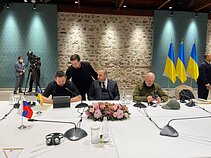
And I think we’ve already seen in the deal brokered over getting the grain out of the Black Sea ports that third parties can play an important role. We saw the UN and the Turks play critical roles in brokering that deal.
So I think what would need to happen is that there would be a conversation between the US and Ukraine, between the US and its allies and Ukraine. To discuss when and under what circumstances to push for a ceasefire and to pivot away from the continuation of the war toward a truce and follow on negotiations over territory.
And how would it be possible nudge the Russian side toward the negotiation table? Do you think this grain deal was an indication that it’s possible to maintain contacts and negotiate?
I think the grain deal is a potential first step. It shows that diplomacy is not useless. On the other hand, this is a deal that has yet to be implemented. We don’t know if or when it will be implemented. We do know that soon after the deal was signed, Russia attacked some facilities in the Odesa port area. So let’s wait and see how the deal goes.
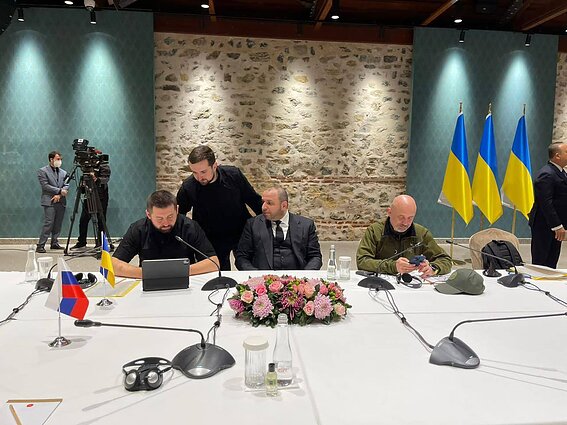
But I do think that the channels of communication must remain open. And the fact that the Ukrainians and the Russians are talking, with the help of the UN and Turkey, is in my mind a good sign. You’ll recall that early on in the war there was a series of conversations between Russian and Ukrainian officials. I think that that conversation needs to continue taking place.
I’m not naive in the sense of putting a great deal of confidence in the success of those negotiations. Russia, when it sends troops into its neighbours, tends to stay for a very long time. And as a consequence I think the most likely outcome is probably a new frozen conflict. With Russia keeping a hold of some of the territories that it is in the process of taking and then an uneasy stalemate emerging.
However, I think it would be preferable to move toward a ceasefire and a negotiated settlement. Negotiated settlements are more stable than frozen conflicts.
How can we be sure that Russia will stick to the agreement and not just wait five years and attack again?
Well, there is no way to guarantee that. We have relative confidence in asserting that the Russians don’t stand by their word. They said they weren’t going to attack Ukraine, they attacked Ukraine. They were signatories to the 1994 Budapest Memorandum, which proved worthless. So I think that what one would need would be a series of security assurances from mainly Western powers. That they would support Ukraine’s sovereignty and help Ukrainians defend themselves.
In other words, some form of armed neutrality. In which Ukraine probably will not become a NATO member, but would be armed and supported by NATO countries on the path toward EU membership and enjoying sovereignty over as much of its territory as possible.
But do I expect to see Ukraine receive a formal security guarantees anytime soon? No.
And what do you make of the US officials position that Russia should be weakened to such an extent that Moscow would be unable to attack anyone. Is it possible, either through Western support or by Ukraine itself?
I think that this is a war that is largely self-defeating for Russia. Sanctions are hurting the Russian economy, thousands of Russians are being killed and wounded. Russia is as isolated on the global stage as it’s ever been, arguably. For Vladimir Putin to travel abroad and be well-received, you know where he needs to go? To Tehran, a country that is already in international isolation.
So this is not a war that’s going well for Russia and I think that on some level Russia has already been dealt a strategic defeat. Its initial invasion was blocked, and even though many of the world’s countries are not enforcing sanctions, they understand that Russia has engaged in a bald act of aggression.
Do I believe that it’s realistic to weaken Russia so much that it can never use force against its neighbours? No, that is not realistic. No matter how this war ends, Russia will maintain a sizable military capability. Russia is a very large country. I think, hopes of somehow permanently demilitarising Russia are not realistic.
You mentioned that support might decrease for Ukraine. But how would you assess the performance of Western alliances so far, particularly NATO? Did they respond adequately?
I would say that the response has been remarkable. it started before the Russian invasion, when the Biden administration did its homework, engaged in tireless diplomacy and he had ready on day one, hour one, sanctions against Russia, reinforcements to NATO’s eastern flank and arms to Ukraine.
And ever since the war began the solidarity has been remarkable. Have there been differences of opinion about the pace and scope of our arms to Ukraine? Yes. The Germans may not have moved as quickly as some would like. I think in terms of economic sanctions, the measures taken against Russia are even more far-reaching than originally envisaged. And the flow of American forces to NATO’s eastern flank, the increase in force levels in the Baltics and in other areas on NATO’s eastern flank, the impending membership of Finland and Sweden – these are all very significant and, in my mind, prudent steps.

Again, I do worry about political fatigue as time goes on. I’m relieved that gas prices here in the United States have come down substantially. But there’s no question that inflation is taking a toll on the electorates on both sides of the Atlantic.
Speaking from a personal perspective, I worry about the potential return of America First Republicans. And because of the potential political backlash I worry that time may not necessarily be on our side.
And I took the collapse of the Draghi government and the potential ascent of a far-right populist government in Italy as a warning sign.

Newsletter
Every Friday morning.