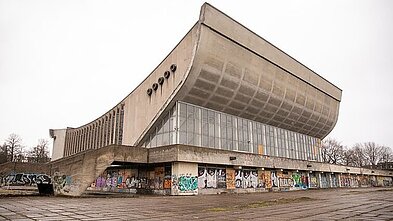















Today, the chic Paupys district is one of the main attractions in the centre of Vilnius. However, 200 years ago, it reminded more of Venice, writes Darnu Group, the developer of Paupys.
From the 16th century until 1939, the present-day district of Paupys was called the suburb of Paplauja. It is believed that the name was given because of the springs and the water running down the hill in the area and was derived from the Belarusian word “поплау” (flooded meadow). The name Paupys only came into use after the Second World War.
“Until independence, Paupys was mainly an industrial area. People settled here around the 17th century,” says tour guide Asta Cicėnienė.
From the 16th to the beginning of the 20th century, mainly mills and workshops were built on the Vilnia River. They produced groats, gunpowder, paper, and flour. Paupys itself reminded more of Venice than Vilnius, with a system of canals, dams, mills, and islands.
“The picturesque landscape, with the river, hills, and islands, meant that people came to Paupys as a resort – to walk, stroll, and socialise. Today, the islands and canals are gone,” Cicėnienė says.

In the 1870s, Efraimas and Dovydas Lipskis opened a brewery and distillery in Paupys, which had been in operation for more than five decades. Here, they also established a Swiss garden with a restaurant, where visitors could eat, drink, enjoy the summer theatre and concerts, to which the owner invited musicians from Italy.
At the same time, Paupys was also home to a lock factory and Samuil Holstein’s fur and leather factory. The latter remained operational throughout the Soviet occupation, but under a different name of Jonas Vitas.
The Lipskis factory was turned into the Vilnius Electrical Instrumentation Plant, which was only closed during the economic crisis of 2008.
In the second half of the 18th century, Antanas Tyzenhauzas, the treasures of the palace of the Grand Duchy of Lithuania, opened a paper mill and a tavern in Paupys.
The wheels of Tyzenhauzas’ mill in Paupys were turned not by the Vilnia River but by a stream flowing down Subačius Hill, which no longer exists.

“It is also interesting to note that at least three mills that existed in Paupys did not grind flour. They were used to make paper from rags,” Cicėnienė says.
“Meanwhile, the fragments of the tavern built by Tyzenhauzas in the 18th century next to the mill have survived to this day,” she adds.
The foundations of the tavern were uncovered in 2018 during archaeological research before the construction of the seventh quarter of Paupys. They are included in the list of valuable features of Vilnius Old Town
The area of Tymo Market in Paupys used to be an island. It was a centre for leatherworking, weaving and other small craftsmen.
“A slightly more exotic story is that this was the home of the cheapest brothels. According to Antanas Rimvydas Čaplinskas, an expert on the history of Vilnius, the brothels on Tymo Street flourished between the wars – it was a kind of Red Light District of Vilnius,” Cicėnienė says.
“After the Second World War, the Tymo quarter was wiped off the face of the earth, and now, a road has been built through it, leading to Subačius Street,” the tour guide adds.
Today, Paupys is an urban hub and home to seven residential quarters, two business centres, Paupys Market, a cinema, and a sports club.


Newsletter
Every Friday morning.