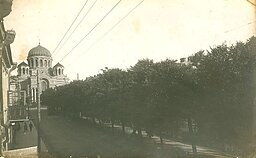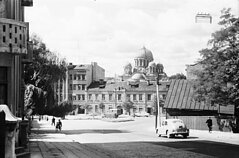

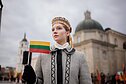


Standing at one point of Laisvės Avenue in Kaunas, the St Michael the Archangel Church, better knowns as simply the Sobor, is an imposing if somewhat incongruous landmark. It has been through an uneven history and was once almost demolished for looking too Russian.
This year marks the 30th anniversary of the first mass in St Michael the Archangel (Garrison) Church after the restoration of Lithuania’s independence. The church has been used by several different religions, but it has probably always been dedicated to the needs of the military. Today it mostly serves the needs of soldiers and statutory officers in Kaunas.
It was built at the end of the 19th century as an Orthodox cathedral – sobor. The architect and the executor of the construction works was a military engineer, Lieutenant Colonel Konstantin Limarenko.
Simonas Jazavita, a historian at the Kaunas City Museum, says that when the Sobor was built, the site was on the outskirts of Kaunas, surrounded by swamps. According to some stories, Kaunas residents would come here to hunt for ducks.
At the end of the 19th century, the swamp was drained and, with the approval of Tsar Alexander III, a house of worship for the army began to be built on the empty but strategically important site.
“The number of Orthodox Christians in Kaunas was small, and as the city became a military stronghold, preparing for a possible war with Germany, the numbers changed. A large number of soldiers arrived, and they were Orthodox Christians. Therefore, they had to have their religious needs met,” says Jazavita.
Two transformations
In 1915, during the First World War, Kaunas was occupied by the Germans and the Sobor was handed over to German troops. Four years later, in 1919, when Lithuania gained independence and the Germans left, it became a Catholic church and was handed over to the Lithuanian military.
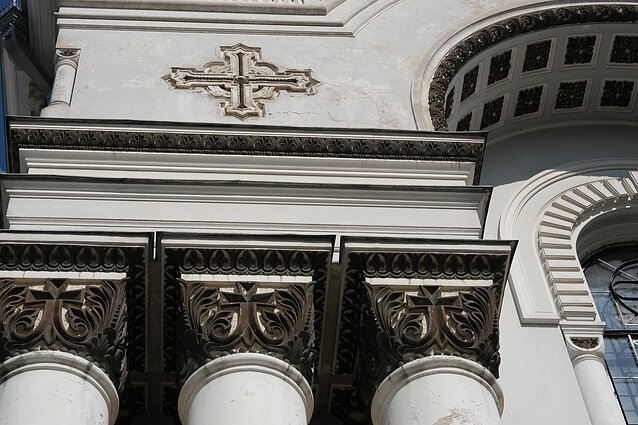
“Then it had to be remodelled from an evangelical church. The interior did not pose any great difficulties, but the exterior was unusual – it was a Catholic church, but resembled a Russian Orthodox house of prayer. This is the uniqueness of our Sobor,” says the historian.

To demolish or to keep?
According to Jazavita, there soon arose the question of what to do with the church at the end of Laisvės Avenue. Two options were prosposed.
"One was to demolish it completely. For example, Jonas Vileišis, a long-time burgomaster of Kaunas, proposed to tear down the cathedral as an ulcer of Russian imperialism in the middle of the capital. Not much was missing. However, Vileišis was quite democratic, and even as burgomaster, he did not vote. The prevailing position in the council was to preserve it and he did not oppose it,” says Jazavita.
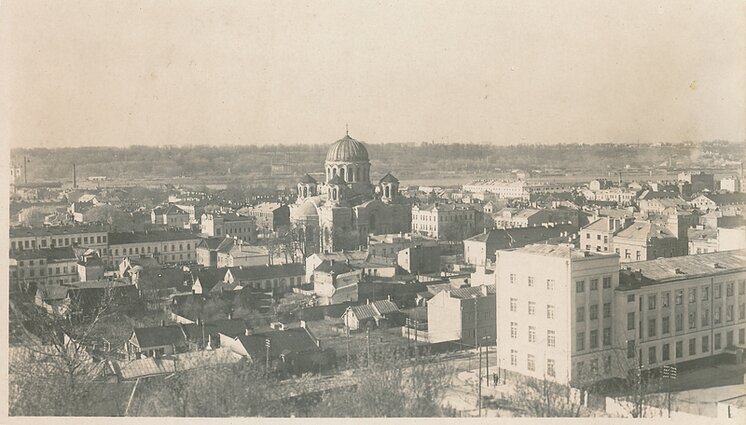
So instead, the Sobor was converted into a Catholic church and handed over to the military.
“It was certainly used for ceremonies. Officers would get married there. It was no secret that ladies would go to see young soldiers. After mass on Sunday, they might go for a coffee or a glass of wine on Laisvės Avenue. There was a lot of this, naturally,” says Jazavita.
When Lithuania was occupied by the Soviet Union in 1940, there was a big campaign to close down houses of worship of all religions. After the war, the Sobor was not immediately decommissioned, but it had to operate under some restrictions.
According to Jazavita, the Sobor was affected by a subsequent wave of anti-religious fervour of 1962.
“It was handed over to the Čiurlionis Art Museum, and there was a stained glass gallery,” he says. “Interestingly, the people who worked there tried to preserve the unique inter-war frescoes and other important religious and patriotic symbols, of which there were many, painting them over so they would not be damaged. The cross has also been removed. In 1991, when the church was handed back to the faithful, we managed to restore a lot of it.”
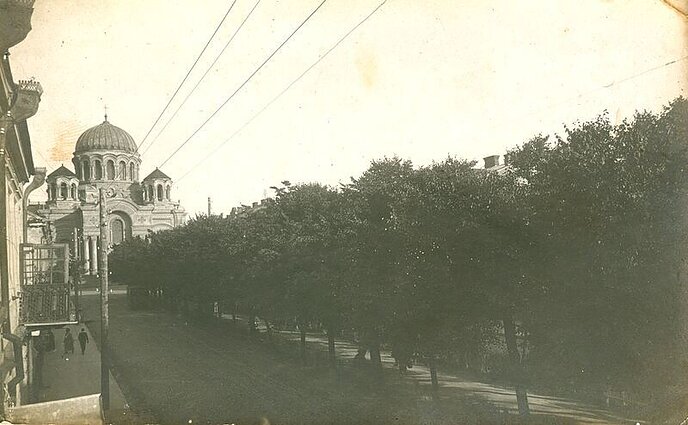
Cardinal Sigitas Tamkevičius has told LRT.lt that, in July 1991, the then Prime Minister Gediminas Vagnorius returned the Church of St Michael the Archangel to the Kaunas Archdiocese. In November of the same year, it was taken over by the chancellor of the Archdiocese, Alfonsas Bulota, who ordered to demolish the existing partitions of the museum.
Back to the military
In 1996, Tamkevičius dedicated the Kaunas Sobor to the Kaunas garrison of the Lithuanian Military.
Kaunas Garrison Chaplain, Maj. Tomas Karklys says today the church does not only serve the military.
“Over the years, we have made the church a pastoral base for the Kaunas region’s statutory structures, where soldiers, officers and civil servants alike find solace and pastoral services. They get married here, baptise their children – all our joys and sorrows revolve around this sanctuary,” he says.

If a newlywed couple leave the Sobor, it means that one of them is in the military or is a statuary officer. According to Karklys, there are around 50 marriages and 100 baptisms every season.
Why ‘Sobor’?
The Sobor also hosts a lot of lay activities: educational programmes, an installation for the blind that has attracted a lot of attention, exhibitions and concerts. Nevertheless, it is still called the Sobor, which refers to its former function as an Orthodox cathedral.
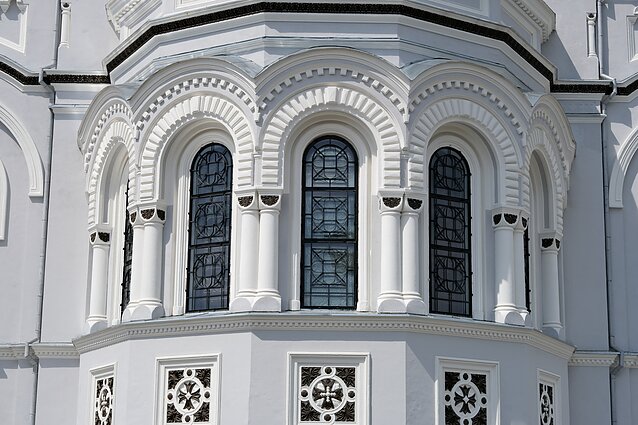
“It was originally built as an Orthodox cathedral and only transformed into a Catholic church in 1919,” notes Karklys. “You cannot change the architecture of the building, which is neo-Byzantine, oriental, in style. It has a plan of the Greek cross. These features make everyone call it ‘the Sobor’. It is certainly not a crime or an insult to call it that, because it was built as a sobor, even though now it serves as a [Catholic] church,” says Karklys.

Newsletter
Every Friday morning.