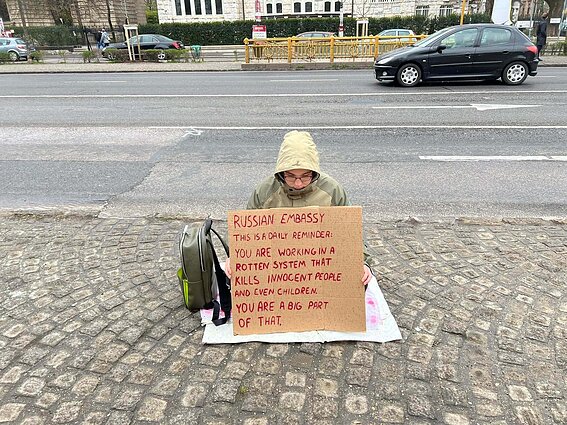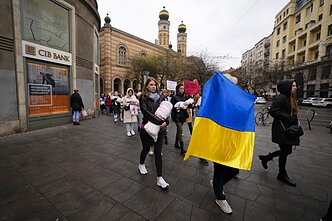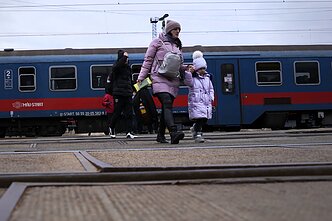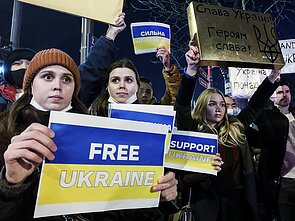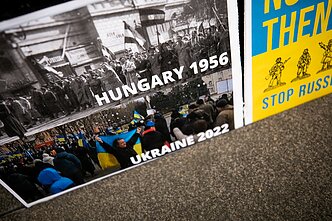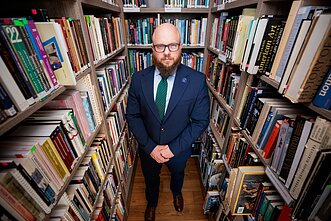











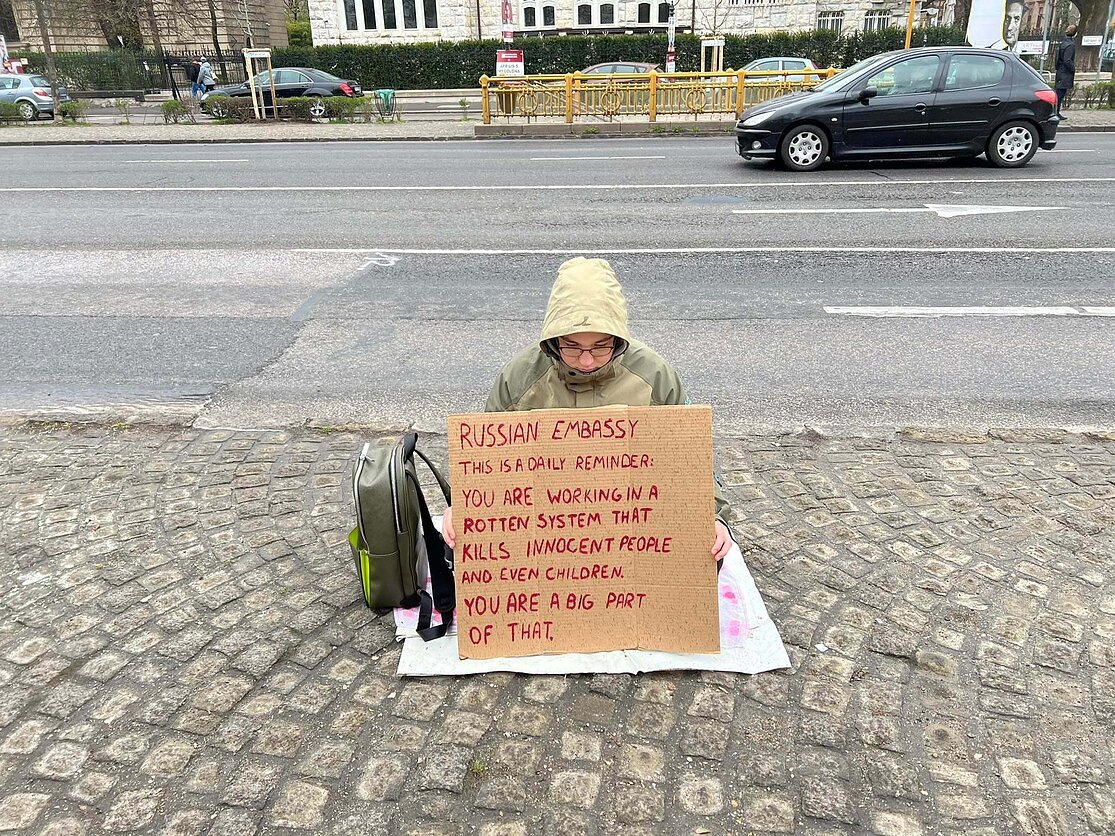
“When I sit down on the ground with a protest poster, Hungarian policemen always come up to me within a couple of minutes,” says Dominykas Puzinas. The Lithuanian man has been staging silent protests in front of the Russian Embassy in Hungary for two hours every day for the past three months.
Puzinas is an exchange student in Budapest. When the Russian aggression against Ukraine started on February 24, he was back in Lithuania for a few days and immediately started thinking what he could do to help.
“I started to think about how to protect my family and friends, and what I could do as an ordinary citizen with freedom of speech. I decided that a few days later, when I returned to Budapest, I would join people there who I hoped would be condemning Russia’s unprecedented aggression, using their 21st century privilege of freedom of speech,” Puzinas told LRT RADIO.
But back in Hungary, he did not find any information about protests against Russia’s war in Ukraine. Frustrated by the indifference of the Hungarians, the Lithuanian student decided that it was not enough to donate to various humanitarian organisations and remain silent otherwise.
“Of course, I encourage people to donate, it’s very important. But for me personally it was not enough. I wanted to somehow declare my position publicly, to show that people cannot accept that a sovereign, democratic country is under attack. My aim was to both stir up the protest in Budapest and to put pressure on the Russian diplomats in the country,” Puzinas said.
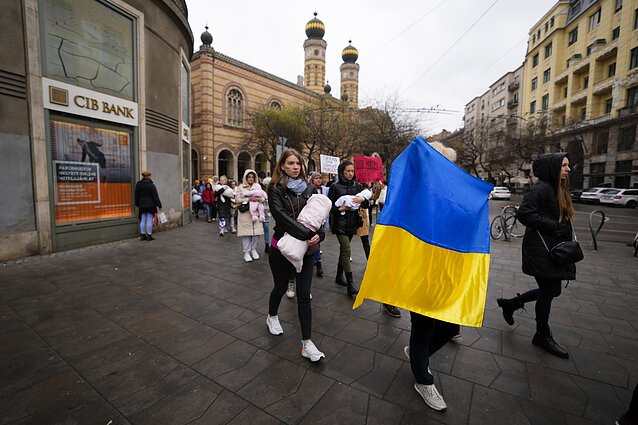
Police bullying
Since March 2, every day Puzinas goes to the Russian Embassy in Budapest, where for two hours he protests silently by sitting and holding a poster that reads “Russian embassy, this is a daily reminder: you are working in a rotten system that kills innocent people and even children. You are a big part of that”.
"On the first day, I arrived with a homemade poster, drawn on a sheet of cardboard I found in a neighbour’s bin. I wrote “Stop the war” on it. When I arrived at the embassy, I went to the gates and sat down. Then, a policewoman ran up to me and told me very angrily to move,” Puzinas remembered.
“She told me to sit on the other side of the road, behind the fence. At that moment, fearing that I would be detained or punished, I obediently followed her orders and sat down quietly behind the fence,” he added.
This was the protester’s first of many encounters with the police. Later, insults and even bullying by officers became almost a daily occurrence, Puzinas said.
“To be honest, the first few days were very uncomfortable, it was scary. Then, I still paid a lot of attention to the angry stares of passers-by. Every approach by a policeman ended in anxiety. It was scary and sad that I was not getting the approval or at least the understanding of these public servants,” he explained.
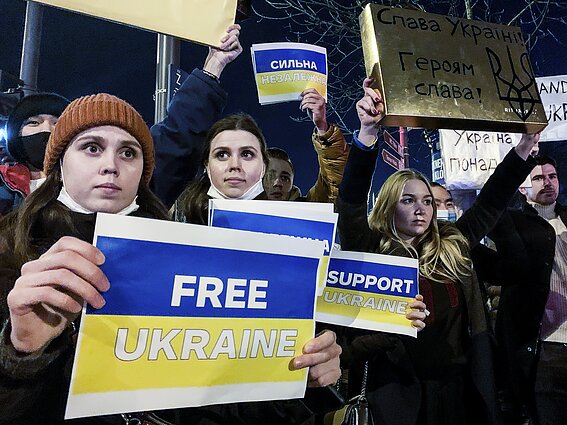
The Lithuanian man has managed to avoid arrests or fines so far. But misunderstandings are still common, he said, as most of the Hungarian officers working at the Russian Embassy do not speak English and interpret the poster in their own way.
According to him, every time he arrives at the embassy, one or two policemen come up to him within a couple of minutes and ask to leave the premises. But over many days of protesting, Puzinas has learnt his right to exercise the freedom of speech without violating the country’s law, he said.
To defend himself against bullying and possible assaults by officers, Puzinas also uses Instagram. When he sees that a conflict might escalate into violence, he goes live and films it. This protects against the actions of some officials, according to the man.
Encounters with passers-by
According to Puzinas, he also receives a lot of attention from passers-by. Although Hungarians themselves are surprisingly indifferent to the war, the reactions to his silent protest are varied.
“Sometimes they read the poster, shake my hand, take a photo, but most of them look at it and walk away. There are some who point their middle finger in the direction of the embassy after reading the poster. But there are also those who spit on me, scold me, wave their hands, and insult me,” the protester said.
He recalled an unpleasant encounter with a half-Russian and half-Hungarian woman a couple of weeks ago.
“She came up to me, called me fascist, and spat in my direction,” Puzinas said.
As the protester did not pay any attention to her, she started filming him and spreading Russian propaganda. Eventually, the woman grabbed the poster, tore it up, and acted aggressively, while the policemen stood by and did nothing.
“This was not the only attack, but it was the most brutal one. Everything piled up after this event – the psychological pressure, the bullying, the angry words and looks from passers-by, and finally this event. After half an hour, I could not stand it and I started crying,” the man said.
“But I realised that my sitting alone outside the embassy is making a difference, people are paying attention, Russian diplomats are seeing it too. A policeman who spoke English told me that the Russian Embassy asks to kick me out every day, but no one has the right to do so,” he added.
Despite everything, Puzinas is not planning to stop protesting. After the end of his exchange program in Hungary, he will join various movements in Lithuania, he said.

Newsletter
Every Friday morning.