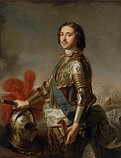






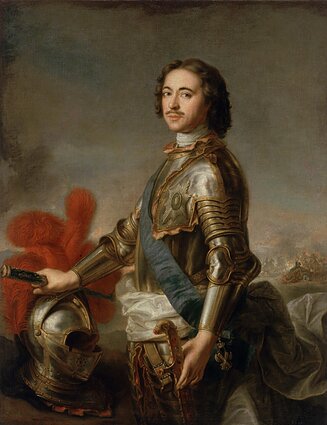
On his way to joining his armies in Poland and Livonia, Peter the Great of Russia arrived in Vilnius on July 19, 1705. For about a month, the tsar dominated the city’s high society, while his troops were camping and occasionally marauding in its streets.
The Great Northern War had been raging since 1700 and the united forces of Saxony, Denmark, the Polish-Lithuanian Commonwealth, and Russia were fighting against Sweden.
Peter was planning a major military operation, so the Russian army entered the territory of the Grand Duchy of Lithuania in late 1704.
City officials and judges of the Lithuanian Tribunal greeted the tsar with bread and salt. However, one of his ministers did not deem it sufficient and he told the Lithuanians: “Why do you regard Augustus your king? Submit to our tsar!”
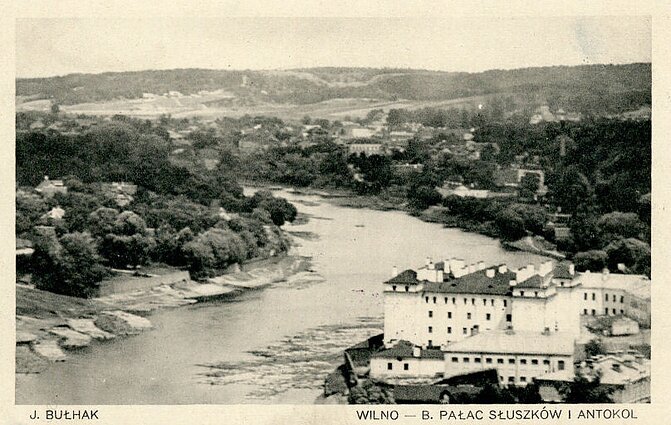
The exact place of residence during Peter’s stay in Vilnius remains unclear. Sources name several places, but the tsar most likely resided in the building of the Lithuanian Treasury, near the Townhall Square. Russian troops were stationed at the Slushko Palace on the riverbank of Neris.
Little is known about the state of Vilnius at the time, but the city undoubtedly had suffered greatly from the war. In February 1705, an envoy of the Queen of England stayed in Vilnius and reported the following:
“I cannot express the suffering I have seen here. The devastation of war has doubled the poverty that citizens endure even in peace. Nobles joined one of the warring sides, fled to lands unburdened by war or retreated into their country estates, so as to be as far as possible from the theater of war, leaving their houses in Vilnius to utter ruin. Townsfolk live in worthless wooden slums that are so common in these lands, however the churches of the Jesuit and other orders are fairly well kept, their design indicates that the city once prospered.”

Churches and the university
Judging by his letters, Peter the Great led an easy lifestyle during his stay in Vilnius. Over almost a month, he dictated only 24 letters and orders, averaging one a day. The tsar spent most of his time visiting churches and monasteries. As legend has it (though no known source can corroborate it), he baptised the great-grandfather of the Russian poet Alexander Pushkin in the Orthodox St Paraskeva Church.

Most of the Basilian monks fled Vilnius the moment they learned that the tsar was approaching. They knew Peter the Great abhorred the Basilians, who recognised the supremacy of the Roman Pope.
What’s more, they had heard about the atrocities in Polotsk where he murdered one Basilian with his own hands, while his companions killed another four. The Greek Catholics of Vilnius, however, were spared violence. Moreover, several Orthodox men once attended their Mass and sang church hymns, after the ceremony Basilians treated them with beer and vodka.
Meanwhile, the end of the academic year was approaching at Vilnius University. The ceremony was traditionally held on July 31, the day of St Ignatius Loyola, the founder of the Jesuit Order. University management learned that the tsar would like to attend the ceremony and prepared an imposing throne for him. Peter, however, chose to sit on a simple wooden bench. Eager to please the tsar, the university held the ceremony in Polish instead of the usual Latin. Once the festivities and the light lunch came to a close, the tsar promised to show favour to the university.
Alcohol and blood
While in Vilnius, Peter the Great also took part in a number of grand balls thrown by some of the most illustrious Lithuanian officials, including Grand Chancellor Karol Stanisław Radziwiłł, Grand Hetman Michał Serwacy Wiśniowiecki, Field Hetman Grzegorz Ogiński, Treasurer Ludwik Pociej, and others.
At one ball, the tsar pressed all the participants to drink by toasting to the Republic and the health of King Augustus II and his own. Later a conflict broke out between two inebriated Lithuanians. Peter watched the brawl visibly thrilled and forbade to separate them until some blood was shed.
The Bishop of Vilnius Konstanty Brzostowski also met the tsar. Customarily, he wished him luck in fighting the common enemy, the Swedes. The tsar offered him a drink, but he refused, lamenting his poor health and disappointing Peter. But tsar’s lost his good humour completely after the bishop mentioned the Basilians killed in Polotsk. Only the intervention of Grzegorz Oginski deflected the emerging conflict that would have affected the fortunes of the Catholic Church in Vilnius.
Marauding Russians in the streets
The main units of the Russian army arrived in Vilnius on July 26. They settled over a wide area, from St. Stephen’s Church to what is now Lukiškės Square. Additionally, camps were built on today’s Kalvarijų Street and between the present-day Green Bridge (on the left bank of the Neris) and Antakalnis.
Vilnians were obliged to feed and support the Russian troops. Building owners or their residents had to supply 140 kg of rye and 5 kg of groats. In addition, some citizens housed and fed the troops or paid a tax. Nevertheless, city officials kept receiving numerous complaints about looting Russians. Peter the Great ordered his officers and nobles to shave their beards and wear Western-style clothing and wigs. But, as a contemporary noted, “foreign clothes did not change their innate inclination to robbery”.
Russian soldiers drilled daily, filling the city with the sound of rifle volts and explosions. Peter commanded the entire Russian army, but during his stay in Vilnius he was also the captain of the Preobrazhensk infantry regiment. Once he arranged a small parade by leading his corps through the Rūdninkai Gate to the city centre.
According to historical sources, lightning struck Russian tents several times and killed or maimed several men. Contemporaries maintained that it was the hand of God, a revenge for the Basilian monks killed in Polotsk.
The Russian troops left Vilnius on August 15, after news had reached Peter about a battle near Jelgava, in what is now Latvia, where the Russians had been defeated. Peter the Great marched on immediately to strengthen his forces in Livonia. Otherwise, Russians would probably have remained in Vilnius at least until the following spring.
The story is part of the Orbis Lituaniae project by Vilnius University.

Newsletter
Every Friday morning.