









On the outskirts of Kyiv, a team of Lithuanian volunteers, AKs in hand, are moving in pairs, putting rounds into a target bearing a caricature of Vladimir Putin. Around them, the blaring air raid sirens are a reminder that they are not merely practising – they are here to fight Russia.
The outfit of Lithuanian volunteers is led by Sigitas Maliauskas. Like everyone else, he introduces himself using his callsign – Pagonis (The Pagan). Their team of six Lithuanians is joined by three Ukrainians.
“We have been asked to form a Lithuanian unit that could do autonomous tasks – reconnaissance,” says Pagonis. This includes setting up a network of contacts in their operating area, which remains under the control of Ukraine, to have “eyes and ears” who could inform them of Russian troop movements, according to Pagonis.
“We have links with artillery, with air defence, we will simply transmit the information to whoever needs it. A good scout is someone who goes out, finds what he needs, and returns without firing a shot.”

The Ukrainian leadership has also asked them to prepare for hit-and-run missions to target Russian convoys. Since the beginning of the Russian invasion on February 24, the Ukrainian military has surprised most analysts with its ability to fight light and inflict heavy casualties.
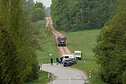
The Russian vehicles “are too heavy for fields, so they move only on roads”, says Pagonis. “The Russians were making it obvious where they would advance.”
The Ukrainians used this as their chance to strike. The videos of burning Russian tanks and fuel trucks have gone viral across social media.
The Lithuanians, meanwhile, remain cool-headed about the looming battles.
“If I am needed [to go into battle] – I will go,” says Barzda (Beard). “It’s our chance to crush them here, for everything [they have done].”

The decision to go
In early April, three more Lithuanian volunteers arrived to join the fight. A car with Lithuanian number plates enters the parking lot of a Kyiv hotel, which has now become a centre for international volunteers.
Passing through the once upscale foyer, three men make their way to sign documents and get ID photos taken. Their journey to fight for Ukraine begins here.
The hotel is a “collection and distribution centre of internationals”, according to Pagonis. “Sometimes, for example, drivers of armoured vehicles arrive and are then sent to different battalions [of the Ukrainian military].” Here, Lithuanians have also run into Georgians, Poles, Spanish, and Scottish fighters.
Pagonis shows the torrent of messages he receives from other Lithuanians, asking to join his unit. However, he only accepts those with prior military experience. “I sometimes look at their Facebook profiles and think that maybe they should just stay home.”
“Very often, there is a lot of enthusiasm, but when you tell them about all the nuances, [...] they get on a train and go back,” he says. One such case allegedly involved a foreign fighter, not a Lithuanian, who was due to join their unit but decided to head back.
Pagonis claims that he has received a phone call from the Lithuanian military, asking him to refuse enlisted personnel.

“Regardless of the fact that we are reserve officers of a NATO member state, when you say NATO you are not speaking about people who are currently enlisted,” says Pagonis. “There have been people [contacting me], who are serving in the military or the National Defence Volunteer Force (KASP), who said they would take holidays and come to help.”
Pagonis also claims that the Lithuanian military has stopped accepting requests from serving members of the armed forces to leave the service, aiming to stem the flow of people seeking to fight for Ukraine.
In a written comment, the Lithuanian Defence Ministry said “some temporary restrictions may exist [...] due to the existing geopolitical situation”, falling short of mentioning the war in Ukraine. Every request is approached on a case by case basis, it added.
“I knew many people with burning eyes, saying that they want to go to the legion, they want to kill,” adds Barzda. “Being this hot-headed will only lead to returning to Lithuania in a bodybag.”
“These people need to think really hard before going,” he says.
The crew would still like for more Lithuanians to join them, but they are careful about letting anyone in.
“When you come here and see the ruins, the dead bodies lying a few metres away, it hits you,” says Lu, another volunteer. “When all of these feelings go through your body, then you decide whether this is truly your place.”
Pagonis shows one message with one eager three-word enquiry: "noriu į frontą” (I want to go to the frontline). He has not replied.

The Ukrainian reality
On February 27, just three days after the Russians struck, Ukrainian President Volodymyr Zelensky called for foreign volunteers to join the fight, saying “this is not just a Russian invasion of Ukraine, it is the beginning of a war against Europe”. Answering the call, people like Pagonis and Barzda departed for Ukraine.
What followed for the eager international volunteers, however, was described by some as chaos.
“I think you’d have to come up with a different word than disorganised,” a Canadian volunteer said in an interview in April. “I don’t think they were ready for that call to action.”
There have also been reports about the alleged lawlessness of the international volunteers – as well as Ukraine’s attempts to better vet the incoming individuals. Testimonies also include outright dissertations after seeing the intensity of combat, as well as the logistical shortcomings of the Ukrainian military.
But for those with more knowledge of Ukraine, the chaos did not catch them off guard. In the eight years of the war in Donbas, basic supply issues have persisted. Self-organisation and grassroots support – something which had blossomed during the Euromaidan revolution and erupted again after Russia invaded the country – has always been necessary to fill the gaps.
International volunteers have previously taken to social media to complain of ammunition shortages, not being provided with an adequate kit, or even enough weapons. But this is something that Ukrainians have faced themselves for years.
“Things are very difficult here, they really like little presents [bribes] here,” says Pagonis.
Arriving at the training site near Kyiv, Pagonis goes off to the side of the road, while swearing on the phone. “There is something new here every day,” he exclaims when he comes back. They were due to be given weapons but the person in charge did not arrive, despite arranging everything a day before. “Here, the word “tomorrow” means nothing,” he adds. The same sentiment is repeated by many – it’s just the way it is in Ukraine.

The foreign fighters in Ukraine can be a colourful bunch. A drunk South Korean man in his 20s on the Polish border, who could barely speak English let alone Russian, said he was eager to join the fight, saying he could no longer sit idle after he w pictures of massacred civilians in Bucha.
Previous causes involving foreigners – such as the fight against ISIS in Iraq and Syria – also attracted people seeking social media attention and outright adventurers.
For Lithuanians, the war in Ukraine is more than that. Here, the war is as close to home as it can get.
“My father said he was too old, he said he would also go himself,” says Lazeris (Laser), one of the Lithuanian volunteers. His grandparents were deported by the Soviets to Siberia, while he also has ancestor links to Cossacks in Ukraine.
“We will do what needs to be done,” adds Lu. “We are here to stop them [the Russians] on this land. If we don’t stop them here, it will be too late to do so in Lithuania.”
Currently, their team is part of the 9th Kyiv Territorial Defence Battalion, outside of the purview of the Foreign Legion. Pagonis says they are using their status merely as an umbrella to operate legally in the country as a stand-alone group. But the exact structure remains difficult to grasp, with Pagonis himself admitting that “things are changing daily”.
They first volunteered to train mobilised Ukrainians in Lviv, condensing a three-month basic course into just two weeks, before proceeding to Kyiv. Now, alongside preparing for combat duties themselves, they will also train Ukrainian scouts.

Meanwhile, it’s impossible to establish the number of foreign fighters currently in Ukraine. According to the statistics announced by Ukraine in March, 20,000 people from 52 countries have answered the call to fight. But the authorities have never published the exact numbers of international volunteers currently in the country.
The number of Lithuanians involved is also unclear. LRT knows at least two more men serving with the Ukrainian armed forces, including at least one of them being involved in active combat duties. There are reportedly many more.
Pagonis’ crew are also unaware of other Lithuanian crews. “According to my knowledge, we are the only [Lithuanian] combat unit,” says Lu. His claims are impossible to verify.
“It’s an open secret that there are Lithuanians and other internationals here,” says Lu. “But this message needs to be spread, this needs to be shown because such things inspire [others to join].”
“It’s always better to be among your own,” he adds.
Although officially part of the Ukrainian Armed Forces, they are yet to receive a wage. According to Pagonis, other international volunteers are also yet to be paid. For now, they are funded entirely by donations from Lithuanians, including high profile business owners.
“Over time, we found our donors,” says Pagonis. The team also collects funds via direct donations, as well as the crowdfunding Contribee platform.

Bucha massacres
At night, we drive at speed through the empty streets of Kyiv. We are met at each checkpoint with smiles, a brief conversation, a glimpse at the fluttering Lithuanian flag mounted on the jeep, followed by a raised hand or a fist in the air, waving the convoy through.
“Our presence here [...] is a very big moral encouragement for the Ukrainians so that they do not feel alone,” says Pagonis.
We sit down inside their temporary accommodation. They ask to keep the location secret.
What’s bonding them here is their decades-long experience of serving in the Lithuanian military. Some of the volunteers in their 40s were among the first to serve in the post-independence military and spent decades in uniform. The younger recruits, meanwhile, have spent only several years in the armed forces.

“Pagonis has a lot of knowledge, you can learn something new from him every day, things which you haven’t learned during three years in the Lithuanian military,” says Barzda. “The person is basically like a father.”
“You are ready to turn your back [toward fire] for that person, to shield him with your body,” Barzda adds. “When such people are together, the motivation increases, and we support each other in such difficult times.”
Lazeris was one of the three men to arrive earlier in the day. “I quit my well-paying job in Sweden to come here,” he says. The civilian massacres sealed the decision for him to join the fight. “I saw the scenes from Irpin, Bucha. The same evening I called my director and said I was leaving.”
“I don’t have a family, children, which is something that is stopping many more from going. [...] We will settle things here first, then we can make money any time later,” Lazeris adds, smiling.
For families of others, the news of their departure was difficult to process. “You saw in their eyes that [they thought] they may be seeing you for the last time,” says Lu. “This is difficult to witness, [but] they make peace with it after a while.”
“It’s most important to remain in touch, to speak, to tell them what you are doing,” he says. “War is, of course, difficult, no one needs weak people here.”

Text and pictures: Benas Gerdžiūnas
Video report: Augustinas Šulija


Newsletter
Every Friday morning.


