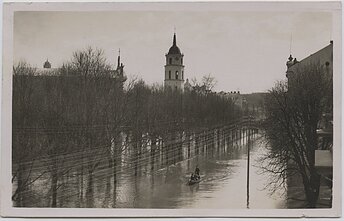
















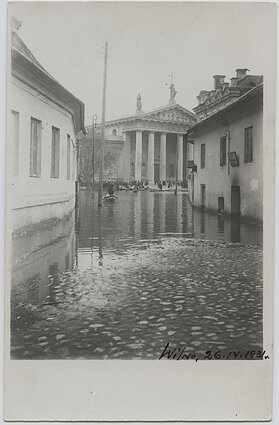
In April 1931, Vilnius a massive flood submerged the city's streets under water. It also led to one of the biggest archaeological finds in the city's history.
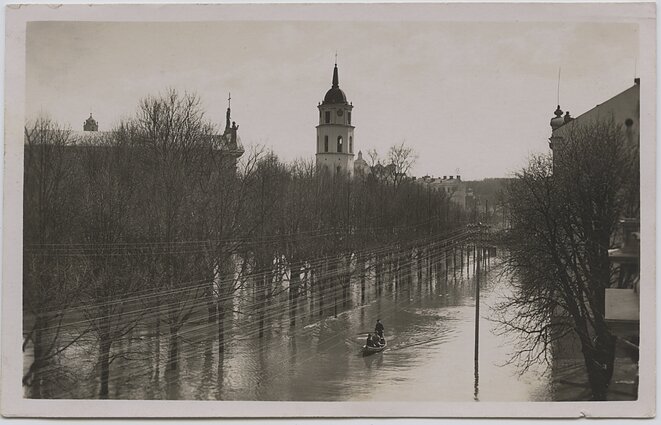
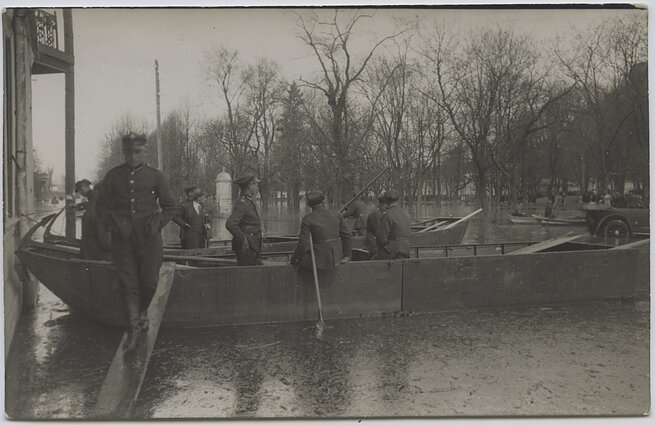
The big flood of Vilnius began in late April when the rivers Neris and Vilnia spilled over their banks. According to contemporary newspaper reports, the flood lasted two weeks and at its peak water levels rose to 8.25 metres. Part of the city was cut off from power and some buildings collapsed.
This was one of the biggest floods in Vilnius, but by no means the only one, says historian Alina Pavasarytė. Due to its low-lying central part and the abundance of underground streams, the city would be regularly flooded. Most people owned boats, as navigation on the Neris and the Vilnia was still quite intense.
“Judging by reports in the press, [the 1931 flood] wasn't described as a big tragedy, a God's punishment. I think it was pretty common at the time that you'd sometimes need to take out your boat and row to a church or a shop,” says Pavasarytė.
Contemporary photos show people taking furniture out of their houses to keep them dry and, in one photo, a pair of men are sailing on a wardrobe, she says.
Treasure trove of history
For historians, the 1931 flood is significant for leading to a landmark discovery in the vaults of Vilnius Cathedral.
According to Pavasarytė, Lithuania's luminaries would be entombed in the vaults since the cathedral was built in the 14th century. However, family crypts would not be kept accessible – if someone had to be buried, the floor would be lifted, the coffins lowered into the room and then sealed again.
In the 19th century, the vaults underneath the cathedral were completely walled up and pretty much forgotten. “Over the years, there was no action there, just tombs rotting, remains mixing up due to water and so on – a macabre image, if you imagine it,” says Pavasarytė.
In 1931, with its base submerged under water, the cathedral started cracking. People of Vilnius then hurriedly appointed a rescue committee to investigate the damage.
After looking at the cracks in the facade, the appointed engineers decided that if the building were to be rescued, they had to start with the foundations.
“The specialists dug under the floor of the cathedral to see if the wooden poles were still there, or if everything had rotted away and needed to be replaced,” Pavasarytė says.
The diggers used existing plans of the building to guide their investigation, but these proved to be inaccurate. Where there was supposed to be a three-metre wall, they instead discovered a cavity.
“The supervisors immediately sent all lower workers away, to prevent talks and rumours from spreading. Essentially breaking every rule, they entered the crypt to see what they had dug up,” according to Pavasarytė.
What they unearthed were the tombs of Polish-Lithuanian monarchs: King Alexander Jagiellon (Aleksandras Jogailaitis, who died in 1506), Queen Elisabeth von Habsburg (Elžbieta Habsburgaitė, 1505), and Barbara Radziwill (Barbora Radvilaitė, 1551).
According to Pavasarytė, the workers knew they chanced upon the royal crypt, because Barbara Radziwill – a wife of the Polish King and Lithuanian Grand Duke Sigismund II Augustus – still had a crown on her head. There were crowns next to the other two royals, too, as well as plenty of jewelry.
“It was known that they were entombed under the Cathedral, only no one knew where exactly,” she says.
Extensive works were subsequently carried out to reinforce the cathedral, which included installing 269 ten-metre ferroconcrete poles around the foundations and iron hooks to support the facade.
The next time that water was threatening the building was in 1996. Fearing another major flood, overseers of the cathedral took out coffins of bishops and valuable artefacts out of the basement.
However, the spring turned out sunny that year and relatively dry, the nearby rivers did not spill over their banks.


Newsletter
Every Friday morning.