











On June 15, 1940, newspaper front pages across the world were filled with images of Nazi columns marching under the Arc de Triomphe in Paris and Adolf Hitler posing in front of the Eiffel Tower. But on the same day 80 years ago, the first Soviet tanks crossed into Lithuania.
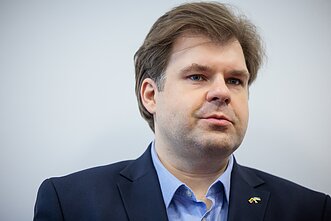
The armoured columns ended Lithuania as an independent state. However, many Lithuanians themselves were slow to understand the significance of what just happened, according to historian Algimantas Kasparavičius.
Secret protocols
On the eve of the Second World War, the Soviet Union and Nazi Germany signed a non-aggression agreement, also known as the Molotov–Ribbentrop pact, dividing Central Europe – including the Baltic states – under the agreement’s secret protocols.
Kasparavičius, from the state-funded Lithuanian Institute of History, says most of the world didn’t know about the secret protocols. A mere 24 hours later, the US government got the news via its agent in the German embassy in Moscow and shared the news with the British.

“All other governments, including those of Lithuania, Latvia, Poland, were only guessing” what had occurred, says Kasparavičius. “Many thought that the non-aggression deal between the USSR and Germany was useful for the Baltic states,” he added, with Estonia and Latvia hoping this would stave off a Soviet invasion.
The Molotov–Ribbentrop Pact itself, according to Kasparavičius, was very much in the tradition of 19-and 20-century geopolitics, when major powers would divide spheres of influence for economic gain.
But part of the Lithuanian elite, including the then president Antanas Smetona, suspected that Hitler had offered Stalin something in return for Moscow staying out of Germany’s way.
A month later, on September 29, the Soviets invited a Lithuanian delegation to come to Moscow where they were presented with a cooperation agreement. The Soviet Union offered to hand over Vilnius, which it had just torn from occupied Poland, but in return the Red Army was to deploy 20,000 troops in the country.
The Soviet negotiators said Lithuania was given to them and no one was going to help it, as the British and the French were fighting the Germans.
“Already in early November 1939, [President] Smetona ordered to prepare for a possible tragic scenario – the occupation of the Lithuania,” says Kasparavičius. The country considered establishing a special fund, transferring Lithuania’s treasury abroad, making arrangements for a government-in-exile, as well as withdrawing the Lithuanian military to East Prussia in Germany.
“For six months, Stalin himself [...] didn‘t know what to do with the territories allocated to his sphere of influence,” says Kasparavičius. “Everything depended on events in Central and Western Europe.”

Left alone
As Hitler‘s armies moved west, Stalin took the opportunity to occupy the Baltic states.
Many Lithuanians accepted the Soviet bases in their country as a pragmatic result of the war and tried to find employment there, as Lithuania’s economic situation was dire.
But the country’s intelligence services saw the bases as a source of Soviet threat, as they began interfering in governing, according to Kasparavičius.
The international community, meanwhile, accepted the occupation of the Baltic states as realpolitik of the day.
“In early 1940, in foreign press and private conversations among journalists and diplomats the Baltic states were already considered as having lost, or about to lose, their independence,” he says.
On June 14, 1940, the Soviet Union issued an ultimatum to Lithuania, demanding to prosecute its high-ranking officials, form a new government, and allow free movement for Soviet forces.
But the country’s government decided not to inform the press, so most of the Lithuanian public didn’t know about the rising tensions.

The government simply didn’t know what to do, says Kasparavičius. Hitler was triumphant in France, the British expeditionary forces were besieged in Dunkirk.
“Lithuania and the Baltic states were left completely isolated. They were caught between the Nazis and the Bolsheviks, and they had to make decisions by themselves,” says Kasparavičius.
During an overnight discussion on June 14–15, the Lithuanian government was split on whether to accept or reject the Soviet ultimatum.
President Smetona, as well as the country’s defence, interior, and education ministers, urged the government to go into exile and thus signal to the international community that the country was occupied.
But the majority in the Cabinet, along with military and political party leadership, wanted to accommodate the Soviets.
“Military officers and leaders considered that [resistance] would result in pointless bloodshed,” says Kasparavičius. “They were thinking pragmatically, not politically like Smetona, who called to withdraw and send a clear signal to the society, Europe, and the world that the country is under occupation.”
Capitulation also seemed a sensible option in view of other countries’ experience with Hitler. “Smetona argued [Lithuania] should follow the heroes – take the example of Norway and Belgium [to fight the invasion] – but his speech didn’t convince the majority.”
Enter the Soviets
Many in Lithuania’s political elite didn’t consider the entry of Soviet forces into the country on June 15 as the beginning of an occupation. According to Kasparavičius, this had to do with Stalin’s methods – the Bolsheviks said that they were coming to topple Smetona’s regime and establish a people’s government.
The Soviets were supported by the influential Christian Democratic Party and left-wing opposition – their representatives were trying to negotiate with Russian diplomats in the Soviet embassy on the make-up of the new government.
The press was also silent, according to Kasparavičius. “When you look at the newspapers from June 15–23, you will notice a lot of happiness,” he adds.

Members of the ruling elite who stayed in Lithuania accepted the ultimatum and condemned Smetona’s decision to leave the country. His critics thought that the Soviets would reinstall democracy after 14 years of Smetona’s authoritarian rule.
“Smetona’s departure was considered a flight not form Soviet occupation, but from the Lithuanian democracy,” says Kasparavičius.
Soviet propaganda actively exploited his departure, saying that “the fascist leader Smetona has fled the wrath of the Lithuanian people”, according to the historian.
But Smetona’s departure was a step in an attempt to maintain a Lithuanian government in exile, according to Kasparavičius. As he left the presidential palace, Smetona said: “I don’t want to make Lithuania Bolshevik with my own hands”, according to Kasparavičius.
‘Creeping occupation’
Although Lithuanian elites hoped for a return of democracy, ordinary people knew the occupation had begun, Kasparavičius believes.
“Common people understood everything very clearly,” he says. “They saw Russian soldiers, Russian tanks, and made a very frank conclusion – Lithuania was no more.”
At the time, international press was focused on the French capitulation to the Nazis and the besieged British forces in Dunkirk. Events in the Baltic states only caught attention several days later.
But the news didn’t shock anyone, says Kasparavičius, as “half of Europe was already occupied by the Nazis”.
In Lithuania, the scale of the tragedy became clear only later, when the terror and the killings began. External symbols of the Lithuanian state were removed gradually.
“It was a very sophisticated occupation. And perhaps this was the biggest problem. The society didn’t immediately understand what they were facing. It was a creeping occupation,” says Kasparavičius.
As Europe was burning, only the US reacted differently.
“The Americans understood what was happening,” says Kasparavičius. “On July 23, 1940, US Secretary of State Sumner Welles made his famous announcement that the US doesn’t recognise the incorporation of the three Baltic states into the Soviet Union.”

Newsletter
Every Friday morning.