













Kazakh chef Danelis Kambajevas has lived in Lithuania for several years, but when the conversation turns to food, he is instantly transported back to Central Asia. There, he says, food was never merely a way to satisfy hunger – it was an expression of culture, family tradition and hospitality. Now 33, he works in a restaurant in Kaunas, slowly getting to know his adopted country, but he has never forgotten the smell of the plov his father used to cook at weekends.
You can read this article in Russian and Lithuanian as well.
Kambajevas arrived in Lithuania – he remembers the date precisely – on September 8, 2023. He came to work as a sushi chef, starting out in Vilnius before moving to Elektrėnai, then Alytus, and finally Kaunas.
"I am gradually getting used to life here," he says.
Roots in two countries
Though he identifies as Kazakh, his story spans several countries. His father was born in Kyrgyzstan, where his grandparents had moved from Kazakhstan. His mother is Kyrgyz.
"My parents met there, married, and I was born in Kyrgyzstan," he explains. Yet his ties to Kazakhstan never broke – he regularly visited relatives on his father's side in Taraz, and his roots extend to the Kyzylorda region. He says he always felt as though he had two homelands.

Kambajevas began his culinary career in Central Asia, starting with Eastern cuisine before moving to European cooking, and later returning to Japanese food. It was while working in Bulgaria that he heard of a sushi chef vacancy in Lithuania.
"Someone suggested I try working there, and I decided to take the risk," he recalls.
The nomadic kitchen
Growing up, Kambajevas was immersed in a culinary tradition shaped by centuries of life on the Central Asian steppe.
"Kazakh cuisine is very closely connected to the history and way of life of the people. Kazakhs were nomads for many centuries, constantly travelling across the steppe with their herds of horses and camels. Food had to be easy to transport, store and prepare in outdoor conditions," he explains.
The foundations of the diet were meat and dairy. Horse meat, lamb and beef provided the energy needed to survive a harsh steppe climate. One of the best-known dishes, he says, is beshbarmak – boiled meat served with pasta and broth.
"It is one of the symbolic dishes of Kazakh cuisine, often served at large family celebrations," he says.

Fermented mare's milk – kumiss, drunk for centuries – is another staple. So too is kurt, a dried salted cheese that can keep for years without spoiling, ideal for a nomadic life.
But cuisine, he stresses, is about more than recipes.
"We have very deep traditions of hospitality. It is believed that a guest brings a blessing to the home. So you always try to prepare the best dishes and lay a generous table, so that the guest will long remember the visit," the chef says.
Plov: a family tradition
Plov holds a special place in Kambajevas' memory. He admits he came to cooking it himself only later in life, but the taste takes him straight back to childhood.
"When I was small, my father would make plov at weekends. It was a family tradition – he would cook it for everyone and we would all gather around the table," he says.
The best plov, he insists, is made in a kazan, a heavy cast-iron pot, over an open wood fire. "The aroma is completely different. It is far more delicious."

The recipe, he says, is straightforward once you understand the key principles.
Oil is heated in the kazan, then a piece of fat from the sheep's tail is added, rendered down and removed. Onions, around 300 to 500 grams, are fried until browned and set aside. They should release a strong aroma.
Then, meat is added in large pieces, sometimes with ribs, and fried until golden. Carrots follow, then water, simmered for about seven minutes before spices are added – salt, black pepper and, crucially, cumin. The mixture cooks for around 30 minutes.
Meanwhile the rice – traditionally a Central Asian variety such as Uzgen, or internationally known Basmati – is washed thoroughly and added to the pot.
The key rule: do not stir. Water should cover the rice by about a centimetre. The pot is covered and left on a low heat for 15 to 18 minutes, then the heat is turned off and the dish rests for a further ten minutes before being carefully mixed through.
Plov is traditionally served with a simple salad of tomatoes, cucumbers and thinly sliced onion, dressed with salt and black pepper.
"This salad accompanies plov across almost all of Central Asia – in Kazakhstan, Uzbekistan and Kyrgyzstan alike," he says.

Lithuanian treats
In Lithuania, Kambajevas has been gradually discovering the local cuisine. Cold beetroot soup – šaltibarščiai – made an immediate impression.
"In summer it is genuinely refreshing," he says.
He has also developed a fondness for kibinai – the Karaite pastries filled with meat.
"They remind me very much of samsa, which we make back home," he says. "And potato pancakes – they are a genuine treat."
He keeps his own diet fairly light these days, as he is devoted to fitness and bodybuilding, but he still cooks beef and plov when the mood takes him.
Cold, quiet and surprisingly drinkable tap water
What struck him most on arrival was the cold. September in Lithuania was not what he had expected.
"Back home it would still be summer – people walking around in shorts and T-shirts, the sun not yet ready to disappear. Here, autumn met me with such a chill that I immediately had to reach for a warm jacket and hat." It took him two full years, he says, to stop feeling the cold so sharply.
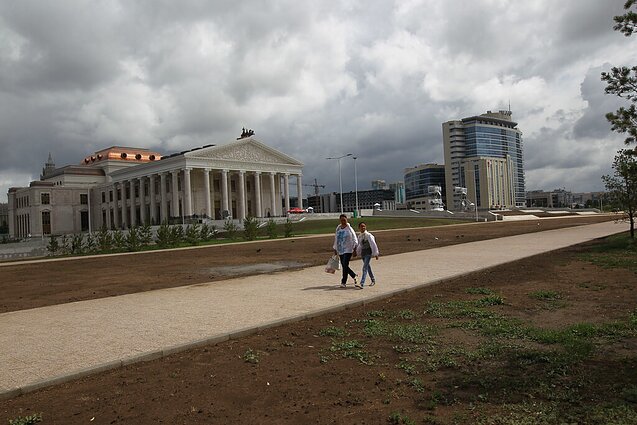
Much about Lithuania, however, has pleasantly surprised him. He appreciates the quiet – he grew up in a city of more than two million people, and finds Kaunas, with its 600,000 to 700,000 inhabitants, a comfortable scale.
He was also astonished to discover that tap water is drinkable straight from the tap. "In my opinion, that is a very great thing," he says.
The biggest challenge remains the Lithuanian language. He admits it is not easy, but he is not giving up – studying, practising at work, listening carefully to the way words sound. Colleagues help him most, correcting and encouraging him, gradually translating this new world into something a little more comprehensible.
He is keen to integrate further into local life, and has always placed importance on getting to know local people and inviting them over. For now, he has no plans to return to Central Asia. On the contrary, he wants to get to know Lithuania better and continue delighting its residents with his cooking.
"I like that there are not many people here. I grew up in a city of about two and a half million, and both Bishkek and Almaty are roughly the same size. Here it is 600,000 to 700,000, and honestly, that is very comfortable," he says, noting that Lithuania, like the major cities of Central Asia, has an international feel to it.
"I have decided to take short breaks and travel around the country little by little. I want to see different cities and places. Top of my list is the Baltic coast – I very much want to go to Palanga and visit the Amber Museum," he says.

Newsletter
Every Friday morning.