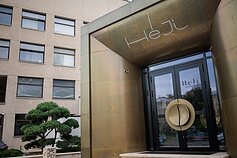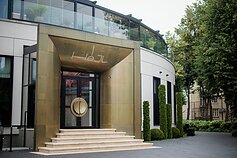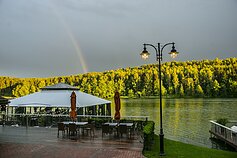










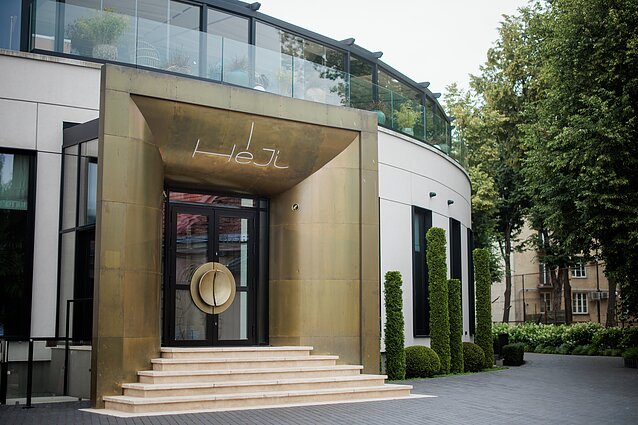
Businessman Artur Hranc, who holds Belarusian and Armenian citizenship, owns some of Vilnius’s most expensive dining venues, including the restaurant HeJi, as well as the luxury hotel Esperanza Resort. His business interests also extend into Belarus – his partners include Dipmarket, a company controlled by the authoritarian ruler Alexander Lukashenko.
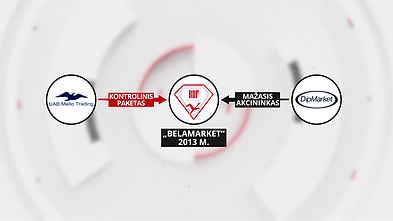
LRT’s Investigation Team and Buro Media found that Hranc’s Lithuanian company Mello Trading owns Belamarket Duty Free, which operates more than 30 shops in Belarus along the borders with Lithuania, Latvia, Poland and Ukraine, as well as a store at Minsk airport.
According to LRT’s partners, the company generated nearly €17m in revenue and €2m in profit in 2024. A 50.1% stake in the chain is held by Mello Trading, while the remaining shares belong to Dipmarket, a company tied to Lukashenko’s administration.

Lukashenko has controlled the duty-free sector for almost 20 years. Since 2008, he has established a monopoly on duty-free goods by granting exclusive market rights to several companies through presidential decrees, including Dipmarket, MarketLiga and Helena Valery.
Duty-free shops have often become lucrative assets for business figures in eastern countries and for authoritarian regimes, allowing them to profit from the sale of alcohol, tobacco and luxury goods.
One of the key conditions for operating duty-free shops in Belarus since 2008 has been a requirement to pay 10% of quarterly turnover into the state treasury.
According to an earlier investigation by the Belarusian Investigative Centre (BIC), founded by independent journalists, MarketLiga has been controlled since 2017 by the National Olympic Committee and the Presidential Sports Club, headed by Dzmitry Lukashenko, the president’s middle son.
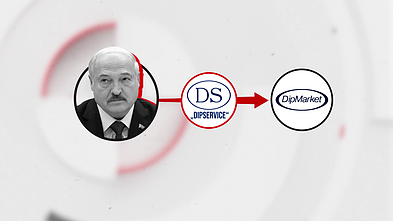
The Helena Valery chain belongs to Alena Skrypel, an influential president of the Rhythmic Gymnastics Federation who has described Lukashenko as a close friend. Dipmarket is controlled by the state body Dipservice, which reports directly to the president.

“Our institution was established in April 1995 by a decree of the President of the Republic of Belarus and is part of the Presidential Property Management Directorate. Dipservice manages complexes including residential and office premises, hotel rooms, sports facilities, saunas, tennis courts, billiards and more,” the organisation states on its website.
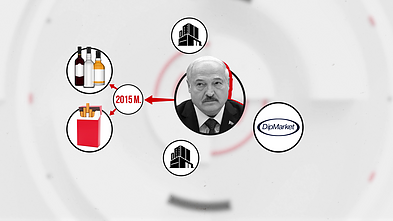
According to Belarusian media, in an effort to increase foreign currency inflows, Lukashenko exempted domestically produced alcohol and cigarettes from excise duties in such shops starting in 2015.
In the same year, the president granted exclusive rights to sell duty-free alcohol to Dipmarket, Helena Valery, MarketLiga and the Lithuanian-controlled Belamarket Duty Free.
“For more than 10 years, we have seen only a handful of players in Belarus’s duty-free market. Most appear to be directly linked to Lukashenko in one way or another. The fourth participant is from Lithuania and is a partner of the Presidential Property Management Directorate. This is a very unusual case,” said Stanislau Ivashkevich, an opposition journalist who has long studied the inner workings of the regime.

EU sanctions on partners in Belarus
Ivashkevich said the Presidential Property Management Directorate represents a “shadow empire” of the regime.
“This is a business empire worth more than a billion dollars. It owns the most valuable real estate, a dairy plant, and virtually any business with a significant market share,” he told LRT.
Viktar Sheiman, widely considered one of the Belarusian leader’s closest allies, headed the directorate until 2021, underscoring its importance to Lukashenko.
“He has been under sanctions for many years. He is believed to be among those who planned the murders and persecution of Lukashenko’s political opponents. He may also be responsible for arms trading with Africa and Latin America. Now, it appears he is overseeing Lukashenko’s private assets in Russia,” Ivashkevich said.
All three current heads of the Presidential Property Management Directorate – Yury Nazarov, Nikolai Shkred and Anton Kraevsky – are on the European Union sanctions list due to their close ties to Lukashenko.
Nazarov was appointed to lead the directorate in 2022, having previously served as Belarus’ deputy prime minister. His role – and that of the directorate – was highlighted by Lukashenko himself.
“The directorate is a unique structure. It addresses issues of national importance, and the position of its head ranks among the highest in the state hierarchy. This means that beyond these functions, Nazarov’s responsibilities extend to all tasks that need to be resolved in Belarus,” Lukashenko said in 2022.
Nazarov’s current first deputy, Shkred, was appointed in 2024. Previously, he served as deputy head of the president’s security service. Belarusian media describe him as one of the leader’s closest confidants, holding a high-ranking civil service status.
In 2024, the Presidential Property Management Directorate and its subordinate body Dipservice were awarded diplomas, medals, orders and honorary titles “for significant contributions to Belarus”. At the ceremony, Lukashenko said it should inspire everyone to work even harder.

Luxury spa in Trakai also linked to Hranc family
Mello Trading is directly connected both to HeJi – listed in the Michelin Guide and considered one of Vilnius’s most expensive restaurants – and to Esperanza Lake Resort, which has received Michelin Keys.
Although HeJi is operated by Olivia Holding, its owners are members of Hranc’s family – his son, daughter and wife – along with the UAE-based company Advanced Technologies Solutions, which is owned by Hranc.
The HeJi trademark is also held by Mello Trading, which operates in Belarus. That company, in turn, is controlled by the UAE-based BF Capital, also owned by Hranc. A new trademark, Mizu Beach by HeJi, was registered last year by Esperanza Resort, which Mr Hranc and his family have owned since 2022.
Shareholder data show that Esperanza was acquired from Canadian owners by the Latvian company GD&L Services, also owned by Mr Hranc, before shares were redistributed among his family members.
Financial statements suggest that Esperanza may have been financed with funds from Mello Trading, as renovations began soon after the acquisition. Company documents state that more than €11m in bonds were issued two years ago to attract investors. Some of these bonds were purchased by AG Invest LT, offering a 5% annual return.
This company is also owned by Hranc through BF Capital. Established in 2024, AG Invest LT was spun off from Mello Trading and received €8.6m in retained earnings, which it then invested in Esperanza.
However, Mello Trading has recently reported modest annual revenues in Lithuania. In 2024, its revenue amounted to less than €300,000, and it operated at a loss. Documents also show that it controls four companies in Belarus: Bela Trading Duty Free SP, Belamarket Duty Free, Beltorgarenda, and Belavtotranzit.
No investigations by authorities
Lithuania’s institutions contacted regarding Mello Trading’s activities with the Belarusian regime said they had no publicly available information.
Hranc did not respond to journalists’ attempts to reach him.
Journalists also asked whether profits generated in a regime-controlled sector were being invested in Lithuania.
Since January 2023, Belarus has prohibited foreign shareholders from “unfriendly” countries from selling their stakes in Belarusian legal entities. This is also reflected in responses provided by representatives of Mello Trading.
“The holding company’s main income was received in the form of dividends from Ukraine, Cyprus, the United Arab Emirates and Georgia, as confirmed by international auditors. Therefore, there are no grounds to claim that the restaurant or spa was financed by duty-free revenues from Belarus. Such an assumption is not supported by financial or legal data,” the company said.
“We inform you that we do not and have not carried out any economic or commercial activities in Belarus. We only hold financial assets in that jurisdiction, but due to existing restrictions and/or legal circumstances, we are unable to dispose of them,” it added.
However, official data appear to contradict these claims.
According to Belarusian registry data compiled by LRT’s partners at Buro Media, the duty-free network controlled by Mello Trading generated nearly €2m in profit and €17m in revenue last year. Profits have increased since the start of the full-scale war in Ukraine: net profit stood at around €800,000 in 2020 and 2021, rising to €1.4m in 2022 and €2.2m in 2023.
Lithuanian registry data show that Mello Trading last received dividends from Belarus in 2022 – about €200,000. The largest payments were recorded in 2020 and 2018, exceeding €1.5m.
In its response to LRT, the company said that no dividends had been paid from Belarus since 2022, and no funds had been transferred either to the Lithuanian company or to third countries, including the United Arab Emirates.
“The payment of dividends during this period was effectively impossible due to financial restrictions in force in Belarus,” Mello Trading representatives said.

Newsletter
Every Friday morning.