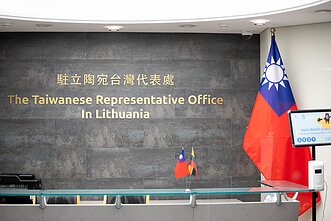















A majority of Lithuanians support renaming the Taiwanese Representative Office in Vilnius in an effort to improve relations with China, according to a new public opinion survey.
The poll, commissioned by LRT and conducted by Baltijos Tyrimai, found that 58% of adults in Lithuania favour changing the name to the “Taipei Representative Office”.
Of those surveyed, 22% said they strongly support the move, while 36% said they somewhat support it. About a quarter of respondents opposed the idea, including 8% who strongly disagreed, while nearly one in five had no opinion.
Opposition to the name change was more common among residents of major cities, higher-income individuals and those with university degrees, the survey showed.

Support was strongest among voters of the Lithuanian Farmers and Greens Union, with 73% in favour, followed by supporters of the Lithuanian Social Democratic Party at 71%. Voters of the opposition Homeland Union–Lithuanian Christian Democrats were evenly split, with 45% supporting and 45% opposing the proposal.
The survey was conducted between February 19 and March 2 among 1,014 respondents, with a margin of error of 3.1 percentage points.
The debate over the office’s name comes amid ongoing tensions between Vilnius and Beijing. Lithuania’s decision to allow the office to open under the name “Taiwanese” in 2021 led to a sharp downturn in diplomatic relations and bilateral trade.
Prime Minister Inga Ruginienė said in February that Lithuania had acted prematurely by opening the office under its current name without sufficient coordination with the European Union and the United States, adding that consultations are underway on normalising ties with China. She has said she sees no reason why the office could not be renamed.

President Gitanas Nausėda has said Lithuania seeks to restore normal diplomatic relations with China while also expanding economic cooperation with Taiwan, noting that opportunities for closer ties with Taipei have so far been only partially utilised.
Diplomatic relations between Lithuania and China have remained strained in recent years, with disagreements over how to restore representation in both countries. Since mid-May last year, Lithuania has had no accredited Chinese diplomats in the country, and bilateral trade has declined following the opening of the Taiwanese office.
The government program of Ruginienė’s cabinet includes a goal of restoring diplomatic relations with China to a level comparable to that of other European Union member states.

Newsletter
Every Friday morning.