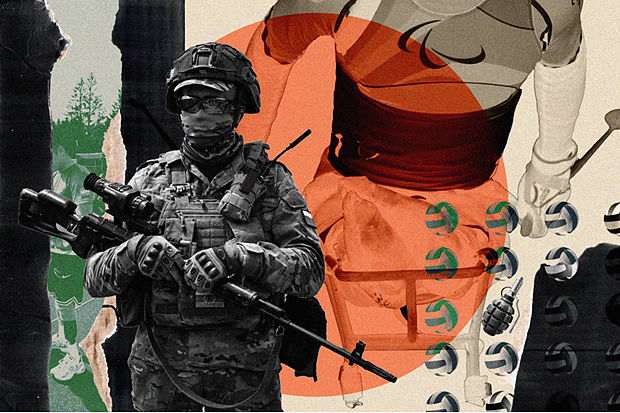






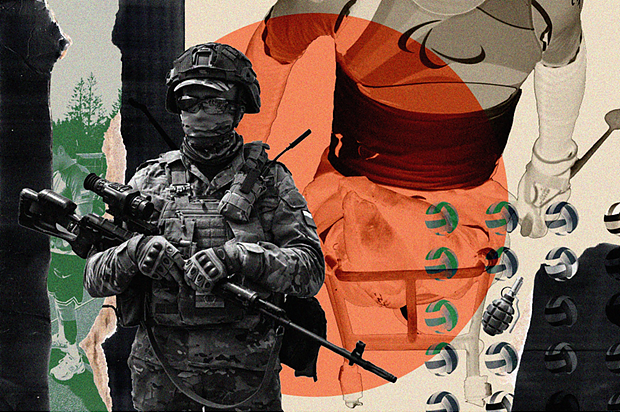
Soldiers fighting against Ukraine are becoming in Russia an inexhaustible reserve for replenishing Paralympic national teams. Those who became disabled at the front are taken into sport directly from their hospital beds by representatives of the Russian Paralympic Committee (RPC).
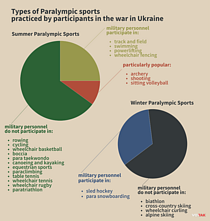
At least 70 participants in the invasion of Ukraine are already members of national teams in various Paralympic sports, and no fewer than 700 are in regional teams. Billions of rubles are being spent in the country to involve former servicemen in the Paralympic movement, Vot Tak has found.
Despite the active militarization of the RPC, the International Paralympic Committee (IPC) restored Russia’s membership and allowed its athletes to compete under the national tricolor at the upcoming Paralympic Games. We explain how the Russian authorities are preparing a new sporting elite of the country from participants in the invasion.
Soldiers of Big-Time Sport
The Russian Paralympic Committee has long-standing experience working with combat veterans. Among its athletes and coaches are participants in the wars in Afghanistan,
Chechnya, South Ossetia, and Syria. However, since 2022, the RPC’s primary focus has been, above all, on participants in the war against Ukraine.
Each year, the number of veterans of the “special military operation” retrained as Paralympic athletes has been growing. In 2024, 300 “SVO” participants were members of regional teams in various Paralympic sports; in 2025, there were already 500; and by the beginning of this year, their number had increased to 700.
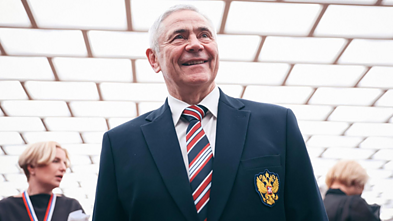
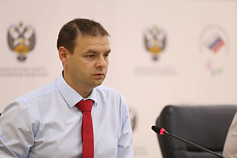
These figures are cited by 69-year-old Pavel Rozhkov — president of the RPC since 2022, a Master of Sport in Greco-Roman wrestling, and an Honored Coach of Russia. He is also one of thousands of individuals listed as sponsors and accomplices of Russian aggression on the website of the Main Directorate of Intelligence of Ukraine and in the “Myrotvorets” database (an online registry publishing personal data of Russian citizens whom the project’s creators consider supporters of the Putin regime. — Ed.).
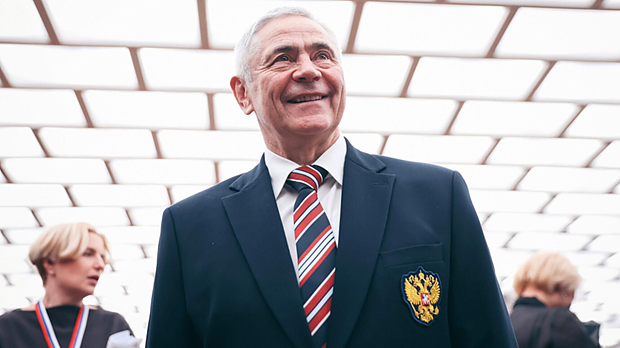
Among other things, Ukraine accuses Rozhkov of encroaching on its sovereignty and territorial integrity. This likely refers to Rozhkov’s public trip to the occupied territories: in 2023, he visited Donetsk and Shakhtarsk.
Since the start of the war, representatives of the RPC have regularly emphasized their efforts to involve former participants in the fighting in Ukraine in sport. Pavel Rozhkov has repeatedly described work with “SVO” participants as “one of the most important and priority tasks” of thecommittee and has assured that the best of them will compete at the largest nationwide and international events as members of regional and national teams.
In August 2024, at the Defense Ministry’s military-technical forum “Army,” Rozhkov delivered a report titled “Involving SVO Veterans in Paralympic Sport.” In it, he noted that former servicemen “take part in regional and nationwide competitions on an equal footing with Paralympians, earning the right to become members of the teams of the constituent entities of the Russian Federation and of Russia.”
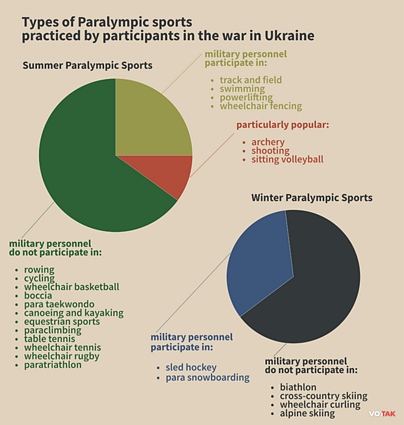
According to Rozhkov, in 2026 the number of participants in the invasion within the national team across various Paralympic sports doubled: 70 people compared to more than 30 a year earlier.
What share of the Paralympic teams is currently made up of former servicemen is not publicly disclosed. The mechanism by which participants in the war move within a few months from the status of hospital patients to candidates for national teams is also not revealed. Vot Tak sent an inquiry to the Russian Paralympic Committee requesting clarification of the total number of athletes in the reserve and an explanation of the procedure for the accelerated training of servicemen. As of the time of publication, the editorial office had not received a response.
Popasna, Wounding, National Team
In order to obtain comments from Ruslan Ustyuzhin and Tsyden Geninov, who fought against Ukraine, a Vot Tak correspondent presented herself not as a journalist but as a film school student and used a different name. The editorial team made this decision on the grounds that the individuals in question would be unlikely to agree to speak with a media outlet and an author designated as foreign agents. We believe that the public importance of the information in this case justifies the method of obtaining it.
Over the past four years, athletes with the same background have increasingly appeared in Russian para-sport: front line, injury, disability, national team. One of them is 38-year-old Ruslan Ustyuzhin. He currently plays for the Moscow sitting volleyball team, competes in the Russian championship, and is a member of the national team in adaptive sports.
In addition, Ustyuzhin is the captain of a Moscow para-volleyball team composed exclusively of participants in the war with Ukraine. But until recently, he was building not a sports career, but a military one. Its culmination was his participation in the full-scale invasion.
Adaptive sport is designed for people with health limitations, taking into account their specific needs. The national team in adaptive sports is a team that brings together athletes from different disciplines to participate in mass and nationwide events. It differs from national teams in specific Paralympic sports, which are formed for elite sport and international competitions.
Lieutenant Ustyuzhin had been serving since 2014 in the Airborne Forces brigade stationed in Ulyanovsk (military unit 73612), the 31st Separate Guards Air Assault Brigade, Order of Kutuzov (in 2023 the brigade was reorganized into the 104th Guards Air Assault Division). He took part in the war on the territory of Ukraine from the first day.
“There is an order. You don’t question it, you carry it out,” he explains how he became a participant in the invasion.
According to him, Ustyuzhin fought in the positions of squad commander and commander of a infantry fighting vehicle (IFV). The lieutenant claims that he does not know what targets he struck and says that he merely acted on the orders of his command.
The paratrooper does not hide that he took part in several offensive operations. On the morning of February 24, 2022, Ustyuzhin, as part of the 31st Airborne Brigade, began the offensive on Kyiv. The site of his first major battle in the course of the large-scale war was the settlement of Hostomel. Fighting for it and for the local Antonov Airport lasted several days. At the beginning of March, the settlement came under the control of the Armed Forces of the Russian Federation. A month later, Hostomel was liberated during a counteroffensive by the Armed Forces of Ukraine.
During 35 days of Russian occupation, according to Ukrainian authorities, more than 400 local residents went missing. Later, international investigative journalists published evidence of extrajudicial executions committed by Russian servicemen.
After the settlement was liberated by the Ukrainian army, Ustyuzhin’s unit, according to him, was redeployed to Izyum in the Kharkiv region, which had come under Russian control. The city was under occupation from April 1 to September 11, 2022, and became notorious because of crimes committed by the Russian army.
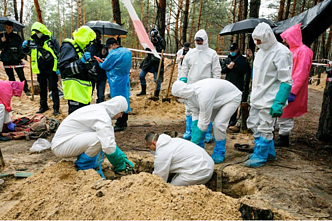
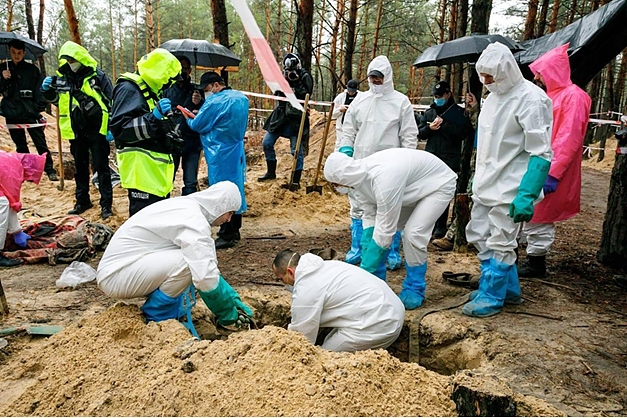
After its liberation, several mass burial sites containing more than 440 bodies of Ukrainians were discovered in Izyum. Most of them were civilians killed by soldiers of the Armed Forces of the Russian Federation, including children. Many of the bodies showed signs of torture.
When asked whether he had to kill during the war in Ukraine, Ustyuzhin replied:
“I don’t know. I didn’t see that I killed anyone. I was carrying out an order and defending my homeland. It’s just that the word ‘killed’ — it sounds criminal. In war, people die for something.”
Ruslan’s participation in the war ended in the city of Popasna in the Luhansk region, where his unit was sent after Izyum. During an offensive on May 23, Ustyuzhin’s detachment came under fire from the Armed Forces of Ukraine. The lieutenant lost his left leg above the knee.
After several months in the 1602nd Rostov Defense Ministry hospital, the paratrooper returned home to Ulyanovsk. In October 2022, he left the Airborne Forces and took a job at the local military commissariat. Around the same time, he received a call from the rehabilitation project for wounded servicemen “Peregruzka” (“Reset”) and was offered a trip to a “military sanatorium” in the city of Aleksin in the Tula region.
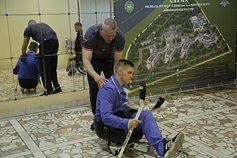
What Ustyuzhin calls a sanatorium is in fact the “Oka” training base of the Ministry of Sport, the first specialized center in Russia for training Paralympians. “Oka” has become a real center for transforming “SVO” participants into athletes: in the first three years of the war, 680 future athletes with severe injuries and amputations completed rehabilitation courses there.
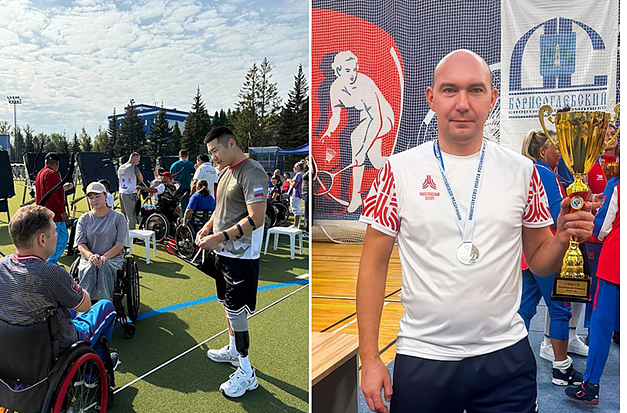
In Aleksin, the Paralympic Committee held master classes in sitting volleyball. Ustyuzhin, who had played amateur volleyball before the war, became interested in this Paralympic sport and began traveling to “Oka” for training camps. In 2024, the former paratrooper decided to train on a full-time basis. For this, he moved to the Moscow region and transferred to a local military commissariat.
Most “SVO” participants with injuries who have entered adaptive sport are men over thirty, Ustyuzhin says, and have been playing for at most two or three years, whereas other Paralympians have been in sport since their teenage years. Competing with such colleagues, he says, is difficult. Despite this, the para-volleyball player has ambitious plans: first to make the Russian national sitting volleyball team, then to compete at European and world championships, and finally to win a Paralympic medal.
For now, Ruslan trains until lunchtime and then goes to his service at the military commissariat. The workload, the para-athlete admits, is low — only to maintain fitness and participate in local competitions. As long as servicemen are not allowed to compete in prestigious tournaments, they have nothing to strive for, Ustyuzhin complains.
From a Hospital Bed to Sport
The path into Paralympic sport for people like Ruslan Ustyuzhin was opened by the main military-focused project of the Paralympic Committee, “We Are Together. Sport” — a nationwide series of events aimed at attracting “SVO” participants with disabilities to adaptive disciplines. It is within the framework of this project that Ustyuzhin and other participants in the war train at Ministry of Sport facilities. Anyone who fought against Ukraine and sustained a serious injury can join the project — regardless of athletic background.
The project “We Are Together. Sport” appeared in 2023. It grew out of competitions of the same name, which were first held a year earlier in Sochi under the banner of the “Summer Paralympic Games” amid Russia’s exclusion from the 2022 Winter Games in Beijing.
From its first year of existence, “We Are Together. Sport” has received funding from the federal budget. The project twice won large grants from the Presidential Grants Foundation: nearly 14 million rubles ($182,000) at its launch in 2023 and 12.5 million rubles ($162,500) in 2025.
The project is headed by Artem Toropchin. Toropchin is a native of Ukraine; he was born in 1987 in the city of Boryslav, Lviv region. In 2009, he joined the Paralympic Committee (he currently holds the position of first vice president), and in 2023 he became a member of the expert council of the state assistance fund for “SVO” participants, “Defenders of the Fatherland.”
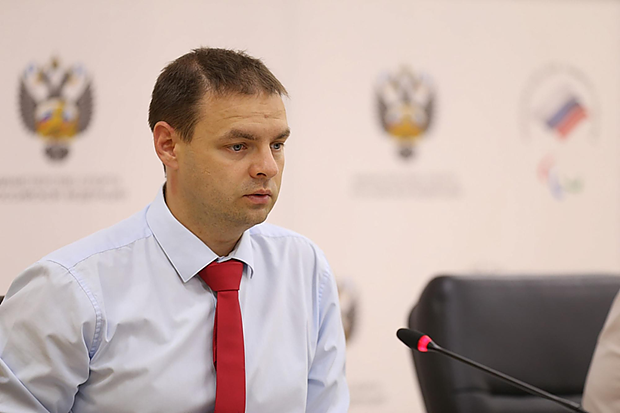
During the first year and a half of the grant-funded project “We Are Together. Sport,” from July 2023 through the end of 2024, 880 Russian fighters with disabilities took part in master classes in Paralympic sports. Three of them joined the national team in adaptive sports — sitting volleyball player Ruslan Ustyuzhin, as well as Denis Ishbulatov, who represents shooting, and Vladislav Shinkar, who competes in wheelchair fencing.
The report on the implementation of the second grant is to be published in the second half of 2026. However, Pavel Rozhkov already predicts that in 2025 and 2026 his colleague Artem Toropchin will bring together for sports activities another approximately 800 “SVO” participants.
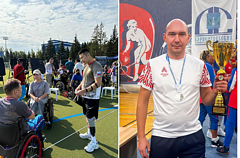
For many Russians wounded in the war, the first stage of selection into Paralympic sport takes place from a hospital bed. In hospitals and rehabilitation centers, the RPC holds motivational meetings, master classes with well-known coaches, and even competitions.
One of the first such meetings took place in May 2022 — less than three months after the start of the full-scale invasion. RPC President Pavel Rozhkov personally visited patients at the Vishnevsky Military Hospital in Krasnogorsk, near Moscow. Together with active Paralympians and coaches, he told former servicemen about their prospects in Paralympic sport.
Over time, such events began to be organized by the regional branches of the Committee and Paralympic sports federations: the geography of involving “SVO” participants in sport spread across the entire country, as well as to the occupied part of the Donetsk region.
Winners of the “hospital” championships receive not only symbolic awards — medals, certificates, and cups from the Ministry of Sport — but also the opportunity to train together with real Paralympians. The main prize is the chance to compete in local tournaments and, from there, make it to the Russian national team and represent the country, as veterans of the invasion are promised, on the international stage.
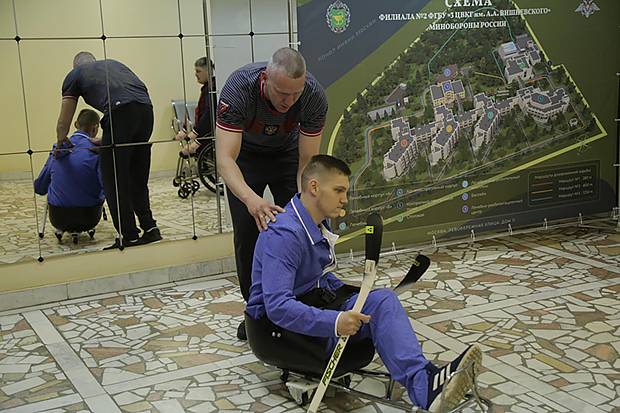
Those who did not meet representatives of the RPC in a medical facility can still count on a sports career. To participate in training camps with the Russian Paralympic Team, an “SVO” participant only needs to fill out an application form or contact local branches of the “Defenders of the Fatherland” foundation or Paralympic sports federations.
Veterans of the invasion of Ukraine are also supported through special conditions. For example, the All-Russian Federation of Sports for Persons with Musculoskeletal Disorders allocated additional spots for “SVO” veterans in sled hockey teams participating in the national championship.
Bronze in Three Months
Former “SVO” participant, 29-year-old Tsyden Geninov from the Buryat village of Urda-Aga with a population of fewer than 800 people, hopes to qualify for the 2028 Summer Games in Los Angeles. In 2020, he entered compulsory military service but immediately signed a two-year contract with the Defense Ministry — because of the decent salary and the prestige of the military profession, Geninov says.
His contract was nearly over when Russia attacked Ukraine. The private infantryman served for three months and took part in assaults but, according to him, does not remember where exactly.
However, the Ukrainian public broadcaster “Suspilne” found that Geninov served in the 5th Separate Guards Tank Tatsinskaya Red Banner Order of Suvorov Brigade. This brigade took part in the offensive on the Kyiv region at the beginning of the war. In 2023, Ukrainian police accused three Buryat servicemen from this unit of shooting 26 civilians.
During one of the assaults in May, Tsyden lost his right leg below the knee. Six months later, he returned home from the hospital. At the end of 2023, the soldier contacted a branch of the “Defenders of the Fatherland” foundation in Ulan-Ude. He was referred to the Republican Sports and Adaptive School to Honored Coach of Russia Tsydenbal Tsyrenzhapov. Thus, the assault soldier began training.
Just two or three months later, at the end of February 2024, Geninov traveled to Bangladesh for the World Championship of the International Military Sports Council (CISM) in archery. It is the only sports organization in the world that refused to support the sanctions recommended by the International Olympic Committee (IOC) against Russia. Moreover, in 2024, Russian Paralympians participated in CISM competitions for the first time.
Geninov brought back bronze from Bangladesh. He acknowledges that the credit belongs to his partner in the mixed “para-mixed” format, Warrant Officer Artem Makhnenko, who competes for CSKA (the Central Sports Club of the Army, a subdivision of the Russian Defense Ministry). “I was shooting sixes and fives, and Artem was putting in tens, tens,” Tsyden said.
After a year and a half of training, Geninov won gold in the individual event at the World Military Archery Championship in Tehran. Like the tournament in Bangladesh, this event is significant only within the military community, but outside of it lacks prestige.
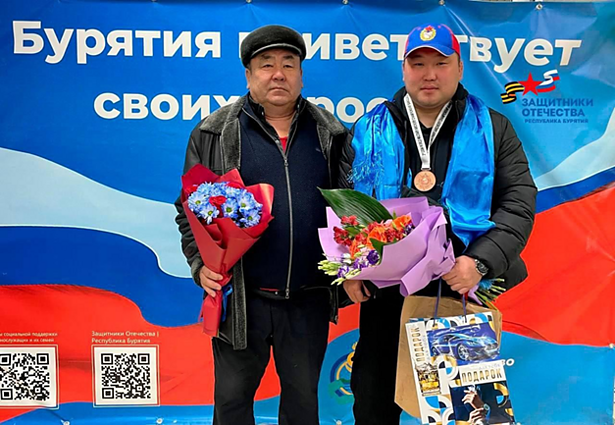
Medals won at world championships among servicemen are not taken into account in selection for the Paralympic national team, since these competitions are not part of the International Paralympic Committee (IPC) system and do not provide ranking points for qualification.
Recently, Geninov’s coach has increased his workload. “I train not like a beginner, not like a combat veteran, but already more or less like a professional athlete,” the archer says. “I train with the mindset of competing for a place on the Russian national team.”
Geninov is currently preparing for the national Para Archery Cup. It will take place in March and will serve as a qualifying round for the spring Para-Archery European Championships in Rome, which Geninov hopes to attend.
“In the future, of course, I want to compete at the European Championship, at the World Championship, to qualify for the Paralympics. That’s my big goal — to take part in the Paralympics,” the serviceman says.
Geninov claims that he did not kill anyone during the war. He does not consider himself a war criminal because of his participation in the invasion and is not afraid that he could be arrested in Europe. He is convinced that “there are athletes there, not politicians.”
A Mercenary, a Separatist, and a Military Volunteer
Thanks to the efforts of the Russian Paralympic Committee, not only career servicemen are accepted into national teams. The key criterion is the very fact of participation in the invasion. Anyone can pass the selection, regardless of status or role in the war. For example, mercenaries of the Wagner PMC and members of armed groups in the occupied territories.
Thus, 49-year-old Donetsk native Vladislav Shinkar is a member of the Russian national wheelchair fencing team. In 2014, Shinkar supported the formation of the so-called Donetsk People’s Republic, became a volunteer, and took the position of deputy commander of the illegal armed formation of Donbas separatists “Vostok.” He served alongside the radical pro-Z war correspondent Vladlen Tatarsky, who had escaped from prison and joined the separatists, and speaks of him in complimentary terms.
Vladislav lost both legs in the spring of 2015 while participating in the seizure of Donetsk International Airport. On the RPC’s page on the social network VKontakte, it is claimed that even on prosthetics Shinkar continued to fight on the front line until 2017.
Shinkar was invited into wheelchair fencing at the Center for Adaptive Physical Culture and Sports of the “DPR.” Just two months later, in January 2018, the separatist took part in the Russian Open Cup in fencing among athletes with musculoskeletal disorders, held in Ufa under the auspices of the RPC. However, he did not win any awards.
The Defense Ministry claims that already without legs, on prosthetics, Shinkar participated in the full-scale invasion and spent the entire year of 2022 at the front. And by March 2023, he was edia as a member of the Russian national wheelchair fencing team.
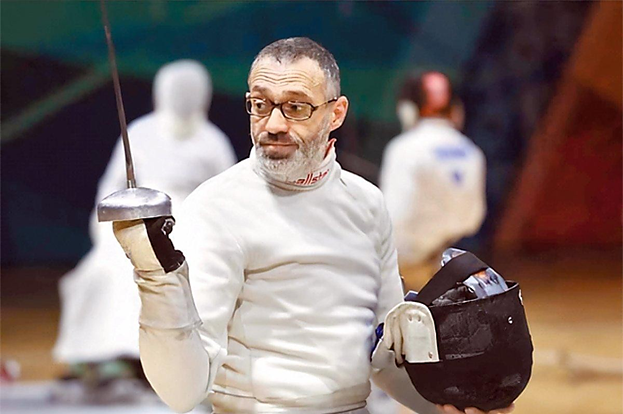
Another Russian Paralympic national team, in powerlifting, includes Dmitry Borisov — a career serviceman, former commander of a motorized rifle company that took part in the full-scale invasion of Ukraine from the first days. During a combat mission in May 2022 near the village of Veseloye in the Kharkiv region, the commander stepped on a mine and lost both legs above the knees.
After his injury, Borisov succeeded in sport. Dmitry admits that before the war he had never even tried playing hockey. Now he has become the captain of the St. Petersburg sled hockey team “Zvezda,” composed exclusively of “SVO” participants. In addition, he joined the Paralympic national team in powerlifting.
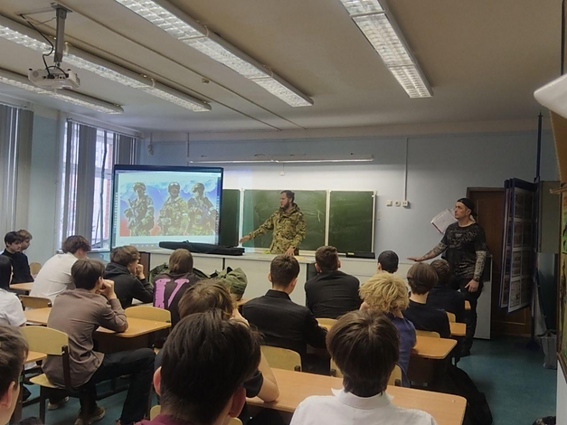
The former motorized rifleman also transports humanitarian aid to Donbas and conducts so-called “lessons of courage” in schools, where he tells children about the “reasons for the start of the special operation.” In 2026, Borisov plans to enter politics — to run for deputy of the State Duma in the upcoming elections.
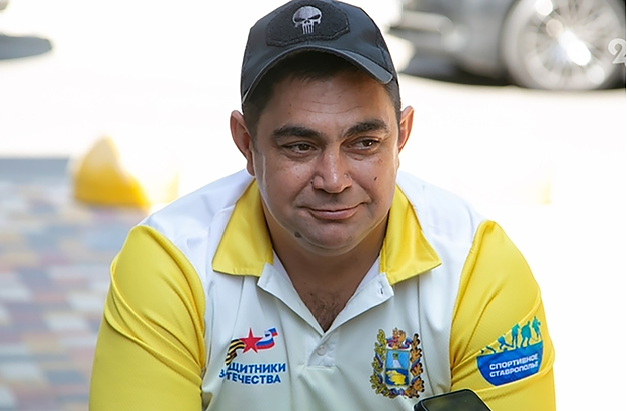
While some fighters aim for world championships, others are content with victories in para-competitions created specifically for “SVO participants” (we will discuss this category of tournaments in the next chapter). Among them is professional mercenary Ruslan Otarov, who in 2024 already became a prizewinner of the regional Defenders of the Fatherland Cup. According to the official version, he went to war in 2022 as a volunteer as part of the Wagner PMC.
According to leaked data, in 2017 and 2020 Otarov traveled to Syria, where Wagner fighters fought on the side of then-President Bashar al-Assad. The “Myrotvorets” database contains unverified information that 41-year-old Otarov is an agent or freelance employee of the Main Directorate of the General Staff of Russia.
A Bet on Para-Sport
Not only the Paralympic Committee is directly involved in engaging “SVO” participants in adaptive sport. Additional funds for these purposes come from state and public foundations, regional budgets, and even allocations from bookmakers.
The RPC’s main partner is the state foundation “Defenders of the Fatherland.” Vladimir Putin created it in April 2023 — exclusively to support participants in the invasion of Ukraine and their
families. The organization is headed by Putin’s second cousin Anna Tsivileva, who is also State Secretary — Deputy Minister of Defense. The organization receives billions of rubles from the federal budget and state programs for the rehabilitation of war invalids. Exactly how much is spent on para-athletes is not disclosed.
However, it is known that since its opening, the foundation together with the RPC has been developing sports rehabilitation programs for “SVO” veterans. In 2023–2024, the foundation spent 1.7 billion rubles (more than $20 mln) on military amputees. On the foundation’s basis, regional demonstration centers of adaptive sports oriented toward war invalids are also being opened.
In 2023, the “Defenders of the Fatherland” foundation, the RPC, and the Ministry of Sport organized the first and main competition among “SVO” veterans — the Defenders of the Fatherland Cup. The tournaments are held several times a year in different parts of the country: from Nalchik to Sochi. Hundreds of “SVO” participants take part in them, including from the occupied territories of the Donetsk and Luhansk regions.
The regions also invest in holding the Cup. On the state procurement website, tenders for organizing the competitions regularly appear, with regional agencies acting as contracting authorities. Thus, more than 60 million rubles ($800 000) were spent on the tournament in Khanty-Mansiysk held in February 2025.
Another partner of the RPC is the public movement “Healthy Fatherland.” Before the war, the organization promoted sports. After the start of the invasion, servicemen with severe injuries who want to develop within the Paralympic movement were added to the project’s target audience. Thus, in 2024, “Healthy Fatherland” allocated 1 billion rubles (more than $12 mln) for the rehabilitation and social adaptation of “SVO” participants with combat injuries. The Paralympic Committee took responsibility for organizing events with these funds.

The Foundation for Assistance to Combat Veterans “Memory of Generations” also participates in the rehabilitation of “SVO” participants. In addition to its core work of providing medical assistance to veterans of the Great Patriotic War and other wars, after 2022 the foundation began actively cooperating with the RPC, organizing master classes for veterans with disabilities and helping them with social adaptation through sport.
Since the start of the war, “Memory of Generations” has twice received targeted grants from the president to assist Russian servicemen who became disabled and servicemen from the so-called “LPR/DPR,” totaling more than 50 million rubles ($644 000). Another, the largest grant of 72 million rubles ($927 000), was awarded to the foundation at the beginning of 2025 to assist participants in the “special operation” and civilians affected during hostilities.
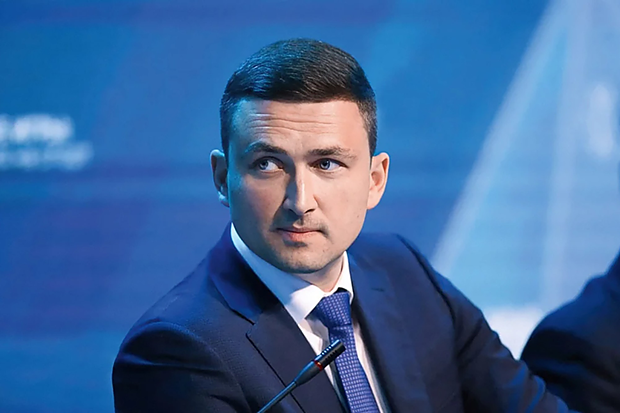
Another portion of the RPC’s funding comes from the Unified Gambling Regulator (ERAІ). This public-law company was established by order of the Kremlin in 2021 to exercise state control over the betting market. The regulator receives mandatory contributions from bookmakers and is required to direct part of them to sports, including Paralympic sports. Over four years, the amount of support for Paralympians exceeded 3 billion rubles (more than $38 mln), said ERAI CEO Alexei Grachev. It is unknown what percentage went to “SVO” veterans; however, RPC President Rozhkov emphasizes that it is precisely this money that allows the committee to implement large-scale projects to involve veterans in sport. Thus, in 2024, ERAI financed the purchase of equipment and gear for “SVO” participants taking part in the “We Are Together. Sport” program.
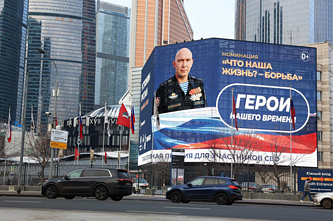
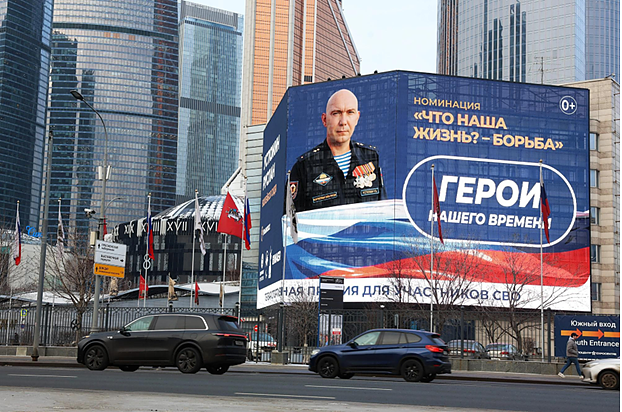
Funding is not limited to organizing competitions. Prizewinners receive cash awards. For example, sitting volleyball player and “SVO” participant Ruslan Ustyuzhin received 300,000 rubles ($3800) after becoming a laureate in the nomination “What Is Our Life? – Struggle.”
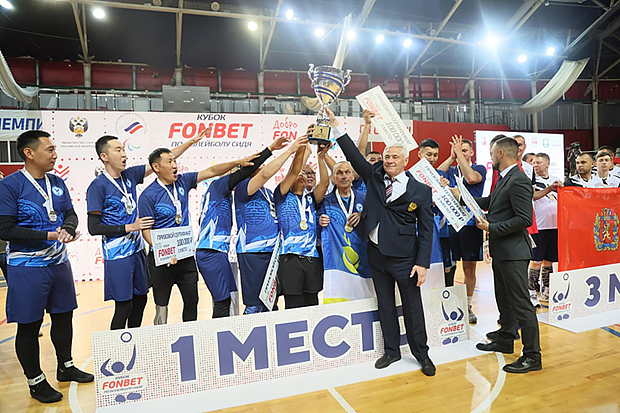
Bookmakers also invest in “SVO” participants directly. In the fall of 2024, Russia’s largest betting company, Fonbet, signed a cooperation agreement with the RPC. The goal remains the same — increasing the number of servicemen in the Paralympic movement. The bookmaker sponsored the Defenders of the Fatherland Cup and the “Heroes of Our Time” tournaments, as well as its own competitions for veterans — the Fonbet Cup in sitting volleyball and the Russian championships “League of Heroes.” Finally, the betting operator invests in the opening of inclusive sports platforms.
Not all para-athletes are pleased with the active involvement of servicemen in Paralympic sport. On condition of anonymity, an athlete from the reserve roster of the Russian national para-snowboarding team shared his opinion with Vot Tak:
QUOTE “As for singling them out in any Paralympic sport — they should not be a separate caste, and it doesn’t matter how a person acquired health limitations. If the state wants disabled SVO veterans to engage in sport, let it develop sport as a whole, rather than creating separate training sessions and competitions.”
Elimination Game
The International Paralympic Committee does not prohibit former servicemen from participating in competitions if they meet disability classification and qualification requirements. Thus, the Ukrainian national team, which competes under its own flag and anthem, includes former servicemen of the Armed Forces of Ukraine.
In March 2022, the International Paralympic Committee suspended the Russian team from the Beijing Games under the threat of a mass boycott by athletes and national committees of other countries. In November, the IPC decided to suspend all membership rights of the Russian Paralympic Committee, accusing the committee of violating the “Olympic Truce” and stating its inability to fulfill membership obligations in accordance with the IPC Constitution, including obligations of neutrality and political impartiality.
For the 2024 Summer Paralympics in Paris, Russian athletes were nevertheless allowed to compete, but under neutral status. The organizers of the competitions separately set out strict conditions for the participation of Russian athletes and support personnel.
Under these conditions, it was impossible for participants in the invasion to qualify for the Paralympics. The IPC and international federations closely examined athletes’ biographies and did not allow Russians connected with the military or any other security structures to compete.
Those who had spoken positively about the invasion on social media and in interviews, or who had displayed the Z symbol, were also unable to qualify. All of this was regarded as “acts of support for the war against Ukraine.”
How the biographies of Russian para-athletes admitted to the Paralympics in Milan were checked has not been publicly disclosed by the organizers of the Games. At the beginning of February, Vot Tak sent an official request to the IPC press service asking for clarification of its position regarding the admission of para-athletes who supported aggression against Ukraine; however, at the time of publication, the editorial office had not received a response.
Problems for Russian athletes began long before the invasion of Ukraine. In 2016, due to a doping scandal, they were completely barred from participating in the Olympic and Paralympic Games in Rio de Janeiro. In 2018, at the last moment, the IPC allowed individual Russian athletes to compete at the Winter Paralympics in PyeongChang, South Korea, under neutral status, if they could prove their non-involvement in doping.
This year, for the first time since 2014, Russians are participating in the Paralympic Games under their own flag, with their anthem and other national attributes. On February 17, the RPC announced the names of six athletes selected by the International Ski and Snowboard Federation from 16 candidates proposed by Russia. From March 6 to 15 in Milan and Cortina d’Ampezzo, they will compete in only three sports: cross-country skiing, para-snowboarding, and alpine skiing.
Already the next day, the admission of Russian Paralympians triggered a negative reaction from Ukraine and some European countries. Ukrainian officials refused to take part in the opening ceremony and other official events of the Games.
“The decision of the Paralympic organizers to allow killers and their accomplices to the Paralympic Games under state flags is disappointing and infuriating… When the Russian flag is raised on the international stage, it becomes part of Russian propaganda. It sends a signal to
the world as if war is normal,” Ukraine’s Minister of Youth and Sports Matvii Bidnyi wrote on his Facebook page.
Ukraine’s position was supported by the Baltic states and Finland. In joint statements, representatives of these countries emphasized that they are not ready to be present alongside delegations of aggressor states as long as the war in Ukraine continues. The Czech Republic, Poland, the Netherlands, and Canada hold the same position. The IPC’s decision also drew disagreement from the government of the host country, Italy. However, the International Paralympic Committee stated that it would not revoke the admission of Russian athletes despite the boycotts.
The Russian authorities are concealing data on the number of Russians who have become disabled in the war with Ukraine. However, the growing number of limb prostheses issued each year makes it clear that by 2026 the count will be in the hundreds of thousands.
While some Russians injured at the front complain about meager pensions, the low quality of prostheses, and difficulties in obtaining disability status, others are becoming the country’s para-sport elite. As long as the war continues, the Russian Paralympic Committee will not face a shortage of potential athletes. According to government forecasts, around 60,000–70,000 new amputees will appear in Russia each year.
In 2026, participants in the invasion of Ukraine were unable to reach the Paralympic Games. However, each year the Russian Paralympic Committee expands its programs to involve veterans in para-sport and increases spending on their training.
If this trend continues, former participants in the invasion of Ukraine may become the main group of candidates to represent Russia at the next Paralympic Games.