
















Lithuania was home to 428 centenarians at the start of the year, including 368 women and 60 men, according to data from the Centre of Registers.
“The difference is truly impressive,” said Miglė Tomkuvienė, a researcher at the Vilnius University Life Sciences Centre, referring to the large gap between male and female centenarians.
Tomkuvienė said several factors help explain why women tend to live significantly longer than men. One is the female hormone estrogen, which she said helps protect against cardiovascular disease. According to the Institute of Hygiene, 50.8% of all deaths in Lithuania in 2024 were linked to diseases of the circulatory system.

She added that women are also more likely to take care of their health and less likely to engage in harmful habits.
“There is also the so-called grandmother hypothesis in evolutionary theory, which suggests that women live longer so they can help care not only for their children but also for their grandchildren,” Tomkuvienė said.
What determines longevity?
Scientific research suggests that only about 20% of longevity is determined by genetics, although estimates vary and may be as high as 50%, Tomkuvienė said. The key message, she added, is that lifestyle and life circumstances play a major role.
“Longevity is not only about genes,” she said. “In families, long life may be influenced not only by inherited genes but also by a learned way of life.”
She cited physical activity, diet, sleep and good psychological health as cornerstones of healthy living. Environmental factors such as air quality, as well as unpredictable events including injuries and infectious diseases that leave lasting effects, also contribute – along with what she described as a measure of simple luck.
Is there a ‘centenarian gene’?
Earlier this month, Lithuania’s oldest resident, Leonora, celebrated her 110th birthday. Her parents also lived long lives, she recalled.
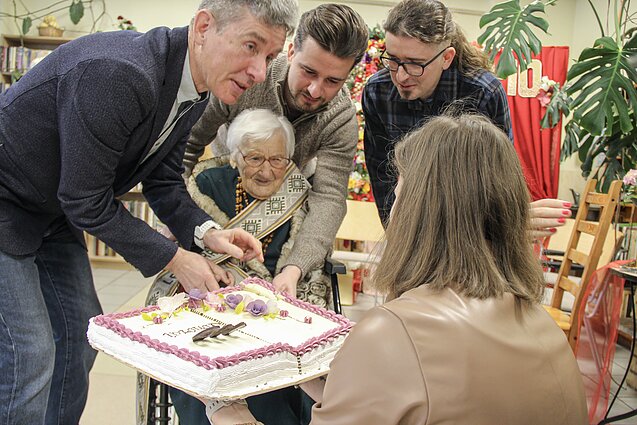
Tomkuvienė said having long-lived parents can indeed increase the likelihood of living longer.
“If your parents were long-lived, you can expect to live a long life yourself, provided you do not undermine that genetical potential with an unhealthy lifestyle,” she said.
Researchers have identified certain genes associated with longevity, including those involved in DNA repair. People with more effective DNA repair mechanisms accumulate fewer genetic errors over time as their cells divide, allowing cells, and the body as a whole, to function properly for longer, she said.
Still, she emphasised that such genes account for only a small part of overall longevity.

Could people live to 150?
Some scientists have suggested that humans may one day live to 150. While Tomkuvienė is sceptical, she noted that average life expectancy has doubled over the past century.
“In the past, people lived on average around 40 years, and now average life expectancy is about 80 years. Looking optimistically to the future, we might again hope to double that,” she said.
However, she cautioned that the maximum verified human lifespan currently stands at about 120 years, and whether 150 years is achievable will only become clear if it happens.
Tomkuvienė said advances in medicine, particularly in personalised medicine, offer hope. Treatments are increasingly tailored to patients’ genetic predispositions, and preventive health checks are becoming more common.
“From genetic data, it is possible to learn in advance which diseases a person may be prone to and to actively try to prevent them through regular screening,” she said.
She added that scientists are also developing specialised technologies aimed at slowing aging processes, raising hopes that healthy life expectancy – the number of years lived without serious chronic illness or disability – could increase in the future. In Lithuania, healthy life expectancy currently exceeds 60 years.

Newsletter
Every Friday morning.