












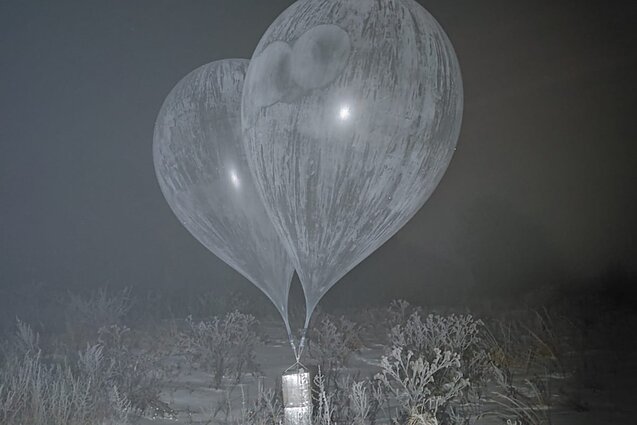
Defence technology startup Luna Robotics has developed a camera system that helps drone operators detect and intercept smuggling balloons at night, using its own funds after being unable to qualify for a government-backed innovation contest.
The camera allows drones to spot balloons flying in the dark and provides operators with visual guidance – similar to navigation cues – directing them straight to the target. The technology addresses a problem that the Lithuanian government, military and public have discussed for months as smuggling balloons increasingly disrupt the country’s airspace.
Making night operations as effective as daytime
Luna Robotics has been refining its camera to make nighttime drone operations as effective as those conducted during the day. In test footage, the camera successfully detects balloons flying at night and helps drone pilots reach them.
“We are trying to create something simple – effective but not costing tens or hundreds of thousands of euros, and not a complex system,” said Luna Robotics co-founder Elvinas Kukys. “We wanted to avoid solutions that would require the military to buy new radars or spend years integrating them.”
Kukys said the Lithuanian military already has operational radar systems and first-person-view drones, prompting the startup to focus on developing a camera and supporting equipment that could be integrated quickly.

Luna Robotics has already tested the technology together with the Lithuanian military and plans to continue improving it. While the current focus is on smuggling balloons, the camera could also be used against other airborne targets.
The camera is developed and assembled in Lithuania. The startup launched the project using its own resources after a surge in airspace violations by smuggling balloons.
“The military liked it, they are interested, and we are continuing to work together,” Kukys said. “It’s a very good collaboration, developing the product jointly.”
Government funding and competing solutions
The altitude at which the balloons fly, the ability to detect them and the risks associated with where they might fall have been cited by the government and military as key challenges.
Edvinas Kerza, managing partner of defence innovation organisation Scalewolf, said teams of specialists are actively developing advanced solutions to counter aerial threats.
“We have more than 20 talented teams looking for new solutions every day,” Kerza said. “Several of them are working on identifying and neutralising drones, Shahed-type systems and other unmanned aerial vehicles. Some of the progress is very strong, and tests already show that integration with the military’s existing capabilities is possible even in harsh conditions.”
The Ministry of Economy launched the €1 million competition several months ago, inviting technology companies to propose solutions that could be developed quickly to counter smuggling balloons. Thirty-five companies applied, and three were selected: IT Logika, Teltonika EMS, and Dangaus Šviesos. Each formed consortia with other technology firms.
Economy Minister Edvinas Grikšas has said the state will ultimately choose one of the three solutions for procurement.
Kerza said the competition itself is beneficial regardless of the outcome.
“The ministry’s initiative is very positive because it encourages more people to engage with defence challenges and look for solutions,” he said. “Today it’s balloons, tomorrow it could be Shahed drones, and later helicopters or other unmanned equipment. The more people understand defence needs and innovation, the faster we’ll be able to respond to future challenges.”
The ministry is expected to announce this month how effective the €1 million investment has been. Luna Robotics did not participate in the contest because it did not meet eligibility requirements, as the startup is considered too small and too new.

Newsletter
Every Friday morning.