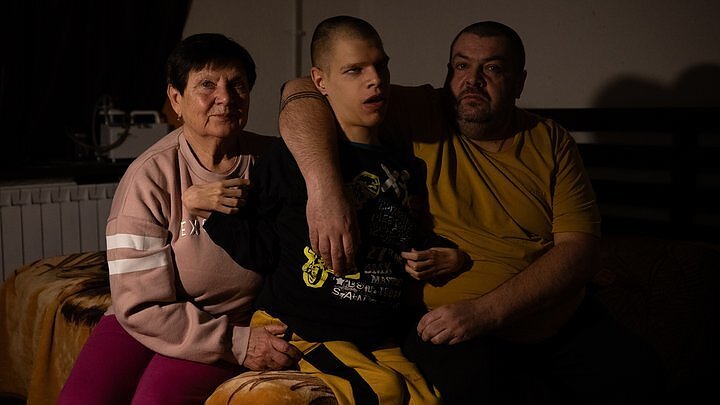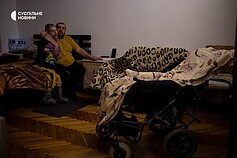








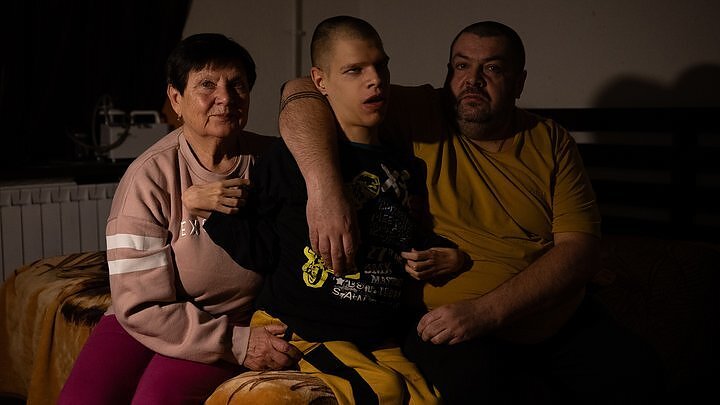
Bohdan is half-reclining in his wheelchair, smiling broadly beneath the glow of an LED garland powered by a power bank. He wears woollen socks and a matching vest under his sweatshirt. He does not speak, only making long, sustained sounds. He barely moves, cannot sit up without assistance, and no one knows whether he even understands what a blackout is.
But his grandmother Nina and his father Taras do. Without electricity, Nina cannot blend food for her grandson; without it, he cannot eat. Without power, Taras cannot switch on the special saliva-suction device his son depends on. Bohdan cannot swallow on his own, and without the machine he risks suffocating.
Without heating, Nina keeps Bohdan warm using heating pads and hot-water bottles. Her 26-year-old grandson weighs just under 40kg, has poor circulation and becomes cold very quickly.
The January frosts and Russia’s strikes on energy infrastructure have transformed daily life for many residents of the Ukrainian capital, both those who were able to prepare for a harsh winter and those who were not. However, it seems that it is not the present that scares people. It is the fact that things could get even worse.
Suspilne reports on how Kyiv is coping without electricity and heating, amid nightly shelling and sub-zero temperatures.
‘No strength left’
On the night of January 8-9, most Kyiv residents lost power, many more lost heating, and some were left without water. Over the following days, utilities were gradually restored, for some households for a few hours at a time, for others permanently. But Russian drone and missile attacks continued.
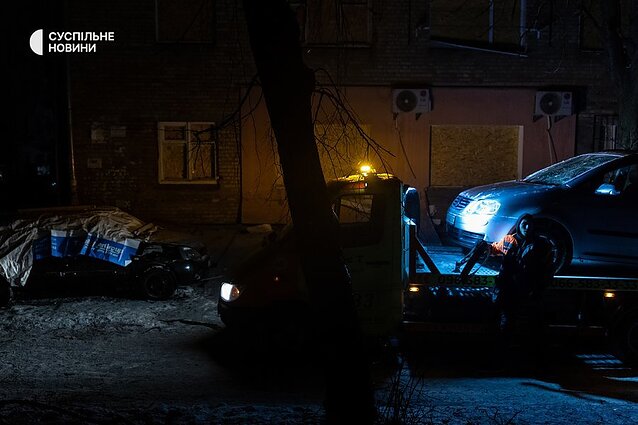
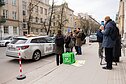
On the night of January 12, the blast wave from a Russian drone brought down the windows of a five-storey building in Kyiv’s Solomianskyi district. Shards of glass crunch underfoot near the entrance, mixed with snow and ice.
Although it is evening and darkness fell hours ago, residents are still boarding up shattered windows with plywood. Outside, temperatures have dropped to minus 15 Celsius.
The plywood was delivered quickly by the utility company. Workers cut the boards to size and residents nailed them into the empty window frames.
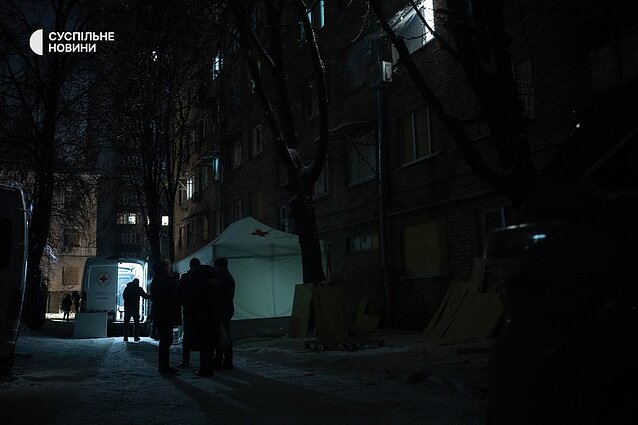
More than 30 years ago, the building was a dormitory. Later, residents privatised their rooms. As a result, there is still a shared kitchen, and a gas supply, though that too is currently unavailable. A month after old pipes were replaced, the management company has yet to reconnect the gas.
Electricity is sporadic. Over the past 24 hours, residents had power for just three hours. Heating has not yet been restored.
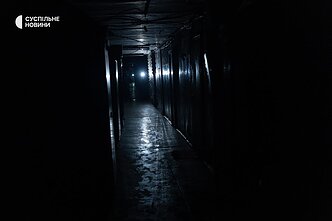
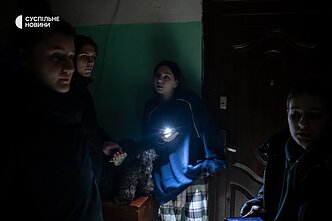
Nastia and her older brother Dima stand outside their flat with neighbours. The long communal corridor is lit only by phone torches.
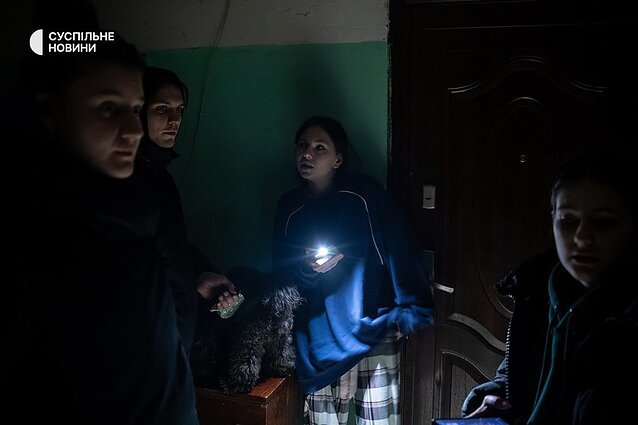
Their father, Serhii, stands on the stairwell landing in a winter jacket, smoking by a window covered with plywood. His family was lucky – their windows remained intact. Still, he and other residents helped clear glass and debris from two in the morning onwards.
“Two of my cars were burned – mine and my son’s,” Serhii says. “Insurance doesn’t cover this. We’ll have to replace everything ourselves. At least the windows and doors survived.”
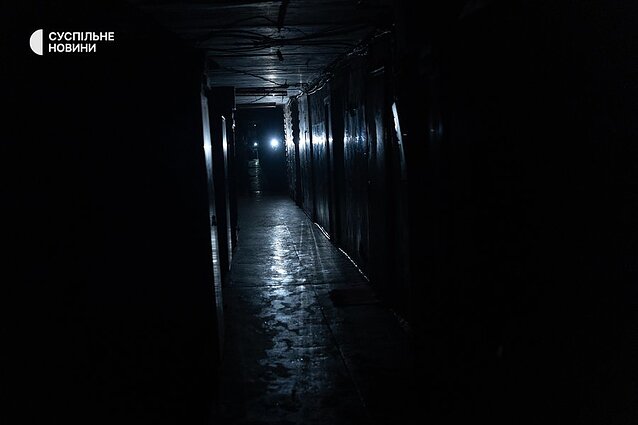
The stairwell is wet. At around eight that morning, old cast-iron radiators burst.
Serhii points his torch at a rusted hole in one of them.
“When we came back on Thursday, there was no heating at all. On Saturday, hot water, and with it – heating, was switched on. But a maintenance worker should have come to release the air so water could circulate properly. That didn’t happen. There was water in the radiators, but no circulation.”
He pauses.
“The house is brick. It stayed warm until today. But once the windows blew out and there was still water inside, the radiator burst immediately.”
Upstairs, Serhii’s neighbour Tetiana listens, smoking in a thick bathrobe layered over warm clothes.
“They came today, as if they were going to fix it,” she says.
“They said they were trying to turn the heating on,” Serhii replies. “But there was no pressure.”
“In other words, they didn’t want to go upstairs to let the air out.”
“The management company says they drained the water,” Tetiana says. “But how could they? It was still there.”
Serhii shakes his head.
“If the system had been working properly, the radiators wouldn’t have burst.”
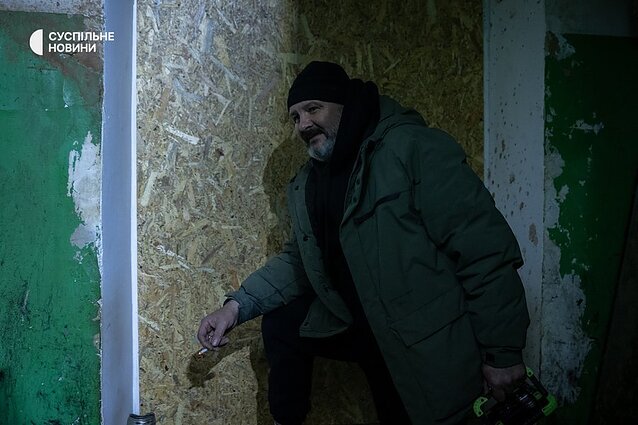
Serhii has lived in the building since 1993. All renovations – including new gas pipes – were paid for by residents themselves. He does not know when the radiators will be repaired, or by whom.
“What are we supposed to do without heating?” he asks angrily. “Pitch tents in the flat? We’re not going to live at the railway station. They say we should leave Kyiv? Let those who can, go. I’ve been awake since two in the morning. I’ve got no strength left.”
‘We are fighting for our lives against the cold’
In high-rise buildings that rely entirely on electricity, power cuts mean everything stops. Heating systems fail. Lifts stop working. Water, if it flows at all, rarely rises above the 12th floor because the pumps can no longer pull it. These buildings are not connected to gas.
Serhii and Nataliia live in one such building, on the 12th floor, elsewhere in Solomianskyi district. Serhii’s foot is partially paralysed and he cannot walk up the stairs. Over the summer, neighbours pooled money to install a backup power supply for the lift. But icy, uncleared pavements make going outside dangerous.
“My left foot is paralysed,” Serhii explains. “I didn’t feel pain, so my joints deteriorated. Then my right leg began failing too. At some point I realised that nothing was keeping me on my feet. I went through rehabilitation. I lost weight. Now I can walk – but I also developed another problem: I couldn’t stand upright.”
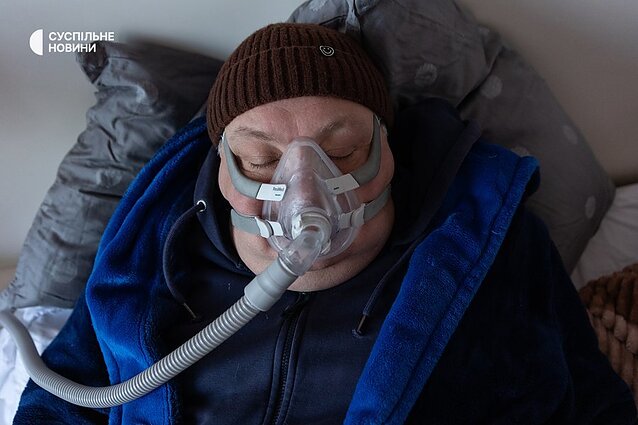
Serhii suffers from severe sleep apnoea. Natalia noticed he would stop breathing for up to two minutes at night. His brain was deprived of oxygen, and without breathing support, Serhii was at increased risk of stroke or heart attack.
The Svoi Charitable Foundation provided him with a CPAP machine. Now he has to breathe through a mask at night, but without electricity, the device does not work.
Thirty years ago, Natalia fled the war in Abkhazia with her young son Astamur. She remembers what it was like to live when people set up generators on their balconies, when there was nothing, no food in the stores. So, when the first blackouts began in 2022, she swore to herself that she would never live like that again.
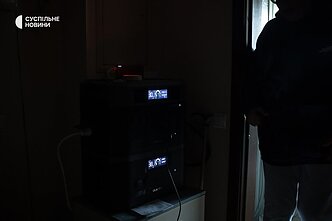
Therefore, in case of further power cuts, Serhii and Nataliia decided to make the apartment as autonomous as possible. At first, they bought a small charging station, but it wasn't sufficient enough to run the CPAP machine. So, the couple decided to buy and install a more powerful system that can power the apartment for up to 15 hours, or 9 hours if the CPAP is used overnight. Recently, they purchased an additional battery to feel safer in case of long outages.
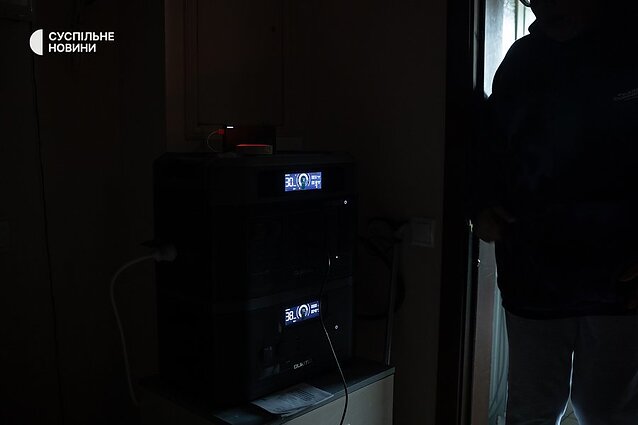
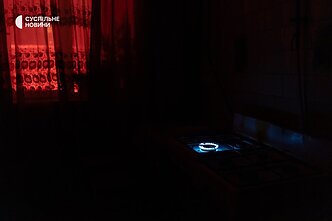
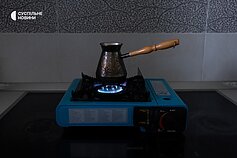
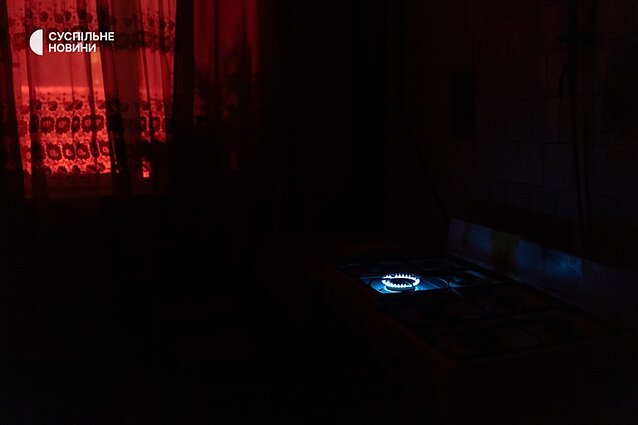
They also have a portable gas burner, stock food supplies, and a barrel of industrial water in the bathroom. The internet runs through a backup power supply. Unable to reach shelters quickly, Serhii sleeps on a folding mattress in the corridor. Fire extinguishers and gas masks stand ready in case of fire.
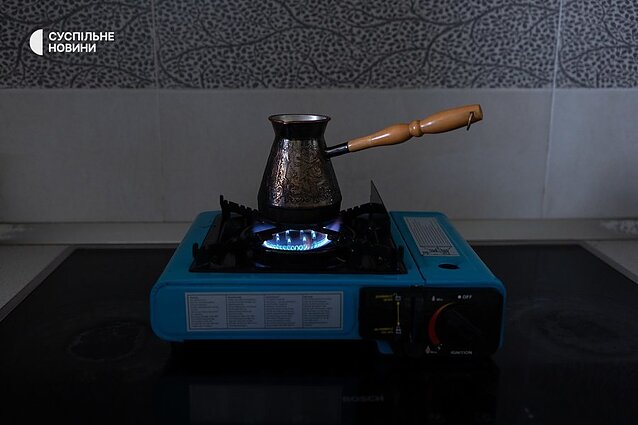
“That's why what's happening in Kyiv now is not yet an apocalypse,” says Natalia, recalling the war in Georgia. "You see, for me, this is the second war. My son Astik [Astamur's nickname] was born in Sukhumi in 1989. I used to cook baby formula for him on a stove in my apartment without water. I swore to myself that I would never find myself in such a situation again in my life.
Astamur volunteered for the war in Ukraine from the very beginning of the invasion and died in the summer of 2022. When we received the compensation for his death, we set up a peace fund in his name. Without it, we couldn’t have afforded this equipment. Perhaps this is how he is still supporting us.”
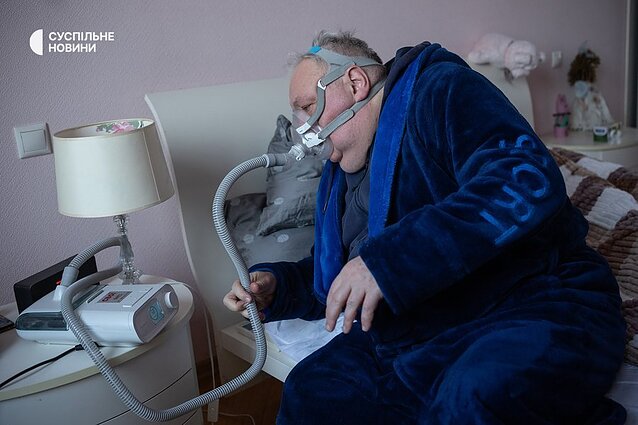
Serhii shows how he sleeps with the CPAP machine. He takes the mask and presses it tightly to his face to create pressure, pulls a hat over his head, wraps himself more snugly in his dressing gown and lies down on his back. The device sits on the bedside table next to a thermometer showing that the temperature in the flat is 13°C. Next to it is a bottle of distilled water, which needs to be poured into the device to humidify the air.
“We are fighting for our lives against the cold,” he says. “If it drops to minus 20, nothing will save us. Using electricity, we can heat one room for three hours a day. Then the temperature at home will not drop below zero. The only hope is for warmer weather.”
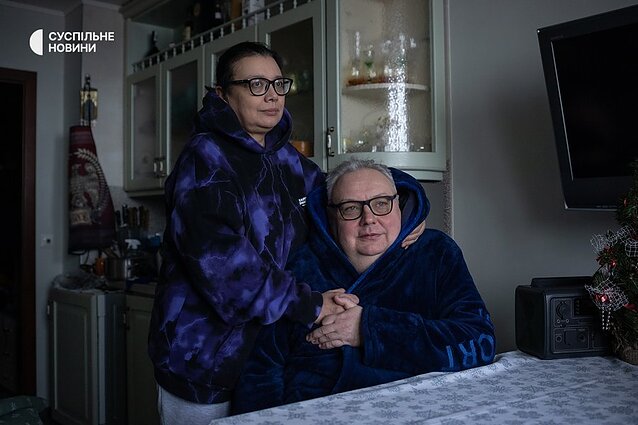
“Yes, we are preparing for things to get worse,” Natalia continues. “What irritates me most is that they said Kyiv residents had been given heating. But that’s simply not true. When I finally got through to the district hotline, I was told that the damage was being dealt with. Officially, everything is fine everywhere. Why say there are scheduled power cuts when in reality there are emergency outages? Why lie to people who can already feel what is happening themselves? It makes it impossible to plan ahead.”
For now, Natalia and Serhii live by a simple rule: when there is electricity, they charge their devices, cook food and heat water – even if the power comes back in the middle of the night. They still have to conserve the charge of their power station so that there is enough electricity for the CPAP machine. When asked whether they could leave Kyiv, Natalia’s gaze becomes glassy and her face hardens.
“To ensure uninterrupted power for everything Serhii needs for his health, we would either have to rent a very comfortable flat or transport all this equipment,” Natalia says. “What’s more, we have a cat – our son’s pet – whom we cannot leave anywhere. And, for example, in Lviv it’s simply unrealistic to rent accommodation with a cat. It's not like you can go away for a weekend and come back.”
“I also think this is not yet an apocalypse,” Serhii adds. “But we are a few seconds away from it. There is some kind of line, and one day – pop! – and we will be on the other side of it.”
A man who has never seen snow
On the evening of January 13, part of Kyiv’s Podil district was almost completely plunged into darkness. It sits on the right bank of the city, where the situation with power cuts is supposedly better than on the left bank – yet some buildings were left without electricity for more than a day. Later, heating also went off for several hours.
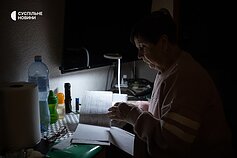
When the radiators went cold, Nina began studying instructions on how to properly warm a bedridden patient using hot water bottles. Nina is retired. For more than a year she has been helping her son, Taras, care for her grandson Bohdan. She moved in with them after Bohdan’s mother, Tetiana, died suddenly of a stroke.
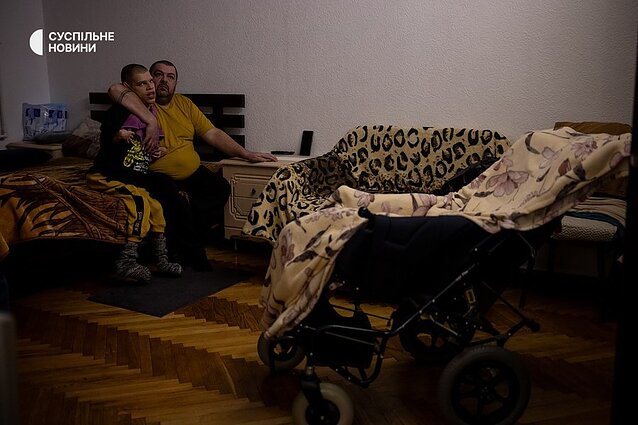
After his mother’s death, Bohdan made no sound for a long time. His grandmother and father do not know whether he understood what had happened to her.
He is a grown man with a severe form of cerebral palsy. Bohdan cannot eat on his own, does not speak and does not move. His arms seem glued to his body, and one leg is longer than the other. Of course, his father and grandmother already know what every movement and sound he makes means. Bohdan’s entire life depends on the people around him.
“We are still adapting,” Nina says. “We heat water on gas, but we can’t use the microwave. Bohdan’s food blender works on a battery for now – otherwise he doesn’t eat at all. We have a saliva suction device, but it runs on electricity. We need humidifiers too, and they also depend on electricity. In short, we survive like everyone else.”
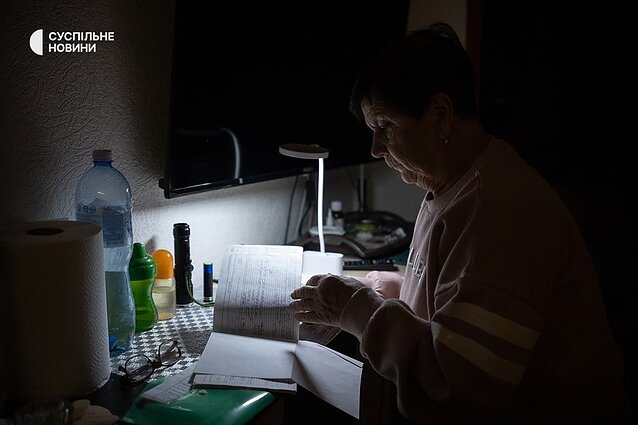
The building where Bohdan lives has centralised heating. So far, the longest period without heating has been about 15 hours. Bohdan is sensitive to the cold and freezes very quickly because of poor circulation.
While a healthy person can warm themselves by moving, Bohdan, who is bedridden, does not have that option. His aunt bought him an electric blanket that can be charged from a power bank.
Still, Bohdan’s palms remain cold. To keep him warm, the temperature in the flat needs to be stable and no lower than 17°C – which is what it is now. Before going to bed, Bohdan is bathed every day and his feet are soaked and steamed in hot water. As long as there is water, his grandmother says it is easier to cope. If there is no hot water, it will place an additional burden on the family, as Bohdan wears diapers around the clock and hygiene is essential.
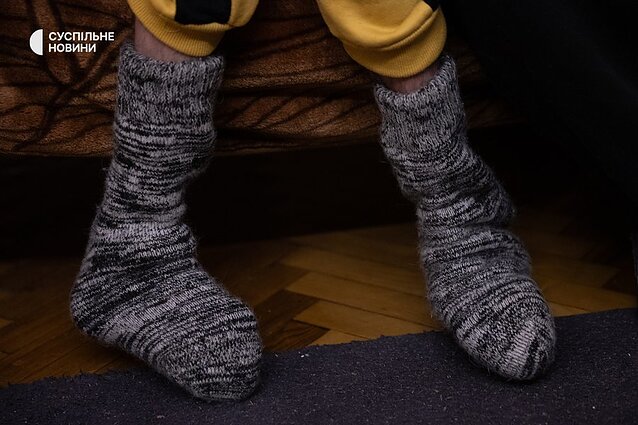
“That’s why heating is critical now. We cover him with two blankets and put hot water bottles beside him,” Nina explains. “At night we change the bottles when the water cools. If the situation with utilities gets worse, we don’t know what we’ll do. I’m hysterical, honestly. There are no other options. We have a house in the village, but the heating there is broken and it would take time and money to fix it. I wouldn’t go abroad. I can’t imagine myself without Bohdan now. Over the past year and a half he has gained weight. I used to lift him and feed him, but now I can’t – as soon as I lift him, a joint dislocates. We’ve adapted to life here so far. But starting everything over again would be very hard for us.”
Nina lists all the medicines Bohdan has to take every day – for blood pressure, for headaches, to maintain muscle tone, for epileptic seizures, and to help him sleep. Usually in the evenings, before bed, the family watches television together. If there is no electricity, they play with a torch in the dark.
Sometimes Nina reads poetry to Bohdan. If someone calls on the phone, Bohdan likes listening to the conversation and gets upset if people talk away from him. He also has a favourite toy – a glass cube with coloured lights, powered by a power bank. It looks like a disco.
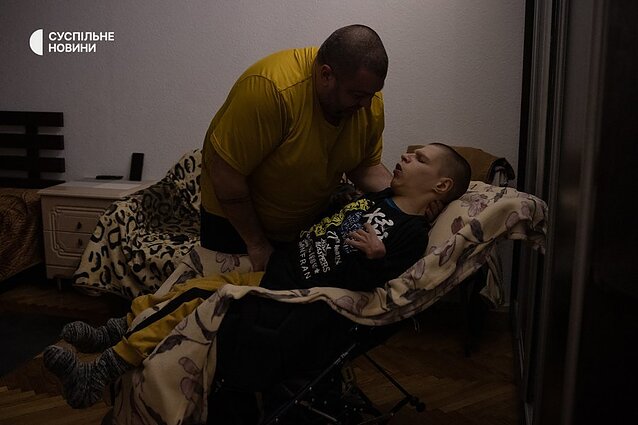
“Over the summer we tried to get a bit more settled,” said Bohdan’s father, Taras. “We now have six power banks in the house, but no charging station because it’s very expensive. We bought LED stick-on lights and rechargeable bulbs. It’s become a little better. We have a heater, but it runs on electricity. So God forbid there is no heating for a long time.”
“I just keep thinking about how we can survive and get through this,” Nina says. “Everything passes, and this will pass too.”
In his entire life, Bohdan has never seen snow, because they do not go for walks in winter. He loves going out, but he doesn’t understand that it is winter now. If he needs to go somewhere for rehabilitation or to hospital, his grandmother and father wrap him up so tightly that his face is barely visible from under the layers.
“Bohdaaan!” his father calls, and his son responds with a broad smile.
“You see, this is the kind of person he is,” his grandmother says warmly. “He never cries. Even when he is in pain, he smiles.”
Originally published on: January 15, 2026; 20:13 GMT+2

Newsletter
Every Friday morning.