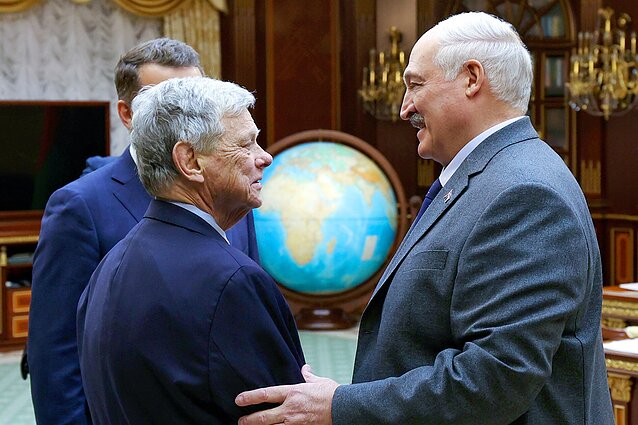












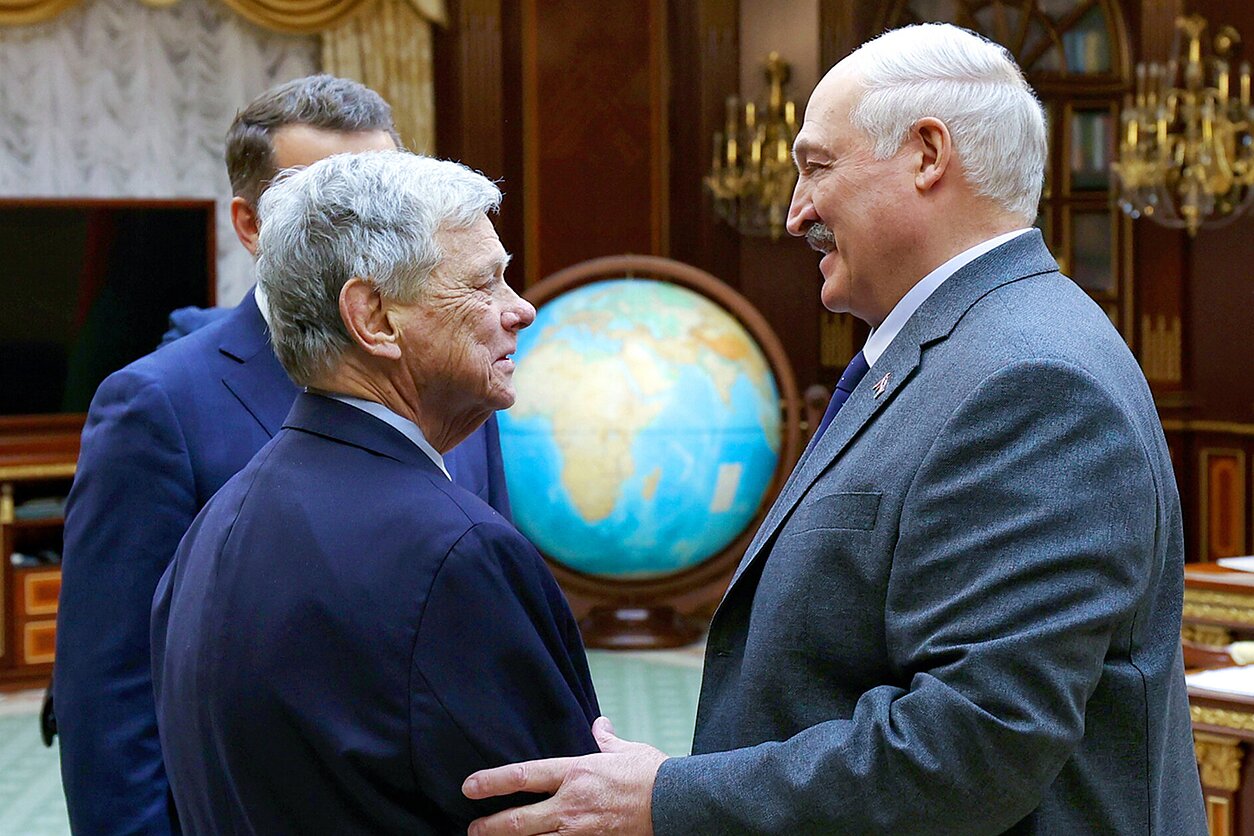
Belarus has released 123 political prisoners in exchange for a US decision to lift sanctions on Belarusian potash fertilisers, a move that analysts say reflects Washington’s economic interests more than a shift in Minsk’s authoritarian policies.
According to the Belarusian human rights group Viasna, 1,110 political prisoners remain behind bars in Belarus despite the releases ordered by the government of President Alexander Lukashenko.
Vytis Jurkonis, a lecturer at Vilnius University’s Institute of International Relations and Political Science, says the humanitarian element of freeing prisoners is being used largely as a facade. The real driver behind the US decision, he argues, is access to cheaper Belarusian potash.
US President Donald Trump has imposed a 10% tariff on Canadian energy resources, including potash fertilisers, and has recently threatened to raise those tariffs further. Lifting sanctions on Belarusian potash, analysts say, gives Washington greater leverage in trade disputes with Canada by opening an alternative supply.
Until February 1, 2022, Belarusian state-owned potash producer Belaruskali exported fertilisers through Lithuania and the port of Klaipėda. The company was a major source of revenue for Lukashenko’s government. After the United States imposed sanctions in late 2021, Lithuania’s government adopted a national decision to halt potash transit through Klaipėda. The European Union followed with its own sanctions on Belaruskali, which took effect on June 3, 2023.

Belarus and Belaruskali strongly opposed those measures. The Lithuanian government’s decision was challenged in Lithuanian courts, but Belaruskali lost. The company and the Klaipeda Bulk Cargo Terminal also appealed to the EU’s General Court, without success. Belaruskali later filed a claim against Lithuania in international investment arbitration, while a related company, Hasenberg, initiated a separate arbitration case.
Despite the US decision to lift sanctions on Belarusian potash, Lithuania’s national restrictions and EU sanctions remain in force.
Analysts see three possible scenarios.
Scenario one: Pressure from Washington
One possibility is that the United States could pressure Lithuania and the EU to lift or not renew sanctions on Belarusian potash.
Vilnius University professor Tomas Janeliūnas says it is not in Lithuania’s interest for Washington to show leniency toward Belarus or Russia, as it sends a signal that such regimes are rewarded for limited concessions.
“We can welcome the release of political prisoners, because every human life matters,” Janeliūnas says. “But if this becomes a transactional policy – releasing some prisoners in exchange for economic benefits – it ultimately strengthens an authoritarian regime.”
He says it remains unclear whether any US-Belarus understanding includes pressure on EU states or is limited to American decisions. In theory, Belarusian potash could be shipped to the United States via Russian ports under a bilateral arrangement, leaving EU sanctions intact.

“But Lukashenko almost certainly asked the Americans to intervene with Europe,” Janeliūnas insists, noting Minsk’s long-standing criticism of Lithuania for blocking the shortest export route through Klaipėda. “The question is whether Washington will directly pressure us – and through us, the entire EU – especially with sanctions renewal due in the spring.”
The United States, he adds, has significant leverage over Lithuania, including the presence of American troops deployed as part of NATO’s deterrence posture.
“If Americans were to apply maximum pressure, including raising the issue of troop presence, then this would no longer be a choice,” Janeliūnas says. “Between US troops and [sanctions on] fertilisers, Lithuania would choose troops.”
He argues, however, that the Trump administration lacks a long-term strategy toward Belarus and is instead focused on short-term, mercantile interests, with prisoner releases providing political cover. For Lukashenko, gradually releasing prisoners allows him to extract concessions from the West over time.

Domestically, pressure could also grow from Lithuanian political forces favouring pragmatic engagement with “authoritarian regimes”, Janeliūnas continues.
“This debate has existed since the days of [former presidents] Valdas Adamkus and Algirdas Brazauskas – trade versus values,” Janeliūnas says. “That dilemma has never been fully resolved.”
He says Lithuania’s current government would likely find arguments to accommodate US pressure, while a previous conservative-led government would have faced a far more damaging political fallout.
At the same time, Lithuania has succeeded in expanding the EU’s sanctions framework against Belarus. At Vilnius’ initiative, EU foreign ministers recently agreed to add new criteria covering “hybrid attacks”, disruptions to critical infrastructure and “information manipulation”, opening the door to additional targeted sanctions.
“That creates a certain dissonance,” Janeliūnas says. “It will not be easy to explain why Lithuania pushes for tougher sanctions on one hand and softens its stance on the other.”
Scenario two: Pressure from Minsk
A second scenario is that Washington refrains from pressuring Lithuania or the EU, while Belarus applies pressure directly.
Janeliūnas points to the launch of weather balloons toward Lithuanian airspace – a method used by cigarette smugglers to transport contraband, but viewed by Lithuanian authorities orchestrated deliberately by the Belarusian government to disrupt civil aviation near Vilnius airport — and the detention of Lithuanian trucking companies’ vehicles in Belarus as examples of such tactics.
US special envoy for Belarus John Cole has said Lukashenko promised to crack down on smugglers that launch the balloons, though Lithuanian officials remain sceptical.
“If pressure comes only from Belarus, I think Lithuania could withstand it,” Janeliūnas is confident, adding that even the current government could resist Minsk’s tactics.
Scenario three: Rerouting exports via Odesa
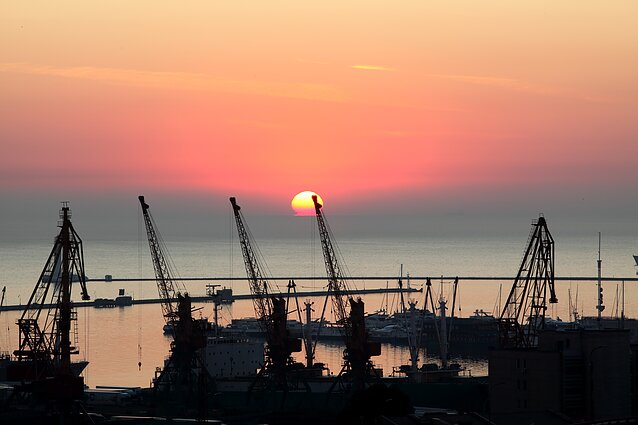
A third scenario involves rerouting Belarusian potash exports through Ukraine’s Black Sea port of Odesa.
Jurkonis says this option could align the interests of the United States, Belarus and Ukraine. For Kyiv, it could generate revenue and add a security dimension to Odesa if US interests were involved.

“Political prisoners are an important humanitarian element, but not the core issue,” Jurkonis says. “The lifting of sanctions alone solves nothing unless the fertilisers can actually be transported.”
He notes that some prisoner releases involved Ukrainian citizens and exchanges with Belarusian and Russian nationals, but said the larger question is the future of Odesa.
“If the United States declared a clear interest in buying potash and ensuring its safe transport through Odesa, this would be a different level of game,” he says. “It would also reduce pressure on Lithuania and Latvia.”
Jurkonis argues that Belarusian potash is significantly cheaper for US buyers and offers an alternative to Canadian supplies. “The release of political prisoners is the component that earns goodwill from neighbouring countries and the Belarusian opposition,” he says, “but it is not the main driver.”

Newsletter
Every Friday morning.