















Around two-thirds of employees at Lithuania’s public broadcaster, LRT, have expressed no confidence in the broadcaster’s Council and are calling for its resignation, citing threats to media independence.
An initiative group said it had collected 413 staff signatures by Tuesday midday, which were handed to LRT Council Chairman Mindaugas Jurkynas ahead of a scheduled council meeting.
More than 100 employees greeted Council members at LRT headquarters, standing in silence while holding placards reading Hands Off and Free Speech and wearing T-shirts displaying protest symbols.
“This is a possible option and it is not new,” Jurkynas told reporters, referring to calls for the Council’s resignation. “It can be a theoretical possibility. We will consider it. Today this issue is definitely not being discussed.”

Jurkynas invited two representatives of the protesting journalists to attend the council meeting and present their position.
In their statement of no confidence, LRT employees said the public broadcaster is facing an unprecedented crisis, arguing that amendments to the LRT law proposed by the ruling coalition are flawed and potentially incompatible with Constitutional Court doctrine and the European Media Freedom Act.
The statement cited concerns raised by the parliament’s Legal Department and warnings from European journalists, international organisations, and the European Commission about possible harm to media freedom in Lithuania. It also accused Jurkynas of supporting amendments that are being “bulldozed” through parliament, despite the council’s legal duty to protect LRT from political influence and safeguard editorial independence.
Employees said Council members have repeatedly filed complaints against journalists with LRT’s ethics watchdog over their reporting, opinions, and commentary on political processes.
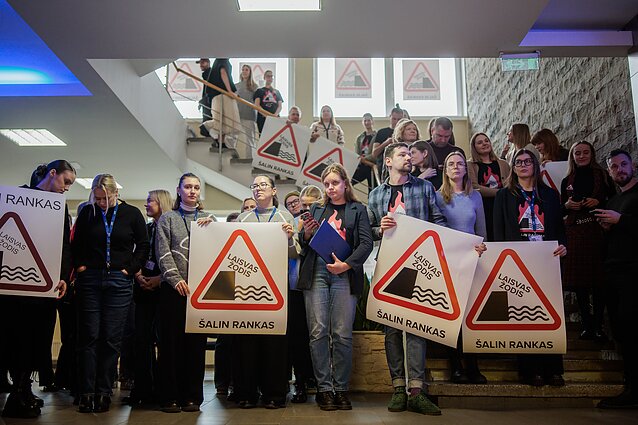
“We express no confidence in the LRT Council and demand that it resign in corpore,” the statement said. Under Lithuanian law, the resignation of all Council members would also require the director general and deputy director general to step down.
“This, we believe, once again proves that the protest by LRT employees is not related to specific individuals,” the statement added.
The dispute comes as amendments proposed by the ruling Social Democrats, the Farmers and Greens Union, and Nemunas Dawn cleared their first reading in parliament last week. The changes would allow the LRT director general to be dismissed by secret ballot if at least seven of the 12 Council members vote no confidence, citing improper performance of statutory duties or the rejection of the broadcaster’s annual activity report.
The ruling bloc is seeking to pass the amendments under a fast-track procedure this week. Both LRT and the Association of Professional Journalists say the proposed changes threaten the independence of the public broadcaster and media freedom.
More than 10,000 people rallied outside parliament last week over what organisers described as a threat to freedom of speech, and protests are expected to continue this week.
Under current law, the LRT director general can be dismissed only if the council cites public interest grounds for a no-confidence motion and at least eight of the 12 members vote in favour by open ballot.
Earlier, similar amendments drafted by Nemunas Dawn leader Remigijus Žemaitaitis cleared a first reading, but the Culture Committee was forced to seek an impact assessment, delaying adoption. The ruling coalition then registered separate draft amendments.

Newsletter
Every Friday morning.