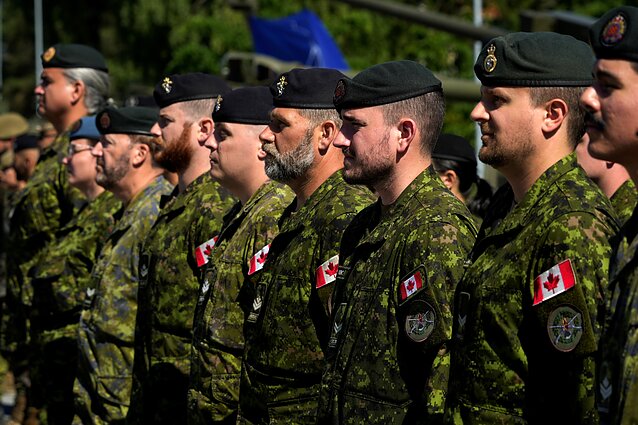
















Canadian troops leading NATO’s multinational brigade in Latvia say they are adapting to the drone lessons from Ukraine, while rising regional tensions in Eastern Europe give their Baltic mission a greater sense of purpose.
Captain Stephen Ye, commander of the defence and security platoon at the headquarters of the Labrie military base near Riga, is responsible for protecting the brigade headquarters. He says innovations in Russia’s war in Ukraine are continually reshaping his job.
“It has helped us understand that the battlefield we operate in is now almost completely transparent. It is very hard to hide when drones have become so widespread that perhaps there is no such thing as a safe zone anymore, so we must always think about security, no matter where we are operating,” Capt Ye tells LRT.lt.
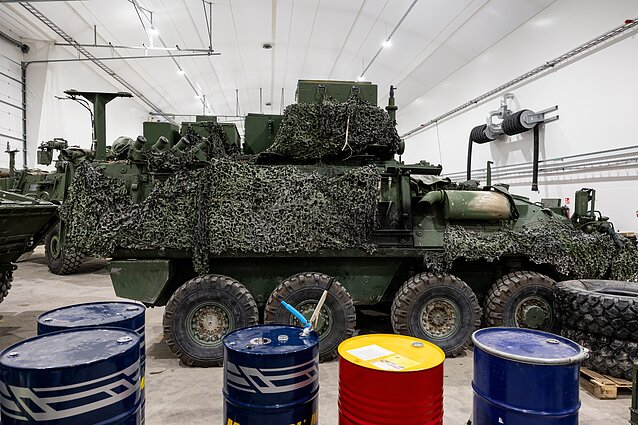
At the base, troops from Canada’s lead multinational brigade train for a range of scenarios – from drone reconnaissance to enemy infiltration. Although they are trained to use various types of counter-drone weapons, NATO troops still lack their own unmanned aircraft to prepare effectively for modern drone warfare.
“As ground-based soldiers, we usually talk about the importance of overhead cover, but it has never been more important than it is now, with the proliferation of unmanned aerial systems all over the battlefield,” Capt Ye says.
Growing regional tensions
The Baltic states, Poland and other countries on NATO’s eastern flank have in recent months faced a growing number of incidents from Russia and Belarus, including airspace violations, drones and contraband balloons, and intensive information operations.
Security experts say that Russia is trying to test NATO’s resilience and unity, undermine public trust in institutions, and weaken Western efforts to support Ukraine.
These developments are being closely monitored at the Labrie base. Canadian troops say they make their mission all the more meaningful.
“We are all motivated and glad to be here supporting the mission. Thanks to the training we had at home and the preparation before coming here, we feel confident,” says Corporal Mopas-Santos, who is responsible for maintaining infrastructure at the Labrie base.
Canada’s increasing role
Canada began its mission in Latvia in 2014 after Russia’s aggression against Ukraine. The operation was named Reassurance, reflecting NATO allies’ intent to reassure eastern flank members that the Alliance would defend them.
More than a decade on, the operation has become the largest overseas mission of the Canadian Armed Forces. During a visit to Riga this August, Canadian Prime Minister Mark Carney announced its extension for another three years.
Canada now deploys ships to the Baltic region, contributing to NATO’s standing naval forces and other missions. The country also maintains an air force unit providing logistical support from the United Kingdom.
Canada’s land forces established their presence in Latvia in 2017, when the country agreed to lead the multinational NATO battlegroup. After Russia’s full-scale invasion of Ukraine, the battlegroup was expanded to a brigade of several thousand troops.
The Operation Reassurance headquarters operates in the capital, Riga, while NATO forces in Latvia are based at two military sites – Adaži and Labrie.
At present, troops from 14 NATO countries serve in the brigade. Around 3,000 allied soldiers are permanently stationed in Latvia, with numbers rising to about 3,500 during major annual exercises.
Similar allied brigades operate in the other Baltic states: the UK leads the one in Estonia, while Germany continues preparations for a permanently deployed brigade in Lithuania.
Canada has long been criticised for low defence spending – in 2024, it stood at 1.4% of GDP. However, Prime Minister Carney pledged in June to reach 2% later this year and to meet NATO’s 5% benchmark by 2035.
The budget presented in November allocates 81.8 billion Canadian dollars (€50.89 billion) for defence over the next five years – the largest sum in decades for a country that has long lagged in military spending and struggled with procurement issues.
The European Union and Canada also announced last Monday an agreement that will allow Ottawa to join SAFE, the EU’s €150-billion defence financing programme. The scheme aims to offer favourable loans to participating states so they can purchase weapons jointly with other partners.
Lessons for allies
As Berlin prepares to deploy a permanent, 5,000-strong brigade in Lithuania by 2027, Capt Ye outlines the key challenges Canada faced when building a multinational brigade and military camp in Latvia.
“One obvious challenge is that Canada is farther away, so everything reaches Latvia later. Germany, meanwhile, is geographically closer to Lithuania. I think it will take them less time to transport their equipment here.
“It’s no one’s fault – it is simply the reality that an ocean separates us. But it has definitely forced us to think more carefully about how we manage our resources, knowing that replacing equipment takes a long time,” Capt Ye says.
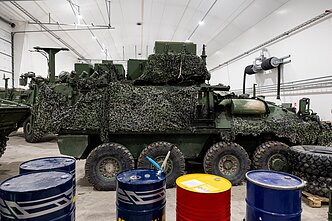
Canada currently has no operational maintenance centre for military equipment in Latvia, so equipment is shipped across the Atlantic for repairs. When equipment stocks need to be renewed or replenished, shipments arrive from Canada, while damaged or surplus kit is transported back.
Most Canadian troops in Latvia serve for six months before being replaced through rotation. However, around 100 soldiers are stationed there for three years, so Canada places considerable emphasis on the cultural and social integration of troops and their families.
Such personnel usually live in Riga, where their children attend school and often take part in ice hockey training – a popular sport in both countries.
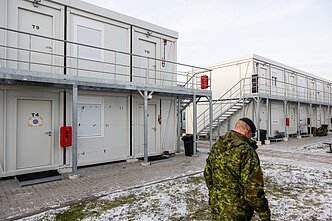
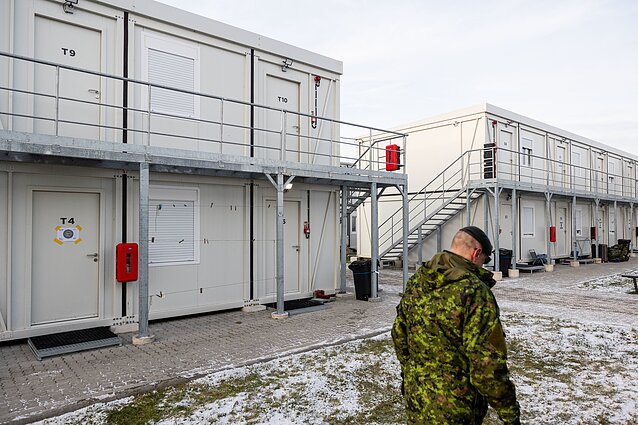
Rotating troops live permanently at the military camp that Canada has set up within the Labrie base, but they regularly take bus trips to visit cities in Latvia and other Baltic states.
Capt Ye’s key advice to the German soldiers now settling in Lithuania is to travel and familiarise themselves with all the Baltic states.
“We have the opportunity to take a bus to Estonia and Lithuania every week. We’ve been to Vilnius and Kaunas several times. And culturally it's been very interesting to see how the Baltic states are similar and yet different at the same time,” he says.
Speaking about cooperation with the host nation, Capt Ye recalls the tragedy in Lithuania when four US soldiers died at the Pabradė training area after their M88 armoured recovery vehicle sank in a swamp. According to him, the incident prompted neighbouring Latvia to take steps to prevent similar situations on its territory.
“We are fortunate and very grateful that when we carry out exercises in rural areas of Latvia, Latvian troops accompany us as local guides. They point out which locations are safe to reach with our vehicles and which should be avoided,” he says.
As his six-month rotation draws to a close, Capt Ye is preparing to return to Canada. Reflecting on his service in Latvia, he says the sense of purpose and the experience gained outweigh all the challenges.
“Working with NATO allies is an opportunity I would not have had at home. Coming here and working with all these different countries has been challenging – because of language barriers, because of different command structures and so on. But that is also why I volunteered to come here: I wanted to get to know our NATO allies better and see what we can learn from them,” Capt Ye says.
The journalist’s trip to the Labrie military base in Latvia was funded by the Canadian Embassy in Lithuania, which had no influence on the content of the publication.