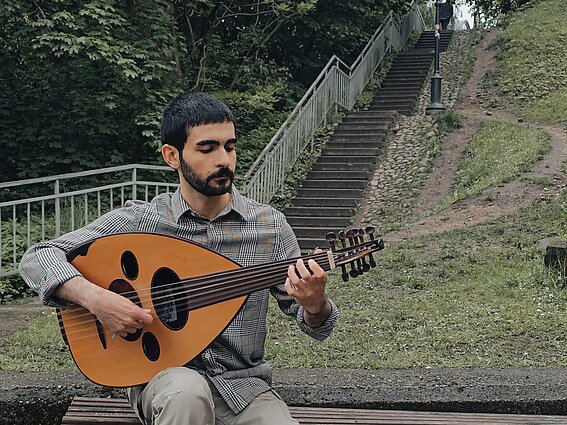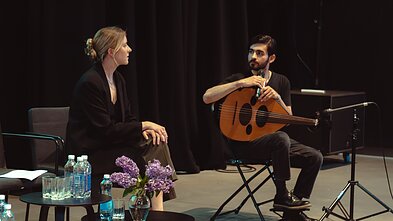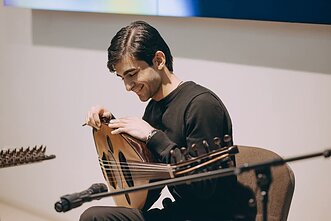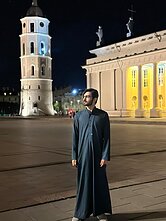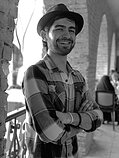





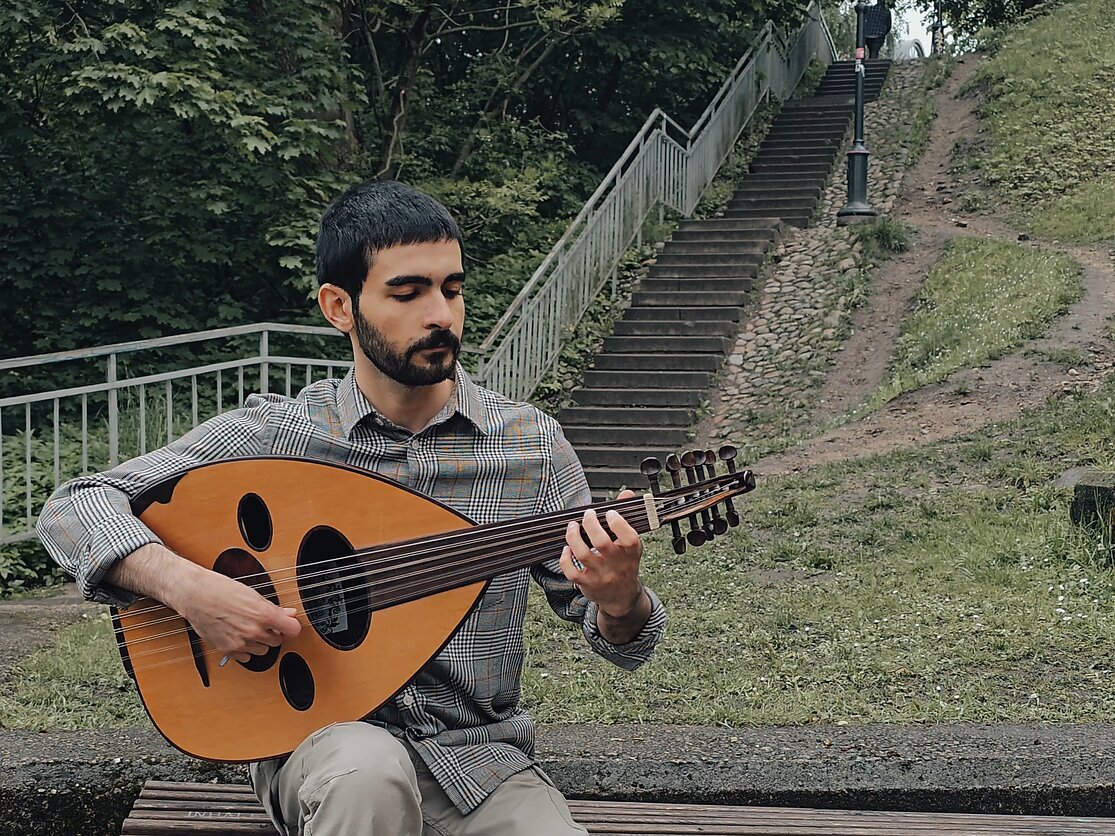
“I believe this is the role of music – to create spaces where people can recognise one another’s humanity,” says Kadim Mazin, an Iraqi-born musician and oud player who has lived in Vilnius for four years. He tells LRT.lt about life in Baghdad, gaining refugee status in Lithuania, questions of identity, and the power of music, which he says can express feelings that words often cannot.
What was your childhood and adolescence like in Baghdad?
My early years were shaped by the US invasion, civil war, and a constant fear of falling victim to suicide bombings targeting schools, markets or hospitals. School was not enjoyable: the classrooms were cold, windows smashed, desks broken, and the rooms overcrowded. I remember many occasions when I had to sit on the floor because all the chairs were already taken.
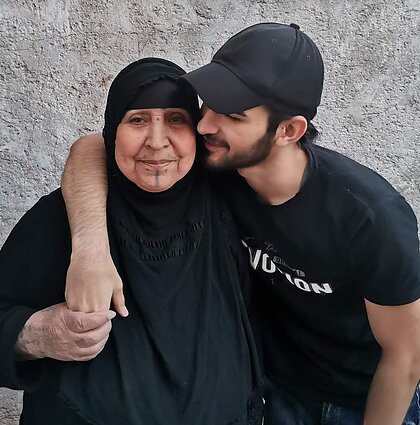
In March 2005, when I came home from school, I learnt that my grandfather had been killed in his carpet shop just a few steps from our house. To this day, we don’t know who was responsible – the case was closed. I had to learn to live with that pain, to keep going and live, as normally as possible. I was surrounded by my mother’s care and my sabria’s (grandmother’s) love. She used to call me ‘the soul of my heart’.
My teenage years were shaped by a sense of hope for political change and stability that emerged after US forces withdrew from Iraq and suicide bombings became less frequent. However, as is often the case in Iraq’s modern history, that hope proved misplaced. It was June 2014, and I was still in school when Iraq descended into yet another war – this time against ISIL. We were terrified of their advance towards Baghdad.
It was at that point that I began considering leaving. I hoped I might be able to study abroad, but my family neither had the means nor the inclination to let me go. My parents wanted me to pursue engineering or medicine. I was offered a place to study civil engineering, but it wasn’t what I truly wanted, so I dropped out.
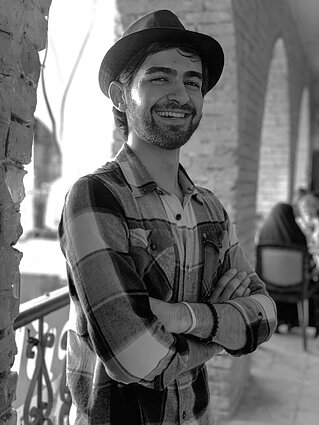
That’s when I discovered my calling in music. Partly, this was influenced by my love of physics and my fascination with Albert Einstein. I remember watching a biographical series about him and learning that he played the violin. That inspired me. I thought, if he played the violin, then I want to play too. So I bought my first instrument – a violin.
I began teaching myself music theory and reading sheet music, familiarising myself with Western classical music by listening to great composers such as Bach, Beethoven, Mozart, and others. Yet it was still another unrealistic dream. I lacked the family support necessary to study music properly – I needed their financial help, and I was still living under their roof.
How did you decide to come to Lithuania?
From the age of 14 or 15, I had been thinking about leaving Iraq as soon as possible; the idea was simply waiting for the right moment. This desire grew stronger and stronger, especially in 2019. That year, on October 1, the largest protests in modern Iraqi history took place. Hundreds of thousands of Iraqis took to the streets, demanding political reform, better representation, a future with adequate services, and greater freedom and security.
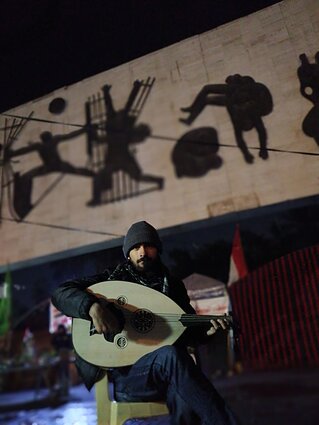
During that protest, I was active both on social media and in the streets. I worried whether the protest could achieve any real change at all. The only thing I saw was that activists, journalists, my friends, or friends of friends were being kidnapped, assaulted, filmed, blackmailed, or even killed. All of this was done to intimidate them and stop them from engaging in activism or criticising the authorities.
These experiences only intensified my anxiety, and with it, my desire to leave Iraq. I was afraid that I might be next. At first, I wanted to move to Turkey, but life there was difficult for Arabs. A friend of mine lived there and told me about the poor treatment he experienced while working long hours in factories for very low pay. So I abandoned that plan and waited another year and a half.
What was the journey to Lithuania like?
I arrived in Lithuania on August 1, 2021 with three friends, two of whom were brothers I met along the way. We had to cross forests for more than 12 hours to reach Lithuania. We were exhausted, overrun with mosquitoes, and short of food and water. One of the brothers was detained after local residents reported us to the police. Another had heart problems, which made our journey increasingly difficult. In the end, I had to call 112 for help. We handed ourselves over to the Lithuanian border authorities.
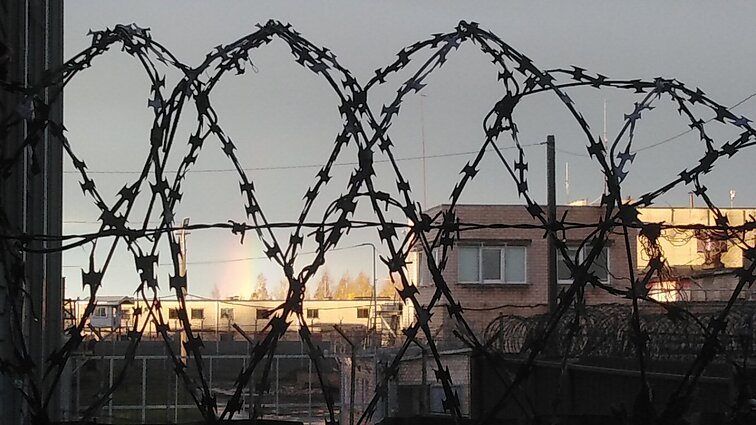
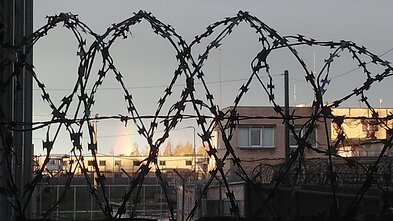
I was detained for nearly six months in three different facilities: a border control post, Rūdninkai, and Kybartai. We called them camps, but one of them, Kybartai, was actually a correctional facility with high fences, barbed wire, and very strict rules. The police would check detainees in their beds in the middle of the night with flashlights, shining them directly in our eyes. Conditions in these camps were poor, rooms overcrowded, and medical assistance very limited.
I applied for asylum, and at the end of December 2021, I was finally granted refugee status in Lithuania. I was first transferred to Rukla, where I spent about three months. I visited Vilnius for the first time in February 2022 and moved there in April. The entire process took nearly a year. I arrived knowing almost no one, except for a few friends I had met in the detention and refugee centres. Over time, however, I began to build a life for myself here.
You have now been living in Lithuania for four years. How has your perception of the country changed over that time?
When I first arrived in Lithuania, I knew very little about the language, the people, or the culture, except that it was the first country to regain independence from the Soviet Union. Everything seemed much calmer, and people were more reserved than I was used to.
In Iraq, for example, people are very open: ready to strike up a conversation, offer help, or invite you for tea or coffee. It seems that many deep friendships in Lithuania are formed at school, and for a foreigner, breaking into those circles is not easy.
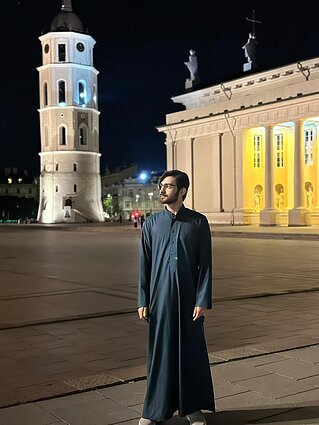
It took me some time to get over the culture shock and to understand that these differences were not a bad thing. Things are simply different here, and I had to learn to navigate that myself. Over time, many of my doubts changed. I discovered that Vilnius offers a wealth of cultural events, music, and art, and that the younger generation speaks excellent English and is open to different cultures.
I was pleasantly struck by the quietness of Vilnius, especially at night. As a musician, I value this calm – it provides space to create. I’m also impressed by how clean the city is, perhaps even cleaner than anywhere else I’ve been.
I had to get used to the winters – the snow, slippery pavements, long dark nights, and the winter blues. But now I look forward to the winter and the festive Christmas atmosphere, and afterwards I can’t wait to see spring and the green trees. I enjoy how distinct the seasons are in Lithuania and how I can experience them fully.
How do you think living in Lithuania has changed your perspective on your own identity and culture?
In the first years, I wanted to distance myself from my origins. It wasn’t that I wanted to hide the fact that I’m from Iraq or that I’m Arab – I was simply afraid of how I would be received. I didn’t want to be judged by Lithuanians, who often view Arabs stereotypically – as terrorists, extremists, or misogynists.
At the time, I was 22, and I didn’t yet understand how stereotypes, orientalism, and these preconceptions could affect me. I was trying to fit in and avoid being judged.
I thought I could leave Iraq, my origins, and my culture behind, start over, and build a new identity. I even limited my connections with the Arab community to just a few close friends.
I was angry at Iraq. I thought that if only the US hadn’t invaded Iraq, if only the government hadn’t been corrupt, if only Iraq had been doing well, I wouldn’t even have considered leaving.
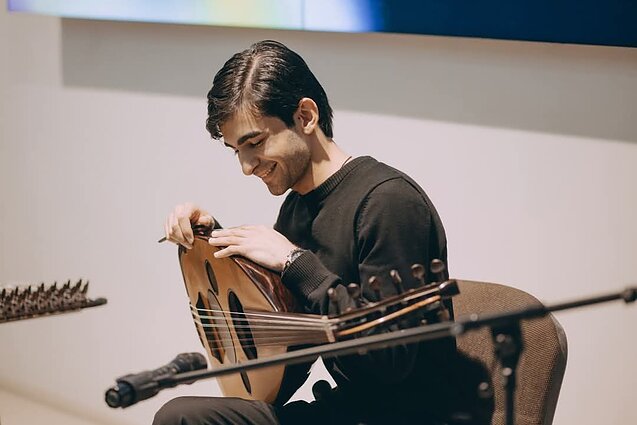
Over time, my anger gradually faded, many things became clearer, and I began to reconcile with my roots. All that anger stemmed from not understanding the bigger picture – that things aren’t simple and that there are many causes and factors at play.
Slowly, I started to feel at ease with who I am: an Arab, an Iraqi, a refugee, and I began to embrace it. I cannot change the fact that some people may not want to be around me because of who I am. I exist regardless.
Arab music also contributed to this understanding. I wouldn’t play the oud if I didn’t carry that identity with me. People in Lithuania are often curious about my culture, which motivates me to reveal it more rather than hide it. Now, I don’t care how others judge me. I know who I am and I embrace my identity and culture with a strong sense of belonging to a broader identity – the human identity.
You are currently the only professional oud player in Lithuania. Can you tell us about the history of this instrument?
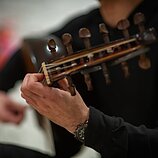
The oud is a traditional Arab stringed instrument. It is also widely played in Turkey, Iran, Greece, Armenia, and across the Balkans. It has an ancient history, tracing back to Mesopotamia, where it was used in temples and religious rituals.
Later, the Arabs adopted and refined the oud, which is reflected in its name. Originally, the top of the instrument was covered with animal skin, but the Arabs began making it from wood, giving rise to the name “ʿoud” (عود) – an Arabic word meaning wood or wooden stick.
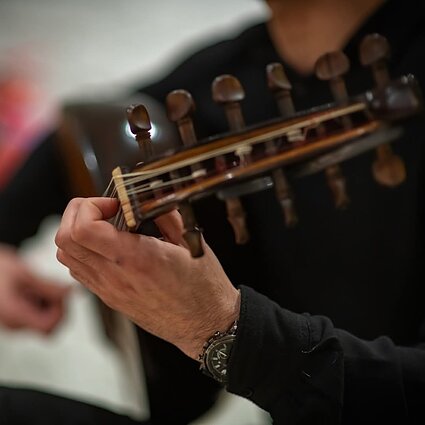
Through Al-Andalus (present-day Spain and Portugal), the oud reached Europe around the 9th century, where it inspired the creation of the European lute, which closely resembles the oud. From the lute later developed the mandolin, guitar, and other stringed instruments.
Traditionally, the oud was an accompanying instrument for singers and composers. However, over the past century, Iraqi oud players such as the Jammel brothers and Muneer Basheer have showcased the oud as a solo instrument, capable of performing complex and sophisticated musical pieces. I am delighted to follow in their footsteps.
How did the oud become a part of your life?
My musical career began in Lithuania. I work with several non-governmental organisations, such as Artscape and the Sienos Group, performing for a variety of audiences. I want my performances to be meaningful, not just entertaining. Through playing the oud, I aim to nurture diversity, multiculturalism, human rights, nostalgia, love, and humanity.
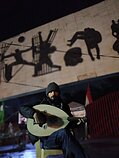
I first saw someone playing the oud during a protest in Baghdad in 2019. It was not just a protest, but also a cultural festival: people were painting, reciting poetry, cooking, and playing music. It was our way of challenging Iraqi society and government norms, pushing the boundaries between what was allowed and what was not.
After years of continuous conflict, people in Iraq had begun to view art and music as something unpleasant, unwelcome, even unnatural. This is deeply sad, as Iraq has a rich history of poets, musicians, painters, artists, and singers. For us, the young people attending those protests, it was a way to break free from that reality and show that another world is possible, one we could reclaim.
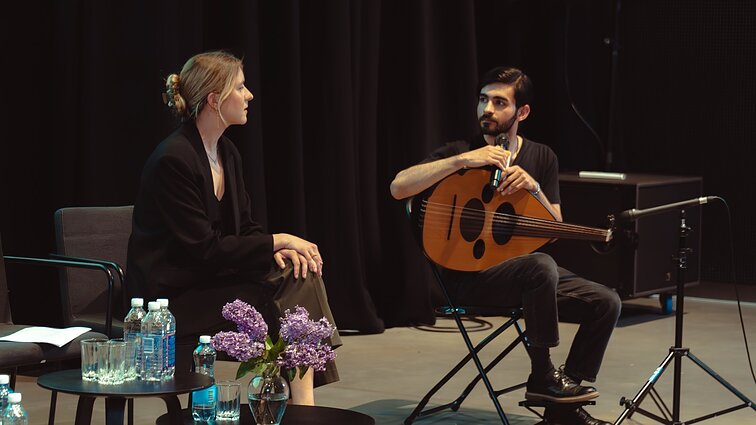
The oud captivated me. Although it is a national instrument of the Arab world, for me, having lived in Iraq for 20 years, it was one of the first times I had seen and heard it live. Soon after, I bought my first oud and began learning how it works, where to place my fingers. That was how it all began. When I left for Lithuania, I had to leave it behind. I spent several months without music, and it was very hard.
When I moved to Vilnius, found work and settled into my own place, I asked my mother to send me my instrument. It arrived a few weeks later, and I was overjoyed to hold it again for the first time since July 2021. A couple of years on, as I began receiving more invitations to perform, I bought a new instrument. I now have an oud that sounds far better, more professional, and is of much higher craftsmanship.
What role do you think music can play in building bridges between different cultures? How do Lithuanian audiences usually respond to your performances?
I once took part in a discussion with the Jewish-American musician Alan Bern. I remember him saying that “building bridges” implies the existence of two completely separated worlds that must somehow be linked from scratch. Instead of focusing on building bridges, he suggested we might try to look for – and celebrate – the roots we share. And we do share roots as human beings; there are common threads linking Lithuanians and Iraqis.
Music can be – and truly is – one of the most powerful tools for bringing people closer together and reminding us of the multicultural world we live in. Music evokes emotions that transcend language and borders, and it can convey a message that words are not always capable of expressing.
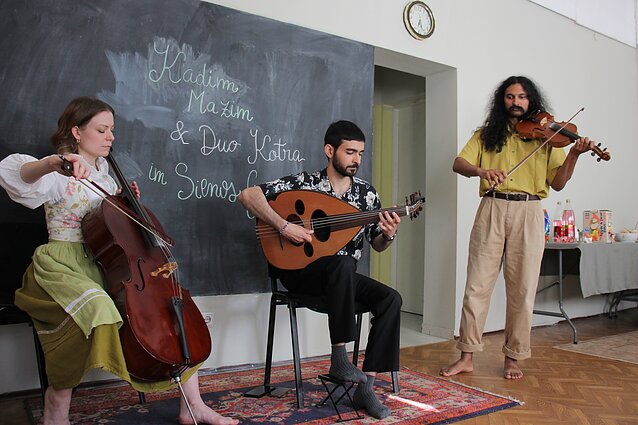
When I play the oud in Lithuania, I can see how listeners experience the instrument’s beauty and depth, even if they have never heard it before. They close their eyes and relax, almost as if in meditation. After each concert, people come up to me, thank me, and share their impressions. They leave feeling happy – and that, in turn, makes me happy. I feel as though I’ve contributed to something meaningful.
I believe this is the role of music: to create spaces in which people can sense one another’s humanity. Through music, I feel I am not only sharing my heritage, but also finding common ground where we can meet as equals.
And this exchange works both ways. For instance, I recently attended an LVSO concert marking the 150th anniversary of M. K. Čiurlionis’s birth. I fell in love with his melodies and with the performance by Jauna muzika.
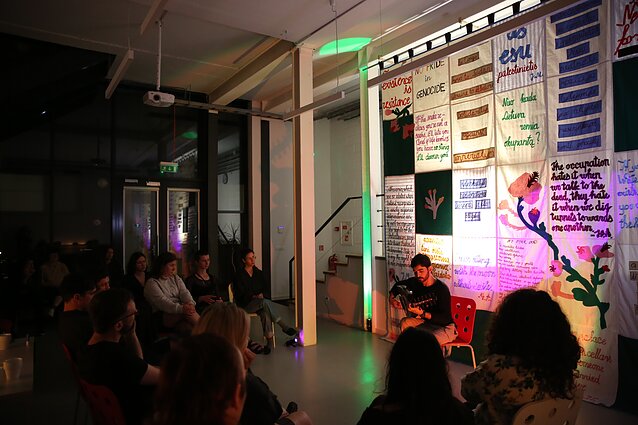
How do you see the place of Arab music and culture within Lithuania’s cultural landscape? Are there any projects you dream of pursuing?
– Arab music and culture can open new doors for dialogue, creativity and understanding. When I collaborate with Lithuanian musicians, we begin from different musical traditions. Arab music is monophonic and melodic, while Western music is polyphonic and harmonic. At first this can seem like a challenge, but over time we find common ground. Collaborations like these create something new – something none of us could achieve alone.
I think young people in Lithuania are very interested in music from beyond Europe. Many concerts and cultural events take place in Vilnius, featuring groups from Armenia, Pakistan and Iraq. I hope Arab music can become part of this expanding cultural diversity. Looking ahead, I have ideas about incorporating Čiurlionis’s works and traditional sutartinės [traitional Lithuanian polyphonic, multipart songs, fromed with simultaneous melodies] into my repertoire. I dream of projects that bring Arab and Lithuanian musicians together on one stage – not only to perform, but to learn from one another. I have also begun teaching oud lessons in Vilnius.
Beyond music, exchanges like these can help people get to know migrants, hear their stories and see them as part of society. For me, this dream is not only an artistic one, but a human one. I want to contribute to a Lithuania that celebrates diversity, where people from different backgrounds feel welcome, and where music helps to break down barriers that words alone cannot overcome.

Newsletter
Every Friday morning.