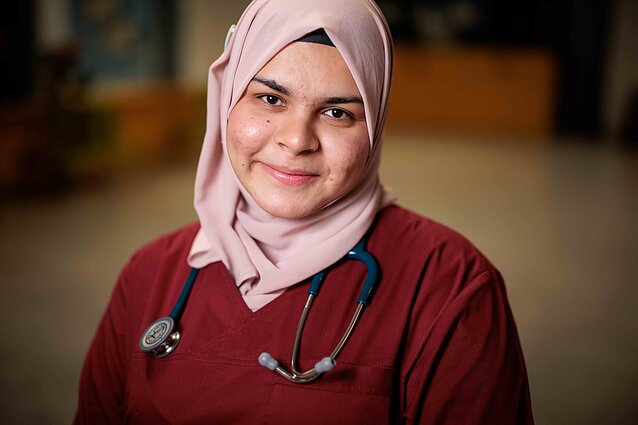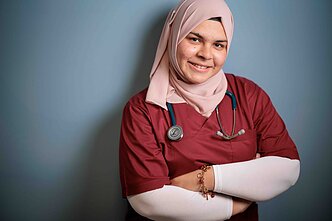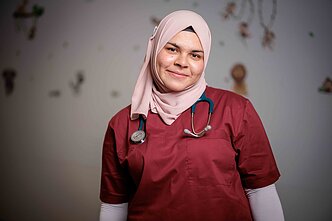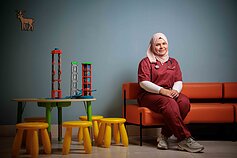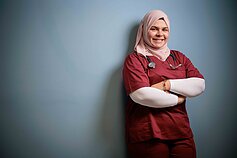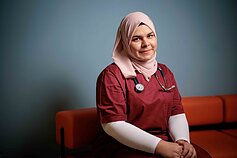







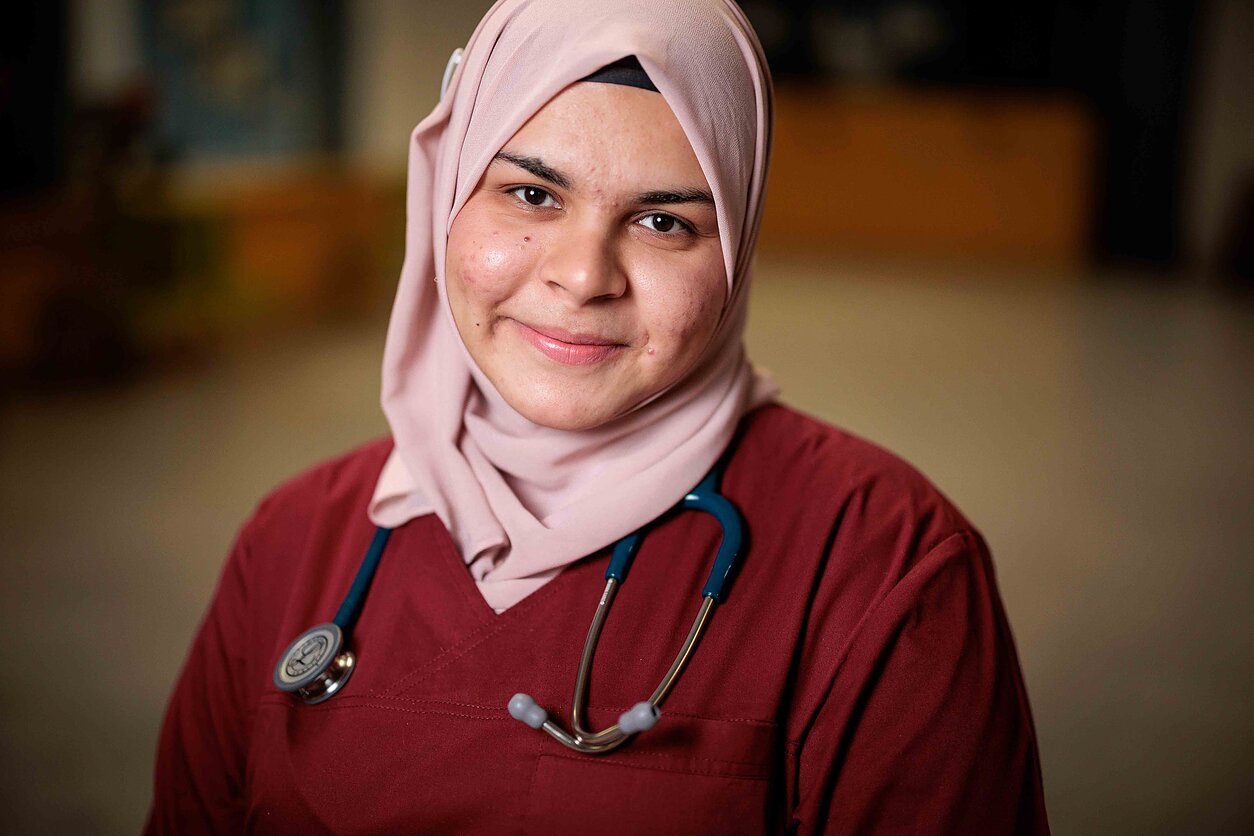
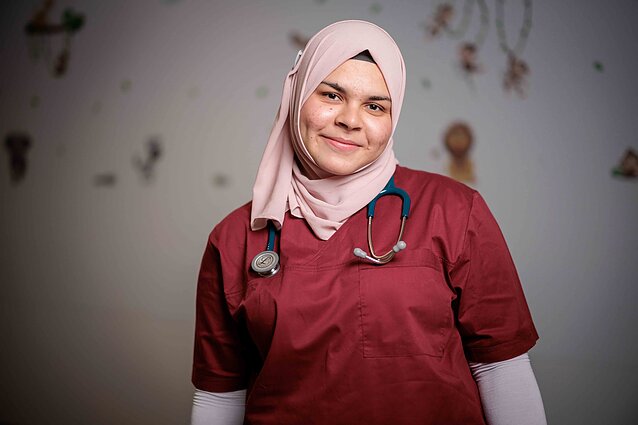
“Instead of looking at my headscarf and assuming I represent a particular religion, just try talking to me,” says Sidra, a medical student from Pakistan. She is currently on placement at a children’s hospital and hopes to become a paediatrician in the future. Sidra recalls initially worrying about how she would be received during her placement and how people might react to her, but was pleasantly surprised by the support and warmth she received from doctors.
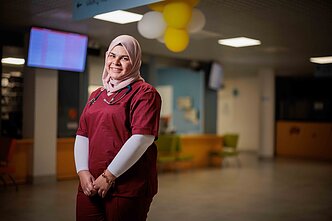
We meet Sidra at the children’s hospital where she is currently undergoing training. She has been living in Lithuania for five years, is finishing her medical studies this year, and hopes to specialise in paediatrics.
Sidra began studying medicine in Pakistan but realised there would be limited career opportunities there, so decided to continue her studies abroad.
“I started studying medicine in Pakistan and completed my first course there. I was very happy, had friends, everything was fine. But then, after talking to senior students and people already working in the health system, I realised there was a lot of corruption. Final-year students complained that it was very difficult to find a job,” she explains.
Though a career in medicine is challenging, Sidra says she has no intention of changing her path.
“If I weren’t going to be a doctor, I honestly don’t know what else I could do. I can’t think of anything. Perhaps it means I chose correctly. Of course, when I compare myself with friends studying other subjects and already on their professional paths, I do get a bit worried. But I think that’s normal for medical students – you always feel like you’re a bit behind in life. That’s the life of a doctor – you really start living at forty.
This is my third placement. I would like to become a paediatrician. For the past four and a half years, I’ve also worked as a nanny, so I spend a lot of time with children. I enjoy it, so paediatrics would be my first choice,” Sidra says.
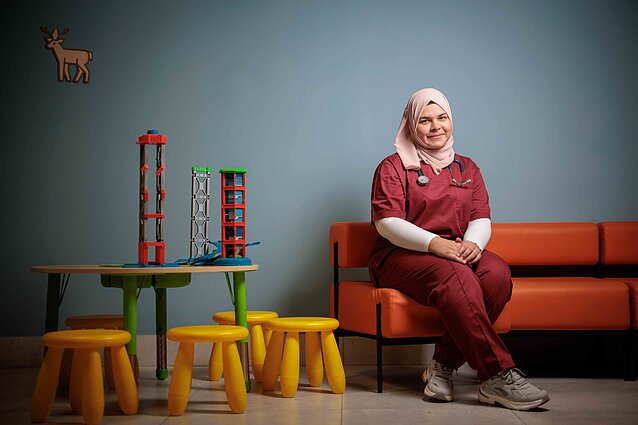
She is currently on placement at Santaros Clinics’ children’s hospital. Sidra remembers feeling anxious about getting in at the start, even considering doing her placement elsewhere.
“Honestly, before starting the placement I was a bit nervous about how people would react to me here. I even considered going somewhere else, like Malta, where my family lives and the country itself is culturally diverse. But I decided to try and see how it went.
I had never seen women wearing headscarves in the hospital [in Lithuania], and I am now the only one. I was afraid of being judged. I think it was normal to feel that way – I knew I would be the first of my kind here. But so far, I haven’t encountered any inappropriate behaviour.
Sometimes I feel the receptionists or nurses look at me strangely, but I think that’s normal. I can’t criticise them – it’s very new for them. I know there are a few male doctors from Pakistan, but no other Muslim women wear a hijab in this hospital,” she explains.
Sidra also recalls worrying about how senior doctors would react, but says knowing Lithuanian helped.
“What surprised me during my placement was the senior doctors. I had heard a lot that they are particularly unfriendly, especially to someone from another country with a different religion, and I thought it might be a problem, but it wasn’t at all.
On one of my first days, while entering patient histories into the system, a senior doctor asked colleagues whether I could write in Lithuanian. I said, ‘A little, a little.’ He was very surprised and pleased. I was also happy to make a good first impression.
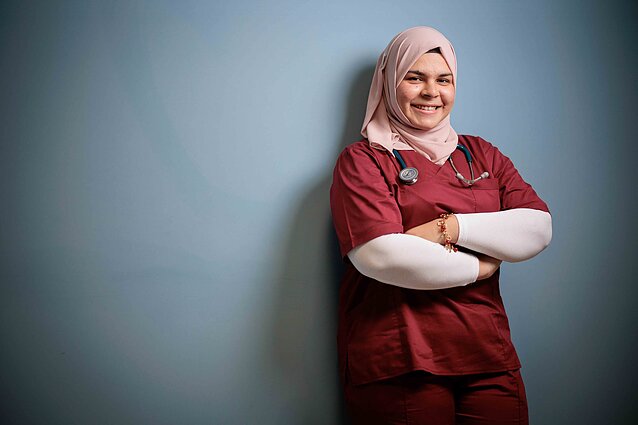
I’d say I was left surprised at how supportive most people in the hospital were. Of course, I’m only talking about one small department in a large hospital. Everywhere else is different. I’ve heard from other students and doctors that not all environments are friendly or positive. We also see in the media what’s happening in the neurosurgery department, with doctors leaving their jobs.
It’s very important to me that the work environment is supportive,” she adds.
Lithuanians are more receptive to those who speak their language
Sidra says she has noticed a trend in the hospital: if a foreign student speaks Lithuanian, colleagues are much more receptive and willing to help if they forget a word.
“I can understand quite a lot of Lithuanian. On my first day, I told my colleagues that I could speak a little and understand a fair amount. They said, ‘Great, then we’ll speak in Lithuanian, not English.’ And they started speaking to me entirely in Lithuanian,” she says.
Sidra says she enjoys working with children. While students have limited involvement in patient care and mostly observe, she already faces challenges.
“I’ve seen that sometimes it’s hard to explain things to parents. Of course, children are children, parents are responsible for them, and you communicate with the parents.
Often, parents come to the hospital, see that their child is a bit better, and want to take them home. Doctors don’t want to release the children because they know parents may not give all the medications or follow instructions. This often happens with antibiotics. It’s important to complete the full course. But when taking antibiotics, the child feels better after two or three days, and parents stop giving it. After a few weeks, they come back because the child is sick again. Sometimes it’s really hard to communicate with parents,” she says.
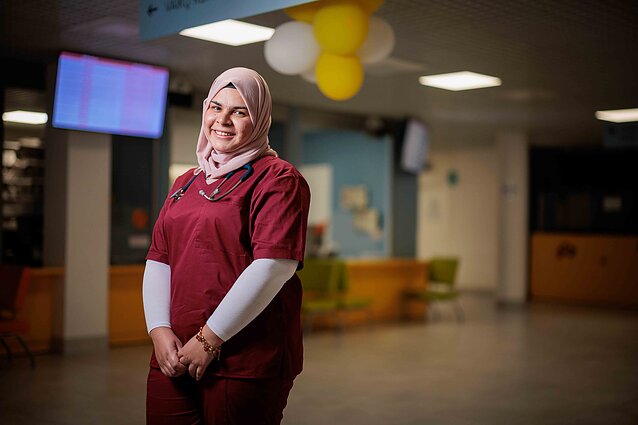
She adds that this is the everyday reality for paediatricians: explaining to parents why treatment is important. She interacts little directly with patients, but her Lithuanian, though still rough, is enough to communicate, and she is encouraged by their reactions.
“Once, a child’s mother recognised me from TikTok. When she heard I was speaking to the doctor in Lithuanian, she was so pleased and encouraged me to keep speaking Lithuanian with them. That really motivates me to continue learning the language,” Sidra says.
Negative comments and an incident on a bus
About a year ago, Sidra began posting on TikTok and Instagram, sharing behind-the-scenes glimpses of her placements and life in Lithuania.
Although people in real life are supportive, she has faced negative reactions online.
“I remember posting a video about being the only employee at Santaros Clinics wearing a hijab. I received so many negative comments. People shared the post on Facebook. I think when people see someone wearing a headscarf, they immediately comment on your religion, beliefs, even though I never talk about my religion online or elsewhere.
In real life, I’ve only had one negative comment. My Lithuanian friend and I were waiting for a bus. An older woman told my friend to tell me to remove my headscarf because I’m not in my own country, not in an arab country, I’m in Europe, and no one will hurt me if I take it off.
I had read similar comments online hundreds of times, but what struck me was that women around her of the same age were trying to discipline her – I thought, ‘Okay, not everyone is the same.’ But it was definitely an unpleasant experience,” Sidra recalls.
We discussed the different attitudes towards women that Sidra experiences in Lithuania and Pakistan. She says people sometimes assume she is oppressed just because she wears a hijab.
“If I didn’t wear a headscarf, people wouldn’t even know I’m Muslim. How would they judge me then?
In my family, my father never treated me and my brother differently because of our gender. I didn’t have fewer opportunities because I was a girl. In fact, I probably had more opportunities because I worked harder. My parents created equal opportunities for my brother and me to learn and develop,” she says.
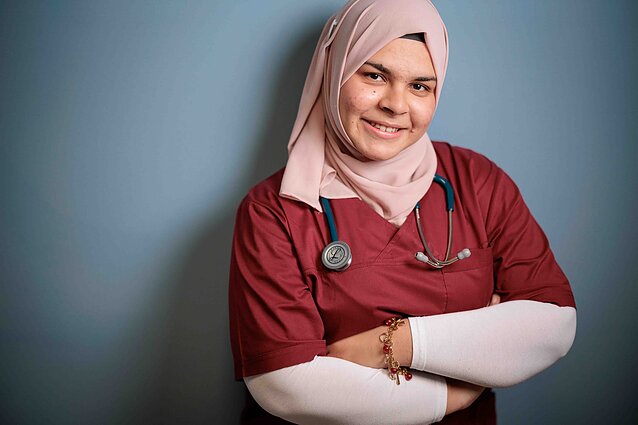
“Some of my distant relatives in Pakistan criticise me for having TikTok, while here it’s normal. People think I’m oppressed or have no rights, but then I like to ask a simple question: if I’m oppressed, why am I here alone in a foreign country?
I think it’s important to know a person before judging them. If people interacted with me without thinking about the fact I’m Muslim, they could get to know me better. Instead of looking at my headscarf and assuming I represent a religion, just try to talk to me,” she adds.
Seeing a future in Lithuania
Sidra says she sometimes finds it frustrating that some locals assume she is a burden on the country. She is open about the fact that she receives no welfare support, funding her own studies and living expenses.
“I respect this country very much. I don’t receive any state benefits; I pay for everything myself or with my family’s support. I work, pay taxes, and cover €11,000 in tuition from my own pocket. People think all immigrants are a burden, but that’s not true. We spend a lot to be here. We are not refugees; we came legally and invest in our own future,” Sidra says.
About her future, she adds: “I would like to stay in Lithuania and work here. Language is key – if I master it, I’m optimistic about job prospects. I’ve heard from senior doctors that once you start working in the system, you can get up to speed quickly.
I enjoy living in Lithuania. It’s calm and safe. I would like to work here for some time as a doctor. Who knows, maybe I’ll stay here permanently? I’ve built a life here over five years, and if I manage to get a job, that would be perfect.”
Asked if she misses the heat of Pakistan, she says: “Lithuanians probably won’t understand, but I like winter. I missed it a lot last year when there was no snow.”

Newsletter
Every Friday morning.