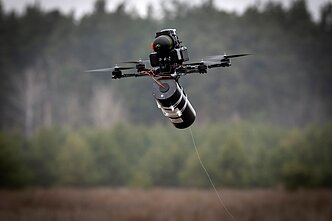














German drone manufacturer Quantum Systems has established operations in Lithuania, aiming to provide maintenance and support services for the German brigade being stationed in the country.
According to data from the Centre of Registers, the company registered its Lithuanian subsidiary, Quantum-Systems, in Vilnius on November 1.
Donatas Sirgedas, head of Quantum Systems in Lithuania, told BNS that the firm plans to expand alongside the defence and high-tech industries of NATO’s eastern flank and will offer drone maintenance, repair, and support services.
“Being on the eastern flank is a commitment, where we see an opportunity to integrate advanced solutions,” Sirgedas said. “In Lithuania’s case, a key factor is the Bundeswehr brigade, as the German army already uses our systems and will deploy the same ones here. They will also need servicing and maintenance locally, a full SSTLC (service, support, training and logistics centre) package.”
Sirgedas said the company does not plan to start drone production in Lithuania in the coming years but may consider it depending on demand and order volumes.
“New solutions and capacities are of great interest to us, especially since Quantum Systems produces between 40 and 80 drones per month in Ukraine alone,” he said. “Adding our European facilities, it’s natural we need partners for production based on scale.”
In May, Quantum Systems signed a memorandum of understanding with Lithuanian laser technology developer Aktyvus Photonics, where Sirgedas previously worked.
The company also plans to sign another memorandum on November 25 during the German-Baltic Defence Industry Conference with ADV Defense, a Lithuanian manufacturer of drone components.
According to the Centre of Registers, ADV Defense is owned by AGP Investments, a company belonging to Teltonika founder Arvydas Paukštys’ family (20%), and former Lithuanian Armed Forces commander Valdemaras Rupšys and his son Dovydas (40% each).
Quantum Systems’ main product is the Vector, a medium-range unmanned aerial vehicle produced in Ukraine and tested in combat conditions.
“We test systems in Ukraine and receive direct user feedback from the front lines,” Sirgedas said. “That helps us improve faster. If you lack real data, you rely on simulations – but we know how communication jamming works in practice, how to operate without connection, and how to apply artificial intelligence effectively. AI without data is nothing.”
The company is also developing Mosaic UXS, an integrated mission management software platform for coordinating unmanned systems in air, land, and maritime domains. In addition to defence drones, Quantum Systems produces the Trinity aircraft used for cartography and surveying.
“Quantum Systems originally came from the civilian drone sector,” Sirgedas noted. “That business still exists, but compared to the current growth of the defence industry, it’s relatively small, all expansion is now focused on defence capabilities.”
The Quantum Systems group employs about 900 people worldwide and expects to exceed 1,000 employees next year. Its revenue reached €120 million in 2024, with projections to grow to more than €200 million in 2025.
“The company already generates a healthy cash flow from rising orders,” Sirgedas said. “Investor funds are being used primarily for expansion.”
Reuters reported in October, citing Manager Magazin, that Quantum Systems was nearing completion of a €150 million investment round that could triple its valuation to around €3 billion.
Headquartered in the Munich region, Quantum Systems operates manufacturing facilities in Germany, the United States, Ukraine, and Australia.

Newsletter
Every Friday morning.