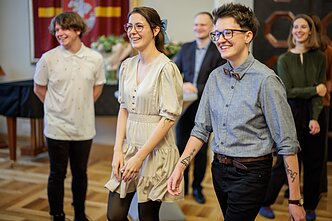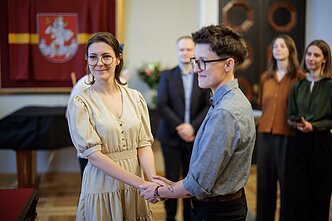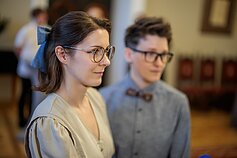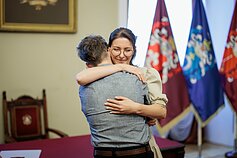















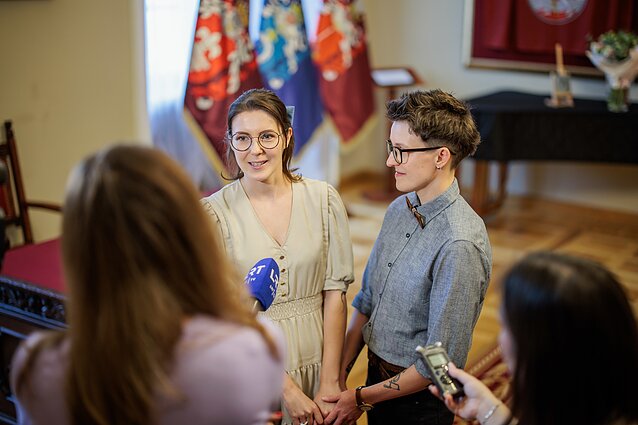
“Our outlook on life is similar, our interests are the same. We always complement each other. Some couples, when faced with difficulties, drift apart or stop trying – but we somehow managed to ride the ups and downs, and miraculously stayed together,” Eglė and Karolina tell LRT.lt.
The couple have been together for 13 years and got engaged a decade ago – yet it is only recently that they’ve had the opportunity to formalise their relationship in Lithuania.
In April this year, the Constitutional Court declared that the Civil Code’s definition of partnership – limited to a union between a man and a woman – was unconstitutional, as it excluded same-sex couples.
The decision effectively opened the way for gender-neutral partnerships to be registered in court, pending formal legislation from Parliament.
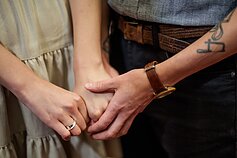
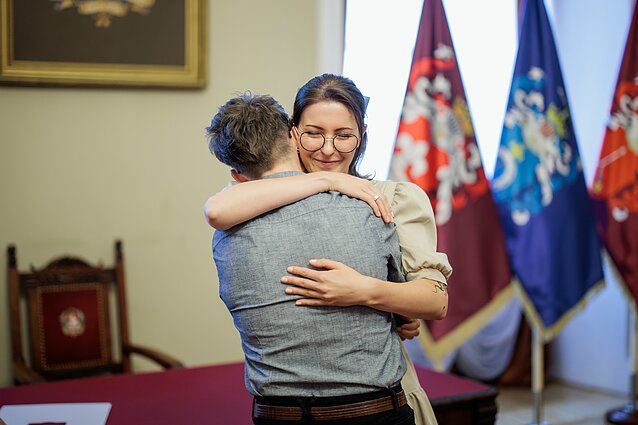
Taking advantage of this new legal avenue, Eglė and Karolina became the first couple in Lithuania to have their partnership recognised by a court. In August, Vilnius District Court officially registered their partnership, followed by a ring exchange ceremony at Vilnius Town Hall on September 11.
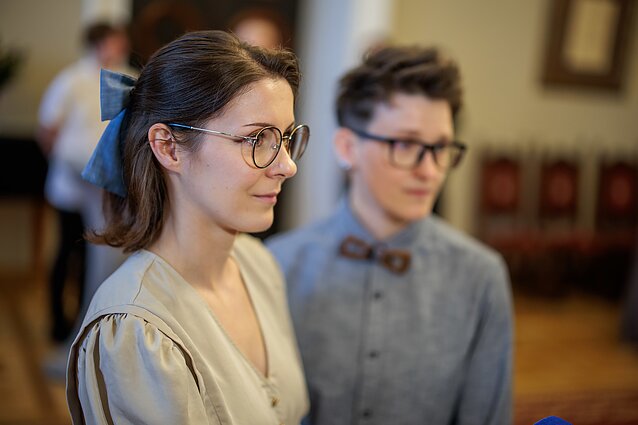
Let’s go back to the beginning of your relationship – how did you two meet? Do you remember your first impressions of each other?
Eglė: We met when we were teenagers. At first, we were just friends – we got on well, had shared interests, and lived in different cities. We were both creative, curious about what the other was doing. The romantic side came when I was 18 – that’s when I realised I really liked Karolina. But it all began with a friendship
Karolina: We bonded over shared hobbies, Japanese culture. That's how we met, at Japanese cultural festivals – our circles of friends overlapped, and one thing led to another.
Later, did the friendship naturally grow into something more?
Eglė: Yes, yes.
Karolina: Maybe for you it did (laughs). At that time, I was trying to come to terms with my sexuality – I was having something of an existential crisis. I was 18 or 19, and it felt like there were no gay girls among my friends. I thought, “Oh God, this is the end of the world, I’m the only one.” Then one of our mutual friends mentioned that Eglė liked girls. That’s when something fluttered inside me.
Eglė: She realized I could be flirted with (laughs).
Karolina: I thought, Eglė’s so cool – interesting, smart, witty, a Kaunas girl (laughs). I had never seen her that way before, but once I found out, something shifted – I started making an effort, flirting with her.

Eglė, did you respond right away, or did it take some time?
Eglė: I think I responded pretty quickly. I noticed Karolina started messaging me a lot (laughs). Before, she’d only text occasionally, but suddenly our conversations got really intense.
Karolina: That extra attention stuck – I clung on like a wet leaf (laughs).
Eglė: It worked!
Do you remember which qualities you liked most about each other back then?
Eglė: We had so much in common right from the start – insanely much. That’s why, even now, there’s never any silence between us; we always have something to talk about or discuss. We see life in a similar way, share the same interests, and always complement each other.
I think that’s one of the foundations of our relationship. We march together. There’s hardly ever anything to argue about – though sometimes we do have our little disagreements (laughs).
Karolina: We both believe that your partner should also be your best friend. For me, that’s the only way it works.
Eglė: I’m really happy I met Karolina. I’m so lucky to have met her so early in life. We’ve known each other for 15 years and been together for 13. It’s such a joy to have spent such a big part of my life with her. We’ve shared so many experiences, we travelled, taken part in various competitions. We’re like a team, and that brings us even closer.
Karolina: We’ve been through so many difficult stages together. When we were studying – our first flats, first rentals, and barely any money. Those were tough early challenges. I’m glad we started dating young, because going through hardships together really made us stronger. Some couples, when faced with difficulties, drift apart or stop trying – but we somehow managed to ride the ups and downs, and miraculously stayed together
Eglė: When we were students, we lived in different cities at first, and later even in different countries – so we had to learn how to maintain a relationship and get used to being apart.
I know you have a dog, do volunteer work, and Karolina is active in the Lithuanian Riflemen’s Union... What does your daily life and free time look like now?
Eglė: We really love dogs and enjoy long walks. We’re a great team, but we also have our own separate hobbies. For many years I practised martial arts and took part in competitions, while Karolina was more involved in creative pursuits.
Now Karolina is very active in the Riflemen’s Union – she’s really found herself in that organisation and keeps trying to persuade me to join too. But I’m a bit terrified of the idea of sleeping in the forest (laughs). Still, who knows – maybe I’ll give in one day.
When the war in Ukraine began, I volunteered with the Red Cross, trying to help Ukrainians arriving in Lithuania as much as I could. There were nights when we stayed up assembling beds, raising funds, encouraging donations. Karolina prepared books for Ukrainian children.
You got engaged ten years ago. A lovely detail is that Karolina made the engagement ring herself. What were your engagement like?
Karolina: I decided to propose to Eglė during a Japanese culture event. Eglė was taking part in a competition at the time, and I was helping with the organisation. I planned to propose at the end of the event. We were staying at a hotel with a beautiful terrace overlooking a horse stable, and I arranged for all our friends to come there.
Before that, our friends organised a fake photoshoot for Eglė so that she’d be all dressed up. One of our friends designs dresses, so she dressed Eglė in one of them – supposedly for the photoshoot. I didn’t want Eglė to show up in tracksuit and feel uncomfortable about her outfit!
But with all the excitement of preparing, I forgot to reply to her messages. My phone was somewhere out of reach, and meanwhile Eglė was already complaining to our friends that I wasn’t paying attention to her – she thought we were breaking up! That evening, after the photoshoot, they brought her to the terrace by the stables, where everyone was waiting with balloons. I was so emotional I could barely speak – I knelt down and proposed.
Eglė: It was such a surprise! I honestly didn’t expect it at all. I remember crying so much.
Karolina: I asked Eglė if she would marry me, and instead of saying “yes,” she said “uh-huh.” I remember that very clearly (laughs).

Even though you got engaged ten years ago, for a long time you weren’t able to officially formalise your relationship. You could have gone abroad – Estonia is right next door, and you can get married there. But it was important to you to have your relationship recognised in Lithuania.
Eglė: Yes, it’s really important for us to have that right here in Lithuania. You can get married abroad, but once you come back, the marriage isn’t recognised here. What’s the point of that? Of course, many couples still do it, and it’s a meaningful way to celebrate their relationship, but we want a partnership or marriage that’s valid in our own country.
We live here, we work here, we pay taxes here, we’re building our future here. We want a proper legal framework that applies to us. It’s not just about rights – it’s also about the responsibilities we have to each other.
We’re not asking for extra rights – we just want the same rights as every other Lithuanian citizen. And likewise, we want the same duties and obligations that married couples have towards one another.
Karolina: We’ve even thought about ways to get around the system. It turns out that foreigners in Lithuania in a way have more rights than Lithuanian citizens. If one of us were to change citizenship, then a marriage performed abroad would be recognised here. We even joked, “Alright, one of us will sacrifice her Lithuanian passport so that our marriage is valid in Lithuania.” But that would've been a pity – we love Lithuania.
Eglė: It’s nonsense. Absolute nonsense to have to change your citizenship just to have rights in your own country.
You say it’s important to have those rights and responsibilities recognised in Lithuania and to keep your citizenship. But some couples choose to move abroad – to countries where they not only have legal protection but are also more accepted by society, where politicians don’t throw around hateful words, and where people tend to be more open-minded. You also lived abroad for a while but eventually returned to Lithuania. Didn’t you ever feel tempted to build your life elsewhere?
Karolina: I lived abroad for five years while studying, and Eglė joined me for about two of those years. We lived in Scotland.
Eglė: Yes, we could have legalised our relationship there. We didn’t, even though we could have – and we could have stayed and built a life there. But we were always drawn back home. Our families, parents, grandparents, and friends are here. Before moving to Scotland, we had already built our lives in Lithuania – our community, our roots are here.
Home keeps pulling you back. It’s not easy to just cut everything off, move abroad and say, “Goodbye, that’s it.” No, we’re very patriotic. We genuinely want what’s best for Lithuania, we want things to get better here. It’s a great place, really. Sometimes, amid all the negativity, people forget how wonderful Lithuania actually is.
Karolina: What drew us back isn’t just family and friends – it’s also the culture, our roots. No matter where you go, in another country you’ll always be a foreigner. You’ll never quite belong. When we were in Scotland, most of the people we spent time with were other immigrants, just like us.
Eglė: From what we noticed, all the emigrants come and go, and the locals aren’t really keen to form bonds because they know that after a year, the emigrants will leave again and return to their own countries. And that’s exactly how it is.

And while you were abroad, did you have the sense that society was more open, making it, in a sense, easier to stay?
Eglė: Our relationship was received very differently in Scotland compared with Lithuania. At work, no one gave us strange looks or gossiped. Everything was accepted very naturally. (...) Life just went on, and people didn’t pry into others’ personal relationships. Nobody cared, no questions arose.
In Lithuania, it took you a little while before you could openly enjoy your love; for a time, you kept your relationship private between the two of you. Was it difficult to talk about it at first?
Eglė: Yes, it was very difficult. We probably told our friends first. It was frightening – we didn’t know how they’d react, we were scared of being rejected. We were very lucky with our friends; they are wonderful people and weren’t surprised at all. They just thought it was obvious (laughs).
It was scary to tell our parents, relatives, and colleagues. Of course, there are people I didn’t tell for a long time, didn’t even hint at it. Now they know – it’s hard not to, since everything got quite public.
Coming out is quite complicated. In Lithuania, the culture is such that everyone asks if you have a partner. You’re cornered – either you lie or awkwardly keep quiet. It’s very scary to say, “My partner is a woman”. You’re in this strange situation where you don’t want attention, you fear conflict and gossip, so you just stay silent.
Karolina: I’m a bit more sensitive than Eglė; I had enough of hiding and lying much earlier. I started playing a sort of life lottery – to people, who matter to me, I decided to come out as soon as possible. Then they either accept me or they don’t.
I studied at the Telšiai Faculty of the Vilnius Academy of Arts. The lecturers and artists there were wonderful, and I had no problems. The people I met through the Riflemen’s Union also felt very close to me. I realised that if I hid my identity, it would make me unhappy, so the sooner I came out, the sooner the lottery would play out – either I stay and don’t hide, or if someone rejects me, I leave without lying.
If anyone asks today, I don’t use ambiguous words, like “partner” or “friend,” I just say “my girlfriend Eglė.” It’s simpler that way. You can’t please everyone.
In the LRT RADIO documentary, you mentioned that Eglė’s grandmother got dressed up before meeting you, Karolina. It was clearly an important occasion. From what I understand, your grandmothers took the news of your relationship rather easily?
Eglė: My grandmother is a teacher; she’s probably seen all sorts of children. When we asked her why she reacted so positively, she said she’d known about us for a long time, but since no one was talking about it, she thought she would keep our secret, that she's the only clever one in the whole family to notice it in the first place (smiles).
Was it difficult to start that conversation with other family members?
Eglė: In my case, it was very hard. My parents didn’t accept me at first, and it took many years to mend our relationship. Now it seems everything is going well, but the beginning was tough.
Karolina: I was accepted immediately, but they didn’t allow me to talk about it. My parents, wanting what was best for me, and not wanting to alarm society or affect the image of the first Pride marches, forbade me from speaking about it. Psychologically, that was very hard. They were trying to protect me from the world by preventing me from talking about it.
Eglė: We can’t blame our parents. I remember the first Pride marches more than ten years ago – it was scary, so many police officers… My parents were frightened by what they saw on TV and the public’s reaction.
Their reaction wasn’t very positive, but it’s understandable. The context back then and the prevailing attitudes were different. I think now Lithuania is making big leaps forward. We’re becoming a more liberal country.
It also took a long time until the Constitutional Court decision, which opened the possibility to register a partnership through the courts. What does this decision mean to you – the chance to formalize your relationship, even through the judicial system?
Eglė: It adds dignity, firmness, and confidence. There are many difficult nuances where a legal framework is needed. The Constitutional Court decision shows that progress is happening. And still, it’s not just about rights, it’s also about responsibilities. I think that’s very important.
Karolina: The decision gives security and financial stability. Many things are more complicated without a legal partnership. For example, building a house, buying real estate, or taking out a loan.
If, according to the state, we are “nobodies” to each other, everything becomes much more expensive and complicated. It’s just unfair. We pay the same taxes as everyone else – why should we pay the so-called “gay tax” on top of it? It’s simply unjust.

Could you tell us what you had to go through? How did it feel when the court recognized you as partners? When you reached the finish line?
Eglė: I don't think we crossed the finish line yet. When the decision was announced, we cried tears of joy. It felt amazing to be part of this progress. We’re really grateful to the Tolerant Youth Association and our lawyer for giving us this opportunity.
When we became partners, we felt a huge wave of positive emotions. But later, a very negative wave hit – we received thousands of terrible comments, threats, and were insulted in the most disgusting ways. Psychologically, it was very hard; we started looking over our shoulders.
Karolina: When the Tolerant Youth Association and our lawyer offered us the chance to go to court against the state, we expected it would take a very long time – I imagined a year or two. But it happened much faster than we expected.
To be honest, knowing how the Lithuanian Parliament obstructs everything related to partnerships, I genuinely didn’t believe we would win. I don’t know where that small spark of hope came from, the one that made us agree to take this path. When we were offered the chance, we decided in two seconds to go for it, but deep down I thought it wouldn’t be easy, that someone would surely try to interfere with the process.
When we got the message , “Girls, you are a historic couple, recognized as family and partners,” we were speechless and cried. I couldn't speak: what, it can’t be, it shouldn’t have been so fast, without major obstacles.
Of course, our lawyer and the Tolerant Youth Association went through much longer paths. We arrived at a much later stage. They went through all the mud. We were just lucky that they offered us this opportunity – we didn’t really do much ourselves. We were just lucky.
Eglė: Karolina and I even joked that probably someone would challenge the court decision, and we’d find Gražulis and Žemaitaitis under our windows – “Close the gate, they’ll climb over!” (laughs)
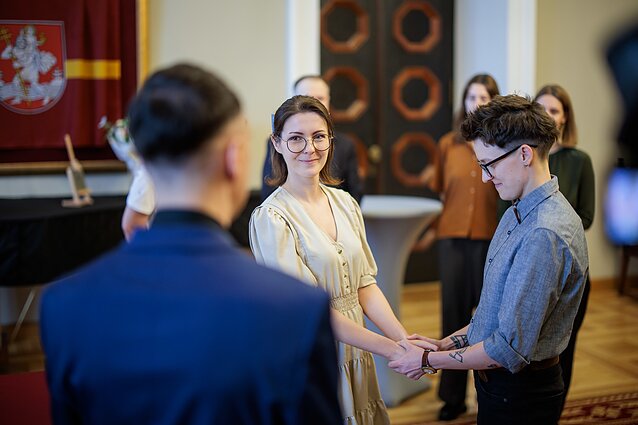
Over a month has passed since the ceremony – how do you feel today? What has changed since the ceremony and the earlier court decision?
Eglė: Now we joke all the time – if one of us annoys the other, we say: “What, are you going to divorce now? You can’t!” (laughs) Overall, it’s nice. There’s a feeling of solidity, more assurance that we are acknowledged as a real couple.
Karolina: When you come out about your orientation – that you’re a lesbian or gay – people often say it’s just a phase, that it will pass.
If a heterosexual couple has been seeing each other for two months, it’s already considered serious. But if you tell people that Eglė and I have been together for 13 years, they'll still tell you that you simply haven’t met the right man yet. Now our relationship is legally recognised. It gives us a sense of solidity.
Eglė: At the moment, we are organising our wedding ceremony. The ceremony at the town hall was without close family, which was a bit sad because we couldn’t arrange it properly. Now we are planning a proper wedding, with our family, relatives, and friends.
This whole journey has been challenging, full of anxiety and doubt. Have you taken anything positive from the process?
Eglė: I think it’s brought us even closer together, if that was even possible. It feels as though we’ve been through everything; I don’t know what could possibly happen next. It seems we’ve already climbed the biggest mountains.
Karolina: We’ve been through all sorts of hardships, we’ve argued, made up again – I don’t know if anything more challenging could come along. Now comes the fun part: choosing the colour palette for the celebration, the invitations, the dress… We’re figuring out who will officiate the ceremony and what music will be played.
Eglė: The same designer friend who helped stage the fake photoshoot for my engagement let me choose my dress. In the end, I went for two dresses – one for the ceremony and one for the evening. It feels very symbolic that, ten years on, we will celebrate our wedding in a dress by the same designer.

Newsletter
Every Friday morning.