















Non-governmental organisations are withdrawing from the president-backed project Lietuvos Galia (Power of Lithuania), saying the appointment of the populist culture minister has put the country on an anti-democratic pathway.
“I see the long-term perspective – a direct course towards the Hungarian way,” Judita Akromienė, director of the National Education NGOs Network, told LRT TV.
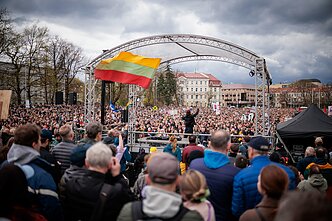
Protests in the cultural sector are expanding – an associaiton uniting farmers has expressed support, while protests are set to take place in Vilnius and other cities on Sunday.
“As organisations, we feel that this is not only a question for the cultural sector, but for the whole state and civil society. All these actions are leading towards the weakening of democracy,” said Akromienė.
The Lithuanian Youth Council has also announced its withdrawal from the cultural project. Its president, Umbertas Masi, said the decision was important for young people because it reflected their values.
“This was not an easy decision. We weighed up whether to stay or leave, and concluded that, in line with our values and the vision of our project, it would be more civic-minded and stronger not to remain silent, but to state clearly that the current circumstances do not seem appropriate for being part of a project that is meant to encourage civic engagement,” he said.
Nerija Putinaitė, associate professor at Vilnius University’s Institute of International Relations and Political Science, said the solidarity of the NGO sector gives the cultural sector tools to influence politics.
“They can influence the president, because it matters to him. He presents himself as a moral authority in Lithuania, someone who supports both culture and other values. I think this grouping has a real impact on the president,” she said.
She added that by refusing to participate in the negotiating group, the cultural community may be signalling further pressure on the president.
“If concrete demands were being made – for example, to increase cultural sector funding by 30% – then joining the negotiating group would be an excellent step. But now the cultural community is putting forward principled, value-based demands,” said Putinaitė.
“As representatives have repeatedly stressed, this is not about one individual, but about the Nemunas Dawn party and its takeover of the Culture Ministry. These are value-based positions. I doubt whether a negotiating group could untangle such demands,” the associate professor said.
As part of the new coalition, Nemunas Dawn has taken charge of the culture ministry. The decision was met by immediate protests by the country’s civil society, which expressed concerns over the party’s previous statements surrounding media independence and cultural policies.

Newsletter
Every Friday morning.