










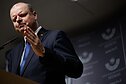

Lithuanian President Gitanas Nausėda said Thursday he hopes to extend cooperation with Moldova on cybersecurity following a Lithuania-led rapid response team deployment during last year’s presidential election in the country.
“In fact, this was more of a deployment of our specialists dedicated to the election date, but we would very much like this cooperation in cybersecurity and other areas where Moldova really needs our help to continue and be long-term,” Nausėda said in a statement released by his press office.
Nausėda made the remarks in Copenhagen ahead of his meeting with Moldovan President Maia Sandu, who has pushed the country toward closer ties with the European Union.
The Lithuania-led EU Cyber Rapid Response Team (CRRT) was tasked with ensuring security during Moldova’s presidential election and referendum on EU membership last year. It was the third and largest CRRT mission in Moldova, involving specialists from eight EU member states.
“I want to know how much Lithuanian specialists who also worked on this anti-disinformation front contributed,” Nausėda added.
Moldova, which borders Ukraine and contains the breakaway region of Transnistria, has long balanced between closer integration with Brussels and maintaining ties with Moscow.
Over the weekend, the country held parliamentary elections widely seen as a key step in its EU aspirations. The vote was won by the pro-European Party of Action and Solidarity (PAS), which has governed since 2021 under Sandu’s leadership.
The election, however, was overshadowed by fears of vote buying, unrest, and what the EU described as an “unprecedented disinformation campaign” by Russia, though Moscow denied involvement.
Two opposition parties had been barred from the elections shortly before the vote, citing alleged financing from Russia. Moreover, there has been criticism that only two polling stations were operating in Russia, despite a sizable Moldovan expatriate community in the country, as opposed to many more in the EU.
“I very much hope that Moldova will be a member of our European family,” Nausėda said. “We will soon begin opening chapters for negotiations, and there are no obstacles for Moldova to move forward today. The green light has been given, no one is objecting, and I believe that the country, especially its people, deserve this path.”

Newsletter
Every Friday morning.