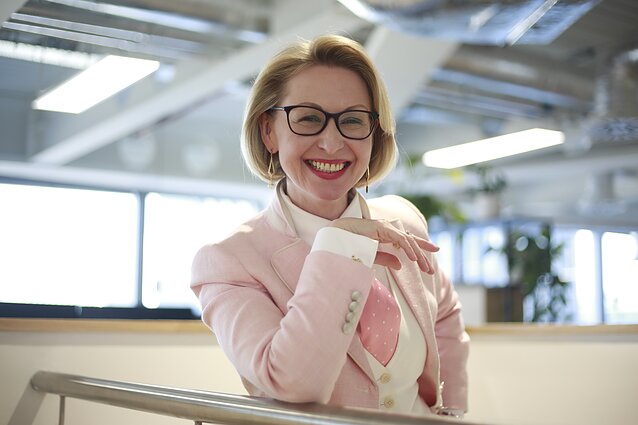













Jurga Žilinskienė, originally from Kaunas, is a well-known figure in the technology sector. She moved to London at just 19, where she developed an interest in programming and founded the translation company Guildhawk, which now serves global corporations including Universal, Sony and Bloomberg.
“If you are determined, you can achieve a great deal, but you must have a clear vision,” says the Lithuanian entrepreneur.
Starting a business while studying
Žilinskienė moved to London to study law and economics. She says she always knew she wanted to start a business, and she began working on it during her studies.
“I noticed that translations, particularly in business, were in demand. At the time, the quality of translations was poor and largely unregulated. The translation industry has existed for thousands of years, yet it was not developed in the way it is now,” she recalls.

She adds that the UK provided favourable conditions for starting a business and was receptive to global trends.
“I always wanted to be an entrepreneur, and this was the perfect place to start a business. Britain encourages business. People often look to America because of the sheer number of the entrepreneurs there, but Britain has plenty too and supports enterprise. It’s an excellent environment to begin,” she says.
Self-taught in programming, Žilinskienė developed her own Customer Relationship Management (CRM) system to analyse client relationships and optimise business operations.
Guildhawk, the translation technology company she founded 25 years ago, now serves major corporations and generates multi-million-pound revenue. The company has expanded to Hong Kong and works with clients worldwide.
“We recently developed a new AI translator that can quickly translate not just in your language, but also in your style. It took nearly four years to train the AI to understand linguistic nuances. Our team worked closely with Google Translate and observed how the systems functioned. That’s when I realised we needed our own improved product. We work exclusively with business clients, including Universal, Sony, and Bloomberg. We also serve several insurance companies, often with over 500,000 employees,” she explains.
She adds that AI has made translation almost instantaneous.
“We can translate almost in real time. We even work with avatars, and I have my own avatar that speaks 70 languages and looks just like me,” she says.

Lithuanian determination
Žilinskienė, who has lived in the UK for three decades, attributes part of her success to the trust she has built with others. She also believes that her Lithuanian determination has helped her navigate the competitive business world.
“If you are determined, you can achieve a lot, but you must have a vision. I notice that Lithuanians are determined, which really helps. Building trust is also crucial,” she says.
Despite her business success, she considers her work a passion. Daily challenges, as well as talented colleagues, drive her.
“We all share a vision for the company’s future, and we tackle every challenge together. The bigger the challenge, the more interesting it is,” she adds, noting that she frequently works with people from diverse cultures, bringing fresh perspectives and expertise.

In June 2019, Queen Elizabeth II awarded Žilinskienė the Order of the British Empire, making her the first Lithuanian to receive this honour. She attributes her career success to a genuine passion for her field.
“If there are no butterflies in your stomach, it feels like you’re just working. It’s also important not to give up. Many will say you tried hard but failed, which just means you didn’t try hard enough. I enjoy being told something is impossible, because it makes me think about how to make it happen. Of course, sometimes ambition can be excessive,” she says.
She jokes: “Always keep a snack or sweet in your pocket; you never know how long a meeting will last,” sharing a practical tip from experience.
Challenges for women in business
Žilinskienė acknowledges the stereotypes facing women in the business and tech sectors. To help address this, she was invited to lead the UK chapter of the International Chamber of Women in Trade.
“Our goal is to promote equality. It won’t happen overnight, but it’s important not to give up. Girls need computers, robots, and Lego, not just dolls. This way, we can change mindsets from an early age,” she says.

She also points out that only a tiny percentage of investment in the UK goes to women-led tech businesses. She recounts being told that investors would not fund a business created by a woman.
“I asked, ‘What’s wrong with my business plan?’ They replied, ‘Nothing at all, dear. If you were born a man, it would be different,’” she recalls.
Staying connected to Lithuania
Žilinskienė returns to Lithuania at least once a year but enjoys the friendships she has built with Lithuanians in London.
“There are many Lithuanian friends in London, and even several Lithuanian restaurants. More are needed so people can learn where Lithuania is! I keep in close contact with the embassy, artists, and professionals,” she says.
She praises Lithuanians for their work ethic and determination.
“Lithuanians are very hardworking and persistent. Perhaps it’s because we come from a small country and have to work hard to be recognised. Work pays off. My brother is an artist and recently won first place at the London Biennale in July. It’s great to see Lithuanians succeed not only in business but also in culture and beyond,” she concludes.

Newsletter
Every Friday morning.