






In an exclusive interview with LRT, Polish President Karol Nawrocki talks about the situation of the Polish minority in Lithuania, as well as the new regional bulwark against Russia.
A few days ago you met with US President Donald Trump. What specifically did you hear about the security of our region?
I think the president was very concrete. One must be aware that he is the only leader of the free world who is ready to negotiate – partly because of his character, but above all because of the strength he represents, namely the United States. He is the only leader ready to negotiate with dictator Vladimir Putin, and we should support him in these efforts.
President Trump is also aware of the important role Poland plays in Central Europe. We have the strongest army, but we also allocate the most – as much as 4.7% of GDP – to the armed forces and their development. President Trump, during a public conversation, said that there are no plans to change the potential of American forces in Poland, and I think this is good information for the entire region.
We as Poles, and I as the President of Poland, are aware that we are responsible for entire regions of Central Europe, including the Baltic States and Lithuania. Thanks to this visit and our cooperation, we feel that we are also building our military potential in solidarity, supported across the ocean.

However, last week information appeared that the Pentagon intends to end long-term military aid, including for the Baltic states. Should the Baltics be worried that US support will decrease?
I will not answer that question, because I am not the President of the United States, the Secretary of Defense, or the Secretary of War. However, I carry within me a deep conviction that thanks to President Trump’s policy, many countries in Europe, including Western Europe, have woken up with the awareness that we must strive for those arrangements that were the result of the NATO summit meeting in The Hague.
We must arm ourselves not in order to have a war, but to avoid a war. That is why we must take responsibility for building our armed forces. Poland is indeed a good example here, but I think also a good partner. We have a deep conviction that precisely with Lithuania, other Baltic states, the countries of the Bucharest Nine, and the Nordic countries, we are able to build a common potential of NATO’s eastern flank, which also receives support from the United States.
I asked your predecessor Andrzej Duda, and I will ask you too – if Lithuania were attacked, would Poland come to help?
This is regulated by Article 5 of the North Atlantic Alliance, which is an expression of solidarity among states. We agreed to its application by joining NATO, therefore it is natural that the attack on one of the countries that belong to the North Atlantic Alliance triggers a reaction of the remaining member states.
This is deeply enshrined in the North Atlantic Treaty. NATO is the largest security alliance in the history of the world, the 20th and 21st centuries. We must have a deep conviction that Article 5 works. We must increase the funding of our armed forces and build such relations as are being built in the United States, and also in Poland and Lithuania.
You are a historian and surely you will agree that Russia, which has changed its various forms of government, has remained a constant threat to our countries, to our region. How do you assess Russia today? Do you notice the rebirth of an empire, or rather the beginning of a collapse?
For a moment I had the impression that you were quoting me, because I say exactly the same thing. Russia, regardless of the changing systems that dominate in Russia – whether it is the tsardom, Bolshevik Russia, or Vladimir Putin – does not really change in the context of its psychology and mechanism of action toward its neighbors.
Yes, Russia is a constant threat, it has in itself a kind of gene that strives to dominate and to attack its neighbours, of which the war in Ukraine is yet another proof. We also know that Vladimir Putin is deeply attached to the traditions of the Soviet Union and somewhere deep in his heart has a longing for the Soviet empire. This is troubling enough for the architecture of security in our region and in the whole world that we should prudently fulfill our duties, first of all internal ones, toward security, but also our allied duties.

Poland and Lithuania have another neighbour, Belarus, which is hostile to our states. Unfortunately, we have various provocations at the border – drones, hybrid warfare. How do you think we can defend our states?
Yes, hybrid warfare has its confirmation not only in our assumptions but also in concrete statistics and analyses. We know that part of hybrid warfare is the Baltic Sea basin. We know that our borders are also under migratory pressure. At the same time, we are responsible for the very important area of the Suwałki Gap, for which Poles and Lithuanians take responsibility.
Fortunately, Belarus does not have the potential comparable to the Russian Federation, but it also constitutes a kind of threat, being of course an ally, or I would say a junior partner of the Russian Federation. To all these threats there is one recipe, to which I return, but which I will not repeat again – building the potential of the armed forces and close cooperation of states that are attached to freedom, sovereignty, and independence, which do not agree to the destruction of this system of values.
Recently we have observed increasing tensions between Poland and Ukraine. You said you do not support Ukraine’s membership in the European Union or NATO. How do you think, is the security of our region possible without Ukraine?
I believe that a state that is at war cannot enter NATO, because that would mean that Poland and Lithuania are at war, so this discussion should be postponed. It is simply impossible.
As for the European Union, we know that accession processes take years. Many things must be taken into account, including the impact on sectors of economic and social life. I of course believe that Ukraine should in the future be part of civilization, but if we want to look for adjectives, let us say the Latin civilization, the Western civilization.
However, a discussion today about Ukraine’s membership in the European Union is in my opinion premature. Such discussions and talks I do not conduct as the President of Poland, focusing rather on what Poles have been doing since 2022.
Poles were the first to so extensively support Ukraine with military equipment and by taking in millions of Ukrainians to Poland and providing social support for the country. As Poles, we feel that we have fulfilled this lesson of solidarity in the best way and we are still fulfilling it, feeling the essence of what affects Ukraine today as a result of the Russian Federation’s attack. Here we remain in solidarity, not believing in Vladimir Putin’s intentions.

You speak a lot about history and the Volhynia Tragedy, but if we look at the history of our region, probably every state would have some grievances toward its neighbour. How can we solve these issues in the 21st century?
I've said nothing about history in this interview, but I understand that you want to ask about the issue of the Volhynian genocide committed by Ukrainians. I approach this matter unequivocally – it is about the lives of murdered women, children, and the elderly. It was carried out by Ukrainian nationalists 80 years ago. The loss of their lives was a very painful experience.
Moreover, the victims and Poles are not crying out for revenge, but for graves, memory, names, and surnames. It is natural for the Polish president to demand a certain justice. It is after all the same terrible, tragic history, only from 80 years ago. Death then hurt just as much and was just as great a loss, therefore if we want to build our cooperation, we should base it on justice, mutual understanding, and partnership.
This matter, of course, does not exclude our support for Ukraine, but we as Poles want to feel like a partner in many economic and business relations. While supporting our partner, we also expect that we will be treated as partners.
Speaking of partners, relations between Poland and Lithuania have recently been really very good, but if I were to ask you, what would you like to do differently than your predecessors in our relations?
Indeed, thanks to President Andrzej Duda, President Gitanas Nausėda, and our prime ministers, the good relations established between Poland and Lithuania in recent years should simply continue.
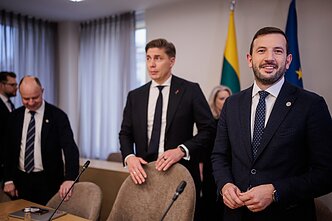
We have good relations in the areas of economy and infrastructure, as well as security. Of course, there are issues that we should also pay attention to, such as the desire of Poles living in Lithuania to write their names and surnames in their original spelling. This was also the topic of my discussions today with the president, the prime minister, and the speaker of the Seimas.
Poles expect that they will be able to use their first and last names. In this case, the President of Poland is the voice of Polish women and men. If the Poles raise issues such as the original names they are waiting for or the use of geographical and topographical names, this is an important issue for the Polish president.
Of course, this will not affect the excellent cooperation between our countries, but it will force us to sit down at the table and think about how we can make Poles in Lithuania and Lithuanians in Poland feel as comfortable as possible.
This is what the modern world expects of us, and among the many excellent relations in many areas of activity, there are also issues that pose challenges for us. These are common tasks that need to be accomplished.

Newsletter
Every Friday morning.