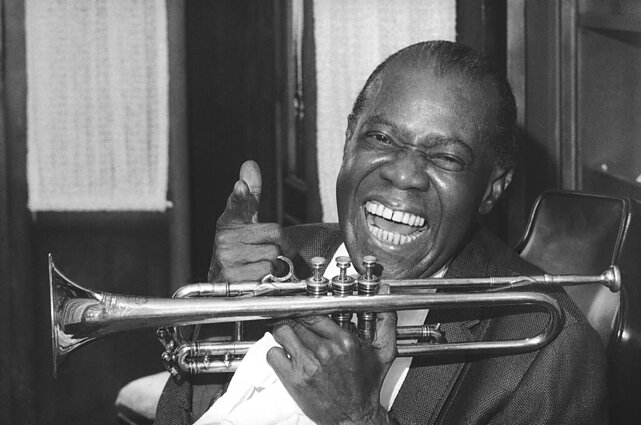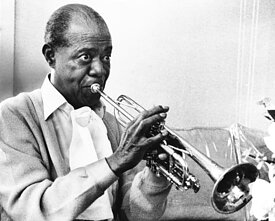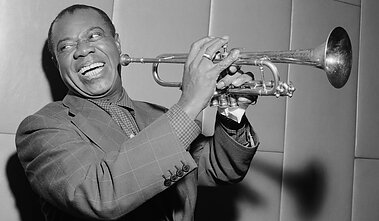










Jazz legend Louis Armstrong has a connection with Lithuania – in New Orleans, he was taken in by the Karnofsky family, Jewish Litvaks who had emigrated from Vilkija in the Kaunas region. Four years ago, an open-air stage in Vilkija was named in Armstrong’s honour.
Louis Armstrong was born in 1901 in New Orleans. His father abandoned the family, and Louis spent much of his childhood with his grandmother. As a boy, he scavenged rubbish tips, collecting waste and selling what he could.
“It’s quite likely that the Karnovski were doing the same thing,” journalist and ethnographer Eugenijus Bunka told LRT RADIO.
He contacted several people who could shed more light on the Karnofsky family, including their descendant, Jacob Karn, and representatives of the Armstrong Museum in the United States. Interestingly, the surname Karnovski originates from the small village of Karnavė, situated on the banks of the River Nemunas.
“They collected rubbish, sorted it, and sold it to whoever needed it. They also traded in coal, and it’s quite possible that they met in a rubbish tip and took the boy in. The Karnovskis had 10 children, and they also raised this one,” Bunka said.
The Kanorvski family often told Armstrong he had talent and even helped him buy an instrument – a cornet. Until then, Louis had only a poor-quality trumpet, which he blew in the streets to announce the arrival of the waste collectors’ cart.
“When Armstrong went out selling coal with his foster brother, it was a good business because both black and white boys were accepted in the different neighbourhoods alike – his brother noticed that every time they passed a shop window with a cornet on display, Louis stared at it longingly. The family must have decided he should be given one.
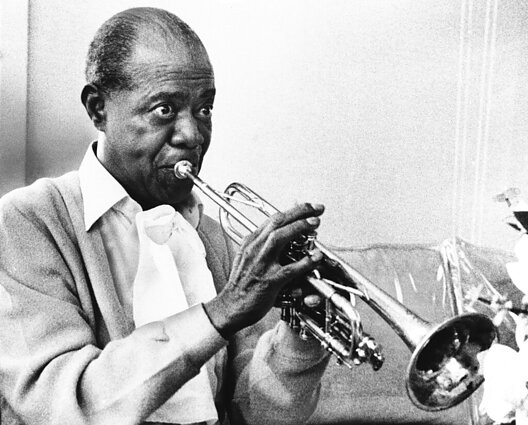
“There’s a Jewish tradition that still survives: giving a child the chance to try something they love, and if they tire of it, offering something else. The Kanorvskis saw Armstrong’s desire to play music and, in line with that tradition, helped him pursue it,” Bunka explained.
He said the Kanorvski family never turned their backs on Armstrong, no matter what happened.
“In New Orleans, there’s still a tradition of firing pistols into the air on New Year’s Eve. I’ve been told that even today, there are big signs warning that falling bullets kill. Back then, measures were already being taken to stop it. Armstrong once grabbed his foster father’s pistol without permission, ran outside, and started shooting.”
“He was arrested and jailed, but while he was in prison, the Karnofskys looked after him and never abandoned him. What’s more, Mrs Kanorvski persuaded him to start singing. That was also their influence – he not only played, but sang,” Bunka said.
Armstrong learned to play by listening and imitating others, eventually developing his own style.
“He played in nightclubs and gatherings. When one of the greats left New Orleans, Armstrong was lucky enough to be taken into a band. From that moment, he wasn’t just learning – he started creating. He learned from those around him who had been doing it for years,” Bunka said.
Armstrong went on to become one of the most famous faces of jazz worldwide. Still, his relationships with those around him remained warm and down-to-earth, Bunka said.
“Once, while driving in a parade, he saw his foster brother standing outside a shop. He stopped the procession, greeted him, and went for a beer. People in the parade shouted at him to hurry up, but his brother said, ‘This is awkward, it’s not right.’ Louis replied: ‘Don’t worry, they won’t go without me – and we rarely see each other.’ Their bond lasted to the end of his life,” Bunka recalled.

It’s unclear whether Armstrong himself had ever known much about Lithuania.
“The Armstrong Museum has his diary. Maybe something about it is written there. I have a short extract in which he says that at the time, the situation of Jews in America was worse than that of black people. That’s all I have in his handwriting. Perhaps there’s more, but I believe the Kanorvskis told him about where they came from, how they lived, and what they did,” Bunka said.
Four years ago, an open-air stage in Vilkija near Kaunas was named after Armstrong. A bas-relief of him stands there.
According to Bunka, the stage is a memorial to both Armstrong and the Kanorvskis. Various events and jazz festivals are held there, keeping their memory alive.

Newsletter
Every Friday morning.