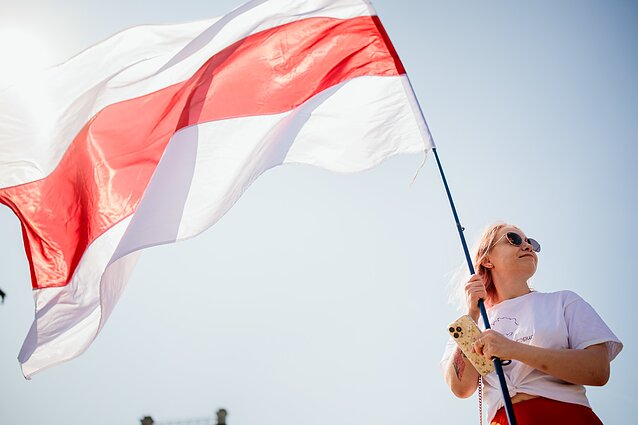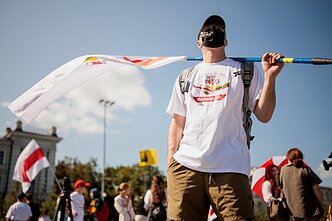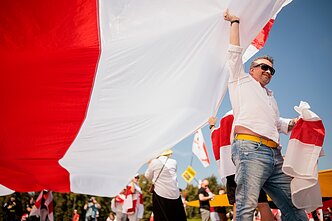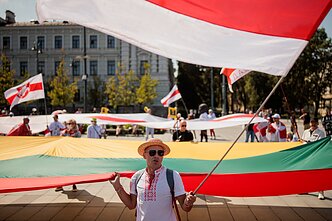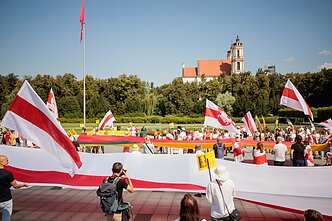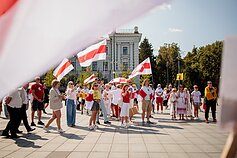









Belarusians living in Lithuania on Saturday marked the fifth anniversary of mass protests against the regime of Alexander Lukashenko, who has ruled the country for more than two decades. While the participants expressed gratitude to Lithuania for sheltering them, some noted a growing hostility from the locals.
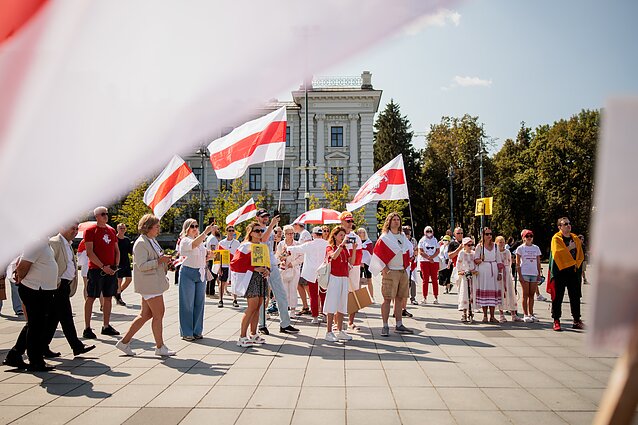
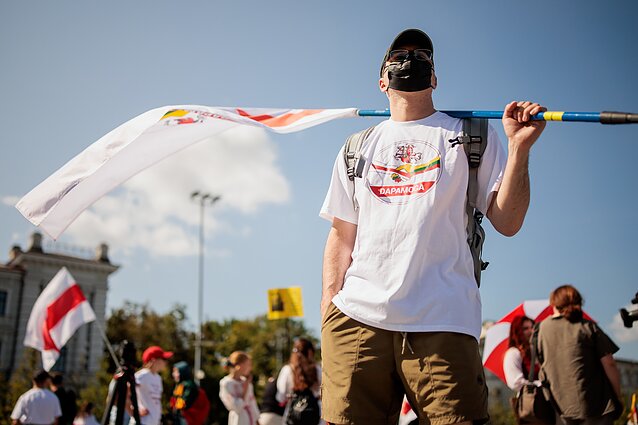
The commemorations in Vilnius began in the morning with a bicycle ride through the city centre to honour participants in the 2020 demonstrations. The ride ended at Lukiškių Square, where about 100 people gathered for a midday rally.
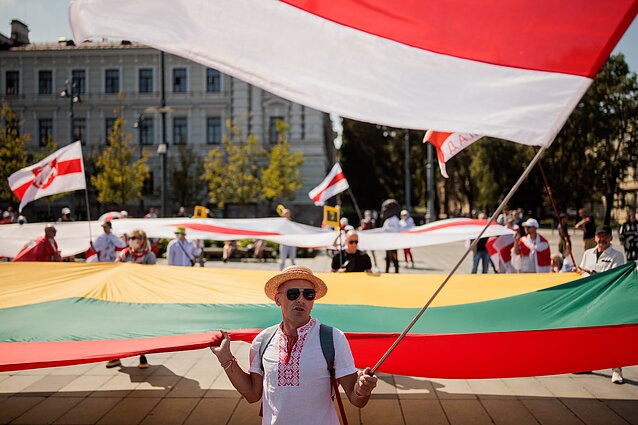
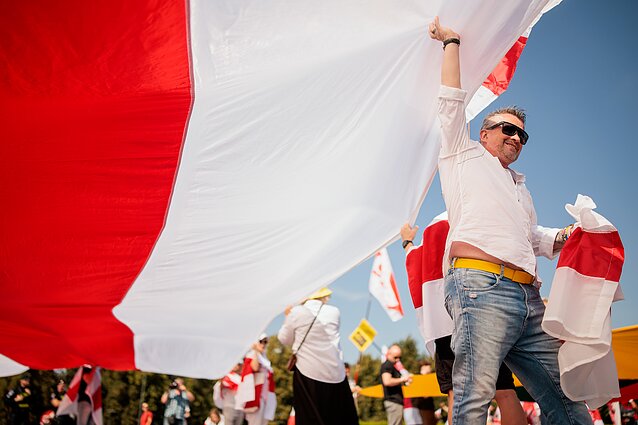
Many participants carried or wore the historic white-red-white Belarusian flag. Some held placards reading “Lukashenko to The Hague” and “Our path – to a free Belarus”, while others displayed photos of political prisoners.
Several protesters expressed scepticism that political change in Belarus was possible in the near future, though some voiced cautious optimism.
“Hope dies last,” said Alexander Bobko, 41, who works in construction. “I’m sure that sooner or later there will be changes. I’m sure people are not giving up, not losing heart. Everyone is doing what they can.”
Bobko said he served a one-year prison sentence in Belarus in 2021 for painting hay bales in the white-red-white coluors, writing the date August 9 on them, and drawing cockroaches, a symbol used by activists to mock Lukashenko. After his release and saving enough money, he moved to Lithuania.
Vadim Kashpur, a 30-year-old scientist who joined protests in 2020, arrived in Vilnius last month after finishing a period of house arrest related to several cases against him. He doubted change was possible, saying the government discourages people from protesting and has cracked down on the most civically active since 2020.
“There was one country, and now I think almost all Belarusians who took part then are either in prison, intimidated, or have left,” Kashpur said.
Olga, a 50-year-old accountant who declined to give her last name, said change in Belarus was impossible while Vladimir Putin remains president of Russia. “Belarus does not have the manpower to resist Putin,” she said.
Language and integration tensions
According to the Migration Department, about 52,000 Belarusian citizens have residence permits in Lithuania, most arriving after the 2020 events, but there are some who are labour migrants.
Opposition leader Sviatlana Tsikhanouskaya, who challenged Lukashenko in that year’s election, was also forced to move to Lithuania, where she established the Belarusian democratic representation accredited by the Foreign Ministry.
But not all Lithuanians welcome the Belarusian opposition diaspora. Some have called for the representation’s accreditation to be revoked following controversial comments by Tsikhanouskaya’s husband Siarhei. Discussions in Lithuanian media about the increased use of the Russian language in public spaces have also intensified.
Olga said she is learning Lithuanian but criticised what she described as hostility from some locals. “If in any Lithuanian institution I am offered the choice of Russian, if everyone around me speaks Russian, why should I learn the language?” she said. She urged Lithuanians themselves to stop using Russian rather than shaming others for it.
Kashpur said some Belarusians should be more grateful for Lithuania’s hospitality but noted that the most visible cases tend to be extreme and negative. “I hope Belarusians will behave with dignity, respect Lithuanian culture and language, and learn it if they want to stay. I want to stay here, because going back to Belarus means prison for me,” he said.
Belarusian opposition leaders in Lithuania have also sought to respond to criticism with expressions of gratitude. Saturday’s rally began with both the Belarusian and Lithuanian national anthems, speeches were translated into Lithuanian, and some placards were written in the language.
After the Lukiškių Square rally, participants planned to march to the Belarusian Embassy for a vigil with candles. The week’s events also included the opening of an exhibition, “Belarusians. Gudai. Belarusians. 2020–2025”.
In August 2020, Lukashenko claimed victory in a presidential election widely denounced as fraudulent, sparking mass protests that drew hundreds of thousands. Authorities responded with a violent crackdown, detaining about 65,000 people. Key opposition figures were jailed or fled the country, prompting EU sanctions on Belarus.

Newsletter
Every Friday morning.