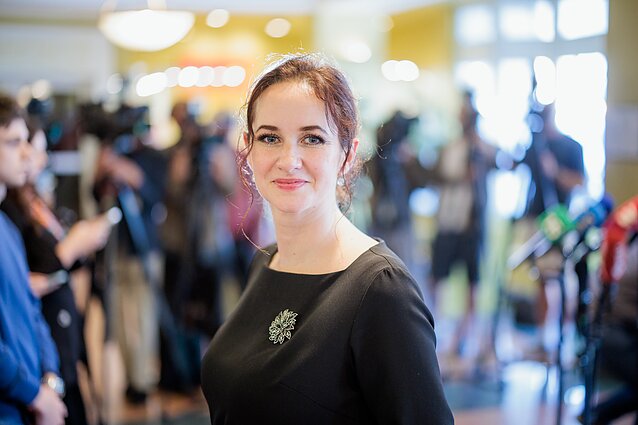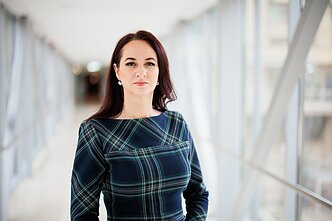










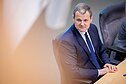

Inga Ruginienė, a 44-year-old political newcomer from Trakai and long-time trade union activist, is set to become Lithuania’s 19th Prime Minister – and the third woman to hold the post (fourth, if we include one acting PM in 1999). Her nomination still requires approval by both the Seimas (parliament) and the President.
Education and early career
After finishing school, Ruginienė initially pursued a career in medicine, studying public health at Vilnius University. She worked as a public health specialist at the then-State Environmental Health Centre and had a brief stint in the private sector. However, she later changed direction, earning degrees in forestry management and, in 2022, a master’s in labour law.
Ruginienė’s journey into the world of trade unions began during her studies. In 2012, she joined the Lithuanian Federation of Forest and Wood Industry Workers’ Unions, quickly rising to the role of chairwoman. By 2018, she had become head of the Lithuanian Trade Union Confederation, frequently appearing in the media to comment on labour law and workers' rights. Prior to entering parliament and becoming Minister for Social Security and Labour, she also served as vice-president of the European Trade Union Confederation.
According to data from Kantar, in 2023 Ruginienė was the fifth most frequently quoted economy-sector expert in Lithuanian media.

In her forms submitted to the Central Electoral Commission, Ruginienė highlighted her civic engagement, including work as a first-aid instructor and volunteer for the Lithuanian Red Cross Society. She also served on its board and was a council member of the Kaunas Forestry and Environmental Engineering College between 2021 and 2023.
She lists painting and travel among her hobbies, and cites The Little Prince and detective novels as her favourite reading. She is married – her husband, Vismantas Ruginis, manages several companies in the print and publishing sectors.
Reform agenda
Ruginienė described her move from trade unions and business into politics as “a natural continuation” of her career. She was nominated by the Social Democratic Party, which recruited her, back then a non-partisan opinion leader, to stand in the Naujininkai–Rasos constituency. Although she did not make it to the second round of voting there – losing to Artūras Zuokas – she secured a seat in parliament via the party list, having initially been ranked third but ultimately entering from fifth place due to the popular vote distribution.
“I joined the trade union movement more than 12 years ago – a fairly substantial period during which a great deal has been achieved. My career began with the restructuring of the forestry enterprises, with the first protests – I even went to see Dalia Grybauskaitė [former Lithuanian president] wearing my rubber boots,” she told LRT.lt after becoming Minister for Social Security and Labour.
Upon entering the ministry, Ruginienė named reform of the private pension system (the so-called second pillar) as a top priority. She advocated scrapping automatic enrolment and introducing more flexible payout rules.
“We will have to reform the second pension pillar within the first six months. There’s no question about it – the reform must happen. These changes need to be implemented quickly. Until then, I can’t even address first-pillar pensions because all the focus is on the second,” she said.
According to Vilmorus polling conducted in April–May 2025, approximately 35.5% of Lithuanians view Ruginienė favourably, while 21.8% have a negative opinion. Compared to the start of the year, her positive ratings have increased.

Newsletter
Every Friday morning.