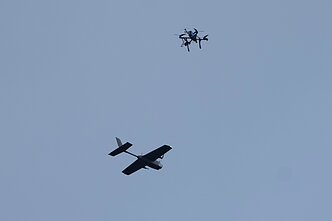













Additional army capabilities will be deployed to guard the Lithuanian border after an unmanned aerial vehicle, possibly from Belarus, flew into the country for the second time within several weeks.
“We will take additional steps to ensure more effective border surveillance in cooperation with the Ministry of the Interior, and we will deploy additional army forces for this purpose,” Defence Minister Dovilė Šakalienė told reporters in Klaipėda on Monday, adding that the drone that flew over Vilnius has not yet been detected.
Chief of Defence General Raimundas Vaikšnoras says that additional air defence capabilities will be deployed closer to the country’s border with Belarus.
“Today, we plan to deploy additional air defence capabilities closer to the border as we see some tendencies. We know roughly the directions, we know where these corridors are potentially going, there is already a second case, and we will make reinforcements in this place,” he said.
Moreover, he said, coordination with the State Border Guard Service (VSAT) will be stepped up because “without their eyes in the sky and on the ground, what they see, what they hear, it is difficult for us to identify”.

According to the defence chief, the armed forces will also work to speed up the acquisitions related to drone detection, for example, the procurement of short-range radars, which had been planned for a much later period. They will not be bought quickly, Vaikšnoras explained, saying that as a lot of equipment is going to Ukraine and technology is changing.
The Sky Fortress acoustic drone detection system should also be deployed on the border with Belarus soon, the chief of defence said.
“What is very realistic to do is Sky Fortress, which is the installation of a system of microphones, which is what the Ukrainians are using, to record acoustic signals on our entire border area. This way we would be able to identify incoming objects in advance, distinguishing between paragliders, hot air balloons, small planes. This would facilitate or shorten the decision-making process,” the military chief said.
“This is a time of peace, and firing left and right can lead to fatal and catastrophic consequences,” he added.
Defence Minister Šakalienė argued that the two drones that flew into Lithuania this month showed that the armed forces needed more effective measures.

The latest drone that flew over Vilnius has not yet been detected and identified, the minister said, adding that military police and special forces are searching for it.
“The situation is not ideal, no doubt. On the one hand, it is very encouraging that the Ukrainian defence is able to disorientate the drones moving towards them, but on the other hand, those disorientated drones with their brains burnt out can, of course, wander into any territory, fly here, to Poland and other territories, with various consequences,” the minister said.
There is no reason to believe that the UAV has been sent to Lithuania deliberately or as a provocation, she added.
“There is a high probability, given that there was a very large attack on Ukraine tonight, that it could be one of those objects that strayed in response to the Ukrainian defence,” she said.
Monday morning, warning messages were sent to people’s phones saying that an unidentified type of UAV had crossed into the country.
The National Crisis Management Centre later told reporters that the authorities were informed by residents who saw and heard a drone possibly coming from Belarus. It was spotted at an altitude of around 200 meters, most recently near Vilnius.
Vaikšnoras said the military had detected the object while it was still in Belarusian territory.
This is the second time this month that Lithuania has recorded a drone entering from Belarus.
On July 10, after a UAV entered Lithuanian airspace, authorities initially suspected it was a Shahed drone, the type used by Russia in Ukraine, but it was later identified as Gerbera, a Russian-made harmless drone designed to deceive air defences.

Newsletter
Every Friday morning.