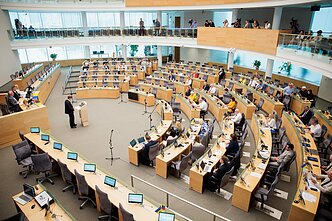
















Lithuanian lawmakers on Monday backed proposed changes to the country’s property tax law, approving in a second reading new thresholds that would see primary residences taxed only if valued above €450,000, and additional properties taxed from €50,000, BNS reports.
The amendments to the Real Estate Tax Law were supported by 73 MPs, with 48 voting against and six abstaining. A final vote is expected on Thursday, with the law set to come into effect in 2026.
Finance Minister Rimantas Šadžius told the parliamentary Budget and Finance Committee (BFK) that this version of the primary residence tax would generate an estimated €700,000 to €1 million annually, with properties of such value largely concentrated in the capital Vilnius and the resort town of Neringa.
Under the current proposal, while primary residence would be taxed only if its value exceeds €450,000, subsequent properties would face a progressive tax starting from €50,000, with rates ranging from 0.1% to 1%, depending on the property's value.
The new legislation would also recognise non-residential premises as primary homes in resort towns if declared as such. Property values for tax purposes would be reassessed at least once every three years.
Initially, the government had proposed that municipalities set their own minimum non-taxable threshold for primary homes, no lower than €10,000, with rates between 0.1% and 1% applied above that.
However, the ruling coalition later agreed that an individual’s sole, inhabited residence should be entirely exempt.
The BFK reversed course following a proposal by the ruling Social Democrats, supporting taxation above the €450,000 threshold – a position that gained traction in the plenary.
According to BNS, earlier this month, the International Monetary Fund said Lithuania, which currently collects relatively little from real estate taxes, should consider broadening the tax base.
Currently, real estate in Lithuania is taxed progressively at rates of 0.5% to 2%, but only for properties valued above €150,000.
As reported by BNS, the new real estate tax is part of a broader government-led tax reform package. Other proposed changes include raising the reduced VAT rate from 9% to 12%, scrapping heating exemptions, increasing corporate tax to 17%, revising personal income tax brackets to 20%, 25%, and 32%, introducing a “sugar tax,” and applying a 10% levy on insurance contracts.

Newsletter
Every Friday morning.