













A recent interview involving a conservative leader has sparked controversy in Lithuania as comments appeared to suggest that members of paramilitary and civil defence units could be permitted to kill “disloyal” civilians in wartime.
The discussion, which was aired on blogger Algis Ramanauskas’ YouTube channel, featured Homeland Union–Lithuanian Christian Democrats (TS-LKD) chair and former defence minister Laurynas Kasčiūnas and musician Gabrielius Liaudanskas-Svaras, a member of the Lithuanian Riflemen’s Union. The two spoke about the role of civilian volunteers and commandant units during a potential armed conflict.
Liaudanskas questioned whether these short-course-trained civilian volunteers could effectively respond to military sabotage groups, asking, “Are they told they’ll have to kill disloyal citizens?”
“I hope they are,” Kasčiūnas replied.

The comment, along with Liaudanskas’ remarks about war requiring the taking of lives, quickly circulated on social media and drew backlash for appearing to advocate extrajudicial violence. Critics accused the politician of encouraging the military to overstep legal boundaries.
Vytautas Valentinavičius, a lecturer at Kaunas University of Technology, warned in a public comment that “public speculation by politicians about ‘cleansing’ during war is no longer a debate, but a dangerous turn”.
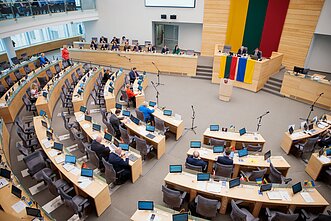
Responding to the criticism in the parliament on Tuesday, Kasčiūnas denied advocating violence against dissenters and clarified that the conversation focused on sabotage groups assisting enemy forces, not citizens with opposing views.
Experts in international humanitarian law emphasised that wartime does not eliminate legal protections for civilians. Col. Lt. Gediminas Latvys, deputy head of the Lithuanian Riflemen’s Union, said the interview was taken out of context and meant to stress the harsh psychological realities of warfare, not to endorse unlawful killings.

“War is brutal, people get killed. Those defending the nation with arms will have to, under certain circumstances, to use the arms,” Latvys said. “[But] Lithuania sticks to international law, namely, the Geneva Conventions, which forbids violence against civilians.”
Legal scholars also highlighted that any use of force must remain within the boundaries of international conventions. “The legal framework of the Lithuanian state wouldn’t collapse into chaos where anyone can shoot someone they disagree with,” said legal expert Tomas Marozas. “Processes would still be governed by authorised institutions.”
There is also no legal definition of a “disloyal citizen”, added Marius Taparavičius, a legal advisor with the Red Cross.
Under the Geneva Conventions, civilians lose protection only if they directly participate in hostilities. However, determining what qualifies as such participation can be ambiguous.

“Law cannot list every possible scenario,” Marozas said, noting that civilians using violence or aiding military efforts may become legitimate targets.
Despite the uproar, experts agreed that civilians could be lawfully integrated into national defence forces under specific conditions – if formally recognised and informed by the opposing side.
“The state can declare that, besides the Lithuanian military, our armed forces include organisations like the Riflemen’s Union. The combatant privilege is extended to them, but, accordingly, the opposite side is informed what is a legitimate target,” said Taparavičius.

Newsletter
Every Friday morning.