











As Russia marked Victory Day on Friday, dozens gathered at Antakalnis Cemetery in Vilnius to honour fallen Soviet soldiers. The holiday is celebrated by parts of Lithuania’s Russian-speaking community, although it is viewed negatively by most Lithuanians due to its embrace by the current Russian government.
According to officers on site, roughly 50 people arrived with red carnations to commemorate May 9 – the day Russia and several other post-Soviet states celebrate victory over Nazi Germany, unlike most of Europe, which observes it on May 8.
Diplomatic staff from the Russian and Belarusian embassies also placed wreaths at the site of a former Soviet memorial and eternal flame.
In a symbolic gesture, Vilnius authorities parked a garbage truck and trash bin at the cemetery entrance, encouraging visitors to dispose of their Soviet-themed flowers, candles and “nostalgia”.
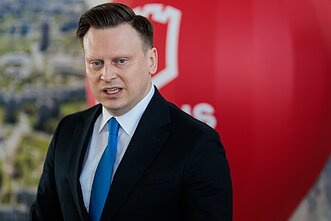
“Today, Moscow celebrates its propagandistic Victory Day,” Vilnius Mayor Valdas Benkunskas wrote on Facebook. “For us, this date marks another occupation. On this day, hostile forces grow more active – spreading lies and provoking division. Red carnations and Soviet nostalgia have their place – and we’ve prepared plenty of space for them,” he added.

Near the gates, civic activist Valdas Bartkevičius held a solo protest with several like-minded individuals. The group was confronted by pro-Russian figure Laurynas Ragelskis, who shouted slogans in support of Russia.
“There was a small group here – they gather like flies, in groups, because some are afraid to go alone,” Bartkevičius told BNS. “I greeted them with ‘Slava Ukraini’. They shouted back, ‘Slava Rossii’. These people justify Russian aggression against Ukraine – and us. They are collaborators.”
One of the central participants of the gathering was Erika Švenčionienė, who is currently on trial in Lithuania for publicly supporting Soviet crimes.
“My dream is to be in Moscow on a day like this,” Švenčionienė told reporters at the cemetery. A court, however, denied her request to travel to Russia for the occasion, citing concerns she might flee and not return to face trial.

Švenčionienė greeted other attendees with “Happy holiday”. When asked by journalists how Ukrainians might feel about her celebration, she replied, “Ask them yourselves.”
As wartime Russian songs played, she recited excerpts of Soviet-era Lithuanian poetry and questioned why celebrating the day should be banned.
An elderly man wearing a Soviet military medal stood nearby. Praised by Švenčionienė for displaying the symbol, he defended it as an award, not propaganda. Lithuania has banned public display of Soviet symbols.
“I don’t ride the trolleybus wearing it,” the veteran said. Now 80, he admitted he was born and raised in Lithuania but never learned the language.
In Lithuania, May 9 remains controversial. While larger commemorations continue in Vilnius and Klaipėda, where Russian-speaking communities are more prominent, the date is shunned due to its use by the current Russian government.


Newsletter
Every Friday morning.