



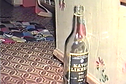







Dainius Valentėlis led the way into the flat. "This is Tomukas’ room – it feels like a museum to me now: I sweep, dust it off, and that’s it," said the father of Tomas Valentėlis, a volunteer killed in Ukraine.
He was killed in the Kupiansk district in north-eastern Ukraine on March 13, but his body lay in the fields for several weeks. It was finally recovered during a high-risk operation; a previous attempt had left four soldiers injured.
Dainius showed a few toy guns he once gave to Tomas. "We used to shoot at cans lined up on the wardrobe," he said.
But when Tomas turned 15, the connection between father and son was lost. "Maybe because of strict parenting, maybe something else," said Dainius.
Tomas became withdrawn and quiet – that’s how he was remembered by both his relatives in Lithuania and later by the soldiers who knew him in Ukraine.
"He shut down, stayed either here on the bed or there on the armchair, in front of the PlayStation and the TV. He didn’t have any friends," said Dainius. "I basically raised him myself. Then I said, 'Maybe go live with your mum in London for a while, see the world a bit.'"
Tomas moved to Britain but stayed there for only a year. He blocked his parents on social media and then left the country. Only the police managed to trace him.
"They figured out Tomas had flown from London Luton Airport to Kraków in Poland. I knew right away that he was probably headed to Ukraine," said Dainius. "He was searching for meaning in life, a purpose. He was trying to find himself."

In search of meaning
Like thousands of Ukrainians, Tomas found himself in a brutal war – one shaped by its cruelty, where drones dominate the battlefield and redefine the future of military doctrine.
Lithuanian volunteer Vygindas Ušinskas, who coordinated the operation to recover Tomas's body, told local media that there is now a "one-man" war in north-eastern Ukraine. Large-scale operations have largely disappeared, with clashes now taking place between small units – just a few soldiers pushing forward and digging into the ground.
Tomas wasn’t naïve or blind to the reality he had stepped into.
In February, I sat with Tomas in a damaged building near Kupyansk that had been occupied by his unit. The sound of Russian Shahed drones buzzed overhead; gunfire rang out in the distance. The house had been abandoned before the soldiers arrived, with a calendar from 1999 still hanging on the wall.
The conversation was brief, with long pauses between each of his replies. On the chair next to the bed was a pile of medication – like the others in the house, Tomas was sick. On the other side of the bed lay an automatic rifle; elsewhere, out of sight, a grenade launcher.
Tomas spoke: "Nothing good ever happened in life, things were hard with the family, I didn’t have much to lose. I came here to help, to find meaning. Now it feels like it wasn’t worth it. I’m trying for something that doesn’t matter – it’s obvious how this [war] will end. That demotivates me a bit.
"It’s the same with the other foreigners, from what I see – they talk about [US President Donald] Trump this, Trump that. The corruption surprised me – I hear a lot about [Ukrainian] commanders, how things go missing. It’s basically the Soviet era again, just in the Ukrainian language.
"I don’t think my team or I are strong enough – as infantry, you can’t really do much. You just sit in the bunker for 10 days while they bomb you. My friends think I’m stupid for being here. I want to make a difference, to fight, but I don’t want to die."
I asked: "Do you think about death a lot?"
"Yes," he replied after a few seconds of silence. "I try to convince myself that everything will be alright. My family is asking me to come home, they know I’m here. I doubt this will last long."

According to Dainius, Tomas had been thinking about leaving the service.
"I’m angry at the Ukrainians, because they didn’t train him properly, didn’t give him the equipment he needed," Dainius said. "Tomukas told his aunt, ‘We’re treated like third-class people here.’"
But the other soldiers didn’t see that disappointment.
"Maybe he just didn’t share it with me," recalled Jara, another Lithuanian soldier who was also one of Tomas’s commanders.
He got used to the service in Ukraine. The messages he sent to his family members also became less alarming.
"He always did everything with enthusiasm. We told him a hundred times, 'Just go home.' That’s all he needed to say," said Jara.
International volunteers sign a minimum six-month contract and Tomas had already served that long. It’s not uncommon for foreign volunteers to cancel their contract and leave early, according to Jara.
"I told him many times: ‘Well done for coming here, but don’t go to the frontline. What for?’" he added.
But Tomas insisted on fighting, according to Jara and other foreign soldiers who served with him.
"Tomas wanted to go on missions. It was us who tried to protect him," said Jara. "He had a thousand chances to leave."
Final words
The whole rotation was marked by losses.
Even before Tomas’s death, much of his platoon was gone – some killed, many more injured, the rest sick. They lacked everything – from food rations and beds to drones and vehicles. In short, everything the Ukrainian army is running short of at the front.
It didn’t help that most of the soldiers in the unit, like Tomas, had no prior combat or even military experience.
Then came an assignment that seemed like a good chance to ease into the battlefield, Jara recalled. The mission was simple: dig positions at the second line of defence.
"Who wants to go on the mission?" I see Tomas raise his hand. I ask, "Are you sure you want to go? Aren’t you afraid?" He says, "I really want to," Jara recalled.
"My last words to him were: 'If I have to visit you in a hospital or, God forbid, bury you, I’ll dig you up and bury you again myself,'" Jara added. "We laughed, I saw him off, and we all went to sleep. In the morning, he went on the mission."
On March 11, I also messaged Tomas to ask how he was doing.
"All good, just digging trenches for now," he replied. But he didn’t respond to any more messages. The last time he was active on the messaging app was 12:45 on March 13.
The very next day, I received word from Jara: "Tomukas is dead or wounded, information blackout for now." He attached a photo to the message – Tomas’ body lying in the Ukrainian steppes, surrounded by leafless trees.
Everyone was left with the same question – how did a simple mission go so wrong?

‘I want to believe we did something good’
Tomas, along with another volunteer from the United States, was en route to a location where they were meant to dig trenches. But with both the Ukrainian and Russian sides chronically short of soldiers at the front, the distance between positions is growing – and both sides are sending in small groups of soldiers to infiltrate each other’s lines.
Ukrainian drones spotted two such Russian soldiers.
"[Tomas] was told: ‘The situation is that either they attack you, or you attack them.’ They decided to strike first," said Jara. "They initiated contact, killed one, and the other started to retreat. A drone carrying a grenade finished him off."
They then began to withdraw, but made a fatal mistake. "They crossed an open area – that's strictly forbidden. I don’t know why they did it," Jara added.
Tomas and the American volunteer were likely spotted by a Russian drone, which was quickly followed by artillery fire. A shell exploded near Tomas, and the other volunteer was wounded. Seeing that Tomas was no longer moving, he pulled back, leaving Tomas lying where he had fallen.
"We trained to move in [twelve-man] squads, but here it’s just two soldiers at a time," said Jara. "Everything we learned was useless. When it’s just the two of you, you know that if you’re injured, there’s almost no chance anyone will come to get you – and one person can’t drag you out."
It was only a Ukrainian drone that managed to reach Tomas, spotting him lying motionless. About a kilometre away from his body, two other soldiers from the International Legion reached a fighting position, but couldn’t get to where Tomas had fallen.
"One of them was wounded, he shouted at his partner to leave him because they would both die. The other soldier fled and the wounded one was killed by a grenade dropped from a drone. The surviving soldier hid in a trench, but the drone began to burn him with thermite [an incendiary mixture]. He suffered burns and then crawled, injured, for four days back to his own lines," Jara said.
A few days later, another attempt was made to reach Tomas. Four volunteers arrived at a point from where they would continue on foot. But immediately next to them, an FPV (first-person view) drone was brought down by signal-jamming equipment. Yet, on its way down, it struck an anti-tank mine lying nearby, causing a detonation.
"It was a one-in-a-million chance," said Jara.

All the wounded, including a volunteer from Latvia, managed to reach the base – but Tomas once again remained where he was.
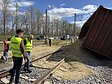
Finally, after several weeks of preparation, a Ukrainian special forces unit reached Tomas. In total, several dozen soldiers took part in the operation. After eliminating the Russian troops nearby, they retrieved Tomas’ body from the battlefield.
And so, nearly a month later, Tomas began his last journey home.
But in the steppes of Ukraine, tens of thousands of soldiers remain lying where they fell. Until their remains are recovered, they are officially considered missing in action – buried in trenches, left in fields, blown apart in armoured vehicles.
According to the latest figures published by Ukraine, some 60,000 people – both soldiers and civilians – are missing in the country.
"I want to believe we did something good. Maybe some Lithuanians who want to go and fight will know – at least we won’t leave you there," said Jara.
On a grey day in Kyiv on April 16, several dozen Lithuanians gathered to bid farewell to Tomas on his final journey home. On Wednesday, a vigil was held at St Ignatius Church in Vilnius, which was also attended by the Lithuanian president and other officials. Tomas will be finally laid to rest in his hometown of Biržai, northern Lithuania, on Thursday.

Newsletter
Every Friday morning.