








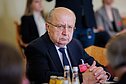

Estonia’s Defence Minister Hanno Pevkur talks to LRT.lt about his country’s plans to withdraw from the Ottawa Convention, the Russian military threat, and the prospects and desirability of getting under the French nuclear umbrella.
The Baltic states and Poland have announced intentions to withdraw from the Ottawa Convention, which bans anti-personnel mines. Why is it necessary for Estonia to renounce this arms control treaty? Is Estonia planning to actually deploy anti-personnel mines inside its territory?
We all understand that the threat is coming towards the Baltic states only from one direction. In Lithuania’s case, it’s also the Kaliningrad Oblast, but it can mostly come only from Russia and Belarus.
That means that we have to be ready to defend our countries and our people by any means we have. One position we had all this way was that when we make the decision to withdraw, we do that together, all the region. It is important to keep our backs together in these times and this is why Estonia was ready to start this process.
From the military point of view, our chief of defence doesn’t see that we will use immediately the anti-personnel mines. It is a deterrence message, rather, and it is an option for us in case of need. We do not see at the moment that we’ll start to use immediately uncontrolled anti-personnel landmines. We have other capabilities against the land forces.

Some critics of the withdrawal from the Ottawa Convention were saying that other NATO allies might not understand it. Did you yourself hear these arguments from NATO allies – or is it purely a national choice?
We are in communication with our allies. We also understand that, among the allies, positions are different. For some countries, the step is questionable, for others, it’s understandable. But again, it was important for us to keep our backs together regionally, and this is exactly what we did. And now also, we are waiting for Finland to make the decision. [Finland announced last week it was also planning to withdraw from the convention.]
How would you judge the Russian military threat? Do you think that the threat to the Baltic states will increase if the war in Ukraine ends in a ceasefire?
We all understand that when this war ends somehow, be it by ceasefire or a peace treaty, Russia will be able to move its forces very quickly to our neighbourhood.

Their army reform shows that they will increase the forces up to 1.5 million troops. They will deploy a lot of new troops and a lot of new equipment close to the Baltic states. Not today, but when they have the freedom to move them, then first and foremost they will move these forces and equipment close to our neighbourhood. Which, of course, significantly increases the risks for us.
What about Estonia’s military capabilities and rearmament? At least some Estonian media claim that there are issues with ammunition. Is it all going according to plan?
Estonian ammunition stocks, when we take the days of supply account, these stocks are one of the best in Europe, I can guarantee that. Our ambition is to have even more. And we will have even more.
We have already acquired ammunition worth close to 1 billion. Only this year, we will have around 700 million worth of ammunition coming to Estonia. We have approved new packages. Just last week, we also approved the increase of defence spending to 5% starting from next year.
And part of that package is ammunition. In our plans is to have more capabilities, we have already bought a lot of new capabilities. There is a plan to rearm Estonia.

We have acquired artillery systems, armoured vehicles, air defence will be arriving this year and next year, the HIMARS systems will arrive very soon, in the coming months.
The European Commission has presented its Defence White Paper. What do you make of it, does it meet our defence needs?
It is good that we have this White Paper, and there are some very good proposals in it. But it is more important that, in every capital, we make decisions. The White Paper is good to have but it doesn’t give us the decisions.
We need decisions from each capital to increase defence spending. And when we will go about 5%, already next year, then this is also needed in every other country. Because we know that the NATO capability targets are something we will agree on all together. And when we want to reach these capabilities, then we need also to invest more into defence here in Europe.
You spoke about NATO’s importance in the defence of Estonia and the Baltic countries. Do you think trust in the transatlantic relations is eroding under President Trump?
NATO is strong and this is important to understand and to reconfirm again and again that NATO is strong. And the United States of America is a strong ally of NATO members. It is important that we have not heard anything that would suggest the contrary.

We also understand that there are global interests for the United States, and they will focus more on the Pacific. But nevertheless, that doesn’t mean that they will leave Europe or not take NATO seriously.
Are you concerned about the renewed contacts between the US and Russia, a reset of relations?
I don’t want to speculate and I don’t want to be concerned. I want to concentrate on what we can do. And what we can and should do is help Ukraine even more militarily and send military assistance. Because we see that the news from the battlefield is encouraging a bit, Ukraine is making some new steps, and we need to give them this option so that they will be stronger at the negotiation table.
Because the peace talks will be eventually held somewhere sometime. But before that, before Ukraine and Russia start negotiating, Ukrainians needs to have a much stronger hand. And this is exactly what we need to focus on at the moment.
How do you see French President Emmanuel Macron’s idea about sharing France’s nuclear umbrella with Europe? Do you think it’s a good and realistic idea?
We don’t know the details yet. In general, we understand that when you have nuclear power, this is already a very strong message. And when you take NATO, then three countries have this capability: the United Kingdom, France, and the United States. So in a way, we already have the nuclear umbrella in the Baltics because France is present here in Estonia. And when they have all these capabilities, they also have the right to use them if necessary.
But at the moment, we don’t need to talk about that kind of escalation, we need to talk about ending the war in Ukraine in favourable terms for Ukraine.

Newsletter
Every Friday morning.