














As the government plans to ramp up military spending, it claims this will give a boost to a local defence industry which, in turn, will help pay the bills through additional tax revenue. Will it work?
Orders and research
Darius Antanaitis, a retired major and head of the company Ostara, says that success in the defence industry depends on two components: research and sales.
“To get things going, one needs orders. If there are no orders, only coaching or encouragement to do something, it doesn’t help. One needs orders and maybe some help, like sorting out the legal framework,” he tells LRT TV about what is needed to develop a viable defence industry in Lithuania.
As the Lithuanian government plans to significantly ramp up military spending, putting pressure on the country’s public finances, it argues that the local defence industry could itself be a source of revenue.
New jobs, investment and profits are quoted as benefits of the military spending, but politicians have so far failed to give answers to key questions: When would the defence industry start generating substantial revenues? What products would it be delivering? And crucially, would it be making armaments for Lithuania only?

The importance of drones
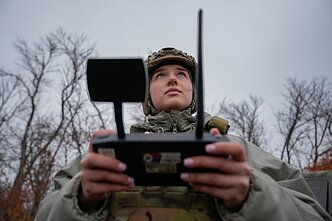
The Ukraine war has shown the importance of having cheap and efficient methods to destroy drones. This is particularly relevant given that drones are much cheaper than air defence systems and missiles.
Frankenburg Technologies, a Baltic start-up, is developing low-cost missiles to destroy drones. According to CEO Karolis Žemaitis, Lithuania would benefit from developing more advanced technology.
“Virtually anyone can tighten a screw. Lithuania needs to create value-added products here in Lithuania, as this not only adds to our economic value, but also increases our security,” Žemaitis says. “If we become interesting, we are worth defending and no one will turn the button off just because they don’t like us using someone else’s technology – if the technology is our own.”
LRT TV sources, who requested confidentiality, described the Lithuanian defence industry in its current state as consisting of a handful of companies that already have advanced products – such as drones, optics and laser-based products – and scientists who have ideas but not enough funding. And no specific products that could be tested now.
Partnerships
According to Lukas Savickas, the Lithuanian minister of economy, the most effective way to encourage local defence industry would be to invite foreign companies to develop products in Lithuania together with local partners.
One example is the German ammunition company Rheinmetall which plans to start making 155 mm artillery shells.
Moroever, he says, local manufacturers should be incentivised to develop products needed by other countries.
“A significant order, a long-term contract from the government can be one of the ways to attract substantial investment to Lithuania, which would significantly change the players in our defence industry, attracting new, powerful players with the technological know-how and the ability to quickly build production lines locally,” says Savickas.

The war in Ukraine has shown that what Kyiv needs most is the production of munitions, long-range missiles and a wide range of drones. That is where it is investing.
Meanwhile, Lithuanian defence companies say they have not heard from either the government or the armed forces about what kind of products they need. Moreover, according to Antanaitis, if defence is to be significantly financed by industry, then products need to be sold beyond the domestic market.
“It takes several years for a Lithuanian company to develop something. Then there are investments in infrastructure and so on. In order for the defence industry to take off, first of all there must be sales. If there are no sales, there is no development,” he argues.
The Lithuanian Armed Forces alone would make for a very small market, he adds.
“For example, once a plant makes 100,000 anti-tank mines [to fulfil an order], the whole production stops and they have to stop everything, they have to lay people off. If we want to kick-start a defence industry, it shouldn’t be just for our own needs, it must have export markets,” says Antanaitis.
According to LRT sources, the Lithuanian military is reluctant to get involved in developing new weapons that may not even pan out. They prefer to buy tested products from global manufacturers right away.
Therefore, even new players offering prototypes face a cautious approach from the Lithuanian military.

Newsletter
Every Friday morning.