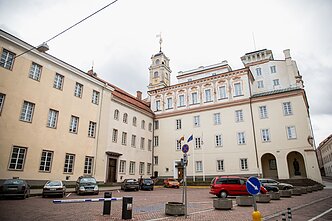














According to the magazine Reitingai, the number of students in Lithuanian higher education institutions has fallen by more than 65,000 over 14 years. Experts blame the declining birth rate in the country.
Maryam from Azerbaijan came to Vilnius six months ago to study marketing. In her words, Lithuania chose her.
“It seems that I didn’t choose Lithuania, but it chose me. My family’s friends live and study here. They suggested I look more into Lithuania,” Maryam said.
More and more foreigners are choosing to study in Lithuanian higher education institutions every year. According to education journalist Jonė Kučinskaitė, however, universities are still struggling to attract Europeans.
“In Lithuania, students from India, Pakistan, Bangladesh and former Soviet countries dominate,” she said.
Although the number of foreign students is increasing, overall enrolments are lower than 14 years ago. This year, 45,000 fewer students enrolled at Lithuanian universities and 20,000 fewer started their studies at colleges, compared to 2011.

The falling birth rates are to blame for this change, according to Kučinskaitė.
“In 2023, 20,000 babies were born. Whereas if we look back to 1994, more than 42,000 babies were born then. So, we can see that the birth rate has almost halved,” she said.
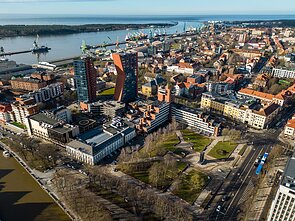
The number of students at Mykolas Romeris (MRU) and Klaipėda Universities went down by almost a third.
However, the thinning ranks of students are not only due to the declining birth rates, notes MRU Vice Rector Saulius Spurga.
“Our university is a social science university. State funding for social sciences has slightly decreased. The structure of the students has also changed, I mean those who pay tuition fees and those who do not,” he said.
Meanwhile, the University of Health Sciences, the ISM University, the Academy of Music and Theatre, and the Military Academy have seen their numbers of students grow, compared to 14 years ago.
Vilnius University (VU) has seen the biggest increase of 3,000 students after merging with International Business School and Šiauliai University.

According to Valdas Jaskūnas, vice-rector for studies at VU, all higher education institutions are affected by the declining birth rate, but the diversity of study programmes is attracting more people to study.
“As a university, we have by far the largest and most diverse portfolio of study programmes. And that diversity is a real attraction for students,” he explained.
At the same time, colleges are opening their doors to adults who have not had the opportunity to study before. Data compiled by Reitingai magazine show that older students make up between half and four-fifths of all students there.

Newsletter
Every Friday morning.