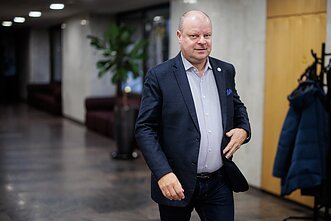
















What’s behind the fear that Belarus is allegedly trying to claim the history of the Grand Duchy of Lithuania as solely its own? LRT sits down to speak with Rūstis Kamuntavičius, historian of Vytautas Magnus University.
How much common history does Belarus and Lithuania have? Do the historical narratives differ?
Since the 13th century, we have lived in one political entity, the Grand Duchy of Lithuania. We lived without borders in the same territory, side by side. But then we were conquered by the Russian Empire. Ultimately, nations create their histories retrospectively.
If Lithuania's territory were different today, our past would be different too. If we owned the Kaliningrad region, we would be writing about Kaliningrad in our history. Therefore, it is logical that if we are talking about the common past of Vilnius, all the people who live here will describe Vilnius differently – each from their own perspective.
This is perfectly natural, it would be strange to write history in the same way because it would mean that one nation is imposing something on another.
This is difficult for people to understand. It is because in school they teach one possible version of history – we have tests with the right or wrong answers. This creates the illusion that there is one correct story about the past.
I do not know of a single country in the Western world that has gone through the history books of its neighbours. And that is where conflicts [between Lithuania and Belarus] stem from.
[...] In the book “Gudijos Istorija. Baltarusijos Istorija”, I tried to show why we tell the same thing from a different perspective. I think Lithuanians would understand the Belarusians better after reading it and would be less afraid of them. By understanding the Belarusians, Lithuanians would also understand themselves better and the fact that they too have constructed their past.

Looking at the history of Belarus and Lithuania, it seems that there are not so many conflicts. Why, then, do we start talking about the threat of Belarusians appropriating our history? Can we share the story of King Mindaugas?
There is a belief that there can be only one version of the past. People do not understand that the Belarusians may have a different view of Mindaugas, which also does not harm us in any way. How can Mindaugas be taken from Lithuanian history and made Belarusian? Who can do that?
It seems that there are psychological elements involved. Mindaugas was crowned in Naugardukas (Novgorod), but we consider him our first king. If Belarus also says that he is the first ruler of the Grand Duchy of Lithuania, which is a semi-Belarusian state, where is the evil in that?
We probably see in Alexander Lukashenko a prototype of Vladimir Putin, in that he used the politics of history to pave the way for aggression in Ukraine.
Two things need to be distinguished. There is history and there is war. If we see that we are threatened, then there is the court, international law, and so on. The second thing is that if Putin wants to attack us, it makes no difference whether Mindaugas is Belarusian or Lithuanian. We are free, we are different from the Russians because professional historians can write about the past as they see fit.
And how would you explain the issue of the threat of Litvinism? We see that there are conferences in the Seimas, and the State Security Department is talking about these threats. Is it our insecurity, or is it the agitation of Belarusian pseudo-historians?
For ten years, we used to organise huge annual congresses of the Belarusian elite in the humanities and social sciences in Kaunas, with 400 people attending. Many sections were devoted to the history of the Grand Duchy.
I know all the Belarusian historians, [...] I also wrote the first and only history of Belarus in Lithuanian. There are certainly no Litvinists in Belarus, as our radicals imagine or as Wikipedia defines Litvinism.
There are many definitions of Litvinism and nobody knows what it means anymore. A marginal appears, his views are elevated and this leads to fear.
Litvinism is not a Belarusian phenomenon, it is a phobia created by the Lithuanians themselves to make us afraid of the Belarusians – it has nothing to do with their people. It is our complexes, our phobias.
Further reading

How difficult is it for a historian to write about a country like Belarus, where its historians cannot talk openly and have to follow a regime line?
The regime does not write history, [but] historians are driven out. Especially after the [abortive] 2020 revolution and what is happening today – persecutions, imprisonments. History is written by the opposition, like the one in Vilnius or Warsaw.
We meet with them all the time, we talk to them. But those people in Lithuania who are very anti-Belarusian do not read the works of the [independent] Belarusian historians.
The main idea of the Belarusian opposition is that Lithuanians are historically their main allies. We are their window to the West, their strategic partners. The only people in the world who want to be [like] Lithuanians are the Belarusians.

Newsletter
Every Friday morning.