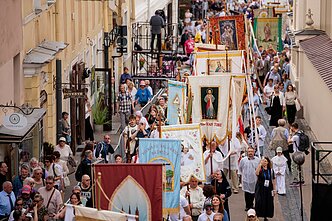













Congregations of churchgoers are shrinking across Lithuania, but so is enrolment in seminaries. As a result, fewer priests must serve multiple parishes.
Klemensas, 96, shows the church where he has been singing in a choir for about half a century. He recalls with joy the church where he spent a large part of his life, but admits it is not as cramped as it used to be.
“On Easter or Christmas, the church used to be filled to the brim. Nowadays, even the pews are not full, while before all the sides of the church were cramped with people,” he recalls.
These days are gone – most parishes have seen their congregations shrink. Clergy say that some of the faithful no longer come to churches because of ill health and age. Following services online is also growing in popularity.

“There has been a slight decrease in the number of churchgoers throughout Lithuania after the pandemic. During the pandemic, of course, churches were closed, and then the numbers bounced back, but they did not recover to the necessary level,” admits priest Rimantas Gudelis.
Conversely, the ranks of priests are also thinning. As a result, the existing priests have to work in several churches. Gudelis himself is in charge of two parishes, Antašava and Palėvenė.
“The record is probably one priest working in four parishes. In France, it is common for a priest to work in 14 parishes alone,” says Gudelis.
However, one parish is not enough to support a priest, he says.
“A person cannot survive in just one parish because he lives on the parishioners’ donations. And if only a handful of parishioners are left, they cannot support the priest,” he explains.

Meanwhile, the number of entrants to seminaries is also gradually decreasing.
“Seven students have enrolled this year, which we consider a good result. Especially after the pandemic years. In general, some courses have only a few students,” says Mindaugas Bernotavičius, rector of St Joseph’s Seminary.
This does not mean that there is any less work for priests, he adds. As people move into cities, they are joining prayer groups and need guidance. Some churches are very busy.
“This is particularly felt in parishes where there are many funerals. Especially in urban parishes, where it takes a priest a while to go to places. If there are many [funerals], they take up the better part of the day for one or more priests,” says Bernotavičius.

As society changes, the church has to respond to different needs, he concedes.
“Perhaps in the future, especially in the regions, several priests could come together and live in a central parish with a bigger parsonage. But then serve a larger number of parishes from there,” Bernotavičius thinks.
The priests say that although fewer people come to church than in the past, this is a way of discovering the true believers, the most faithful members of the congregation.

Newsletter
Every Friday morning.