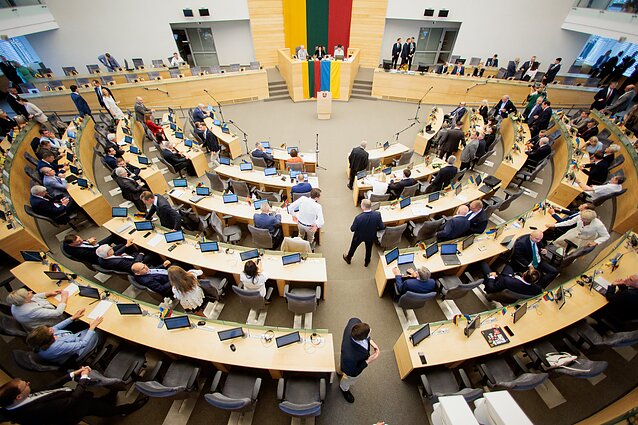
















Lithuania will have a Law on National Minorities again after 15 years, the Seimas decided on Thursday.
In total, 67 MPs voted in favour of the law, four abstained, and no voted against it.
Lithuania has not had a law on national minorities since 2010, when the old version of the legislation expired. Since then, attempts to adopt a new law on the rights of national minorities have not been successful.
The latest bill was prepared by the Justice Ministry and submitted to the Seimas by the government. The law will come into force in January if signed by President Gitanas Nausėda.
Ahead of the vote, Foreign Minister Gabrielius Landsbergis said the delay in adopting the law could harm bilateral relations with Poland.
“I would not rule out that this delay is becoming a sore,” he told journalists at the Seimas on Thursday, adding that Poland is interested in the fate of the law “at all levels”.
The bill defines what a national minority is and establishes the legal framework, conditions, and procedures for national minorities’ education, culture, and information dissemination.
Representatives of national minorities have criticised the new bill, stating in particular that it does not address the basic issues of national minorities and does not change their situation.
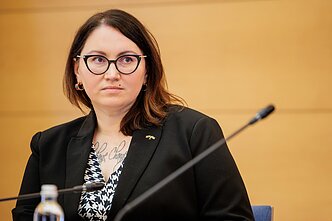
According to Justice Minister Ewelina Dobrowolska, the law creates an opportunity to separate the migration policy from the citizens of Lithuania belonging to national minorities.
The law guarantees rights for representatives of national communities, but it does not regulate things such as bilingual signs or the spelling of names, the minister said.

More rights for minorities
According to the bill, a person belonging to a national minority is defined as a citizen living in the territory of Lithuania who has a national identity different from that of the Lithuanians and who seeks to preserve it.
National identity is defined as a person’s freely chosen identification with the nationality of their parents or grandparents, based on the totality of its characteristic features – culture, language, traditions, customs – or at least one of these features.
The bill guarantees that no one may be forced to prove their belonging to a national minority, to publicly disclose their national identity, or to renounce their belonging to a national minority.
Belonging to a national minority guarantees the right to use its language freely. The bill also provides for the right of a member of a national minority to receive education in their language.
The bill stipulates that state institutions and bodies shall ensure the conditions for the training of teachers of national minority languages, the acquisition of textbooks and other aids for teaching the languages, and the right of representatives of a national minority to establish non-state educational institutions.
The bill states that persons belonging to a national minority have the right to foster and develop their culture, traditions, customs, and language, establish organisations and parties, have their own media outlets and use them to disseminate information in their own language.
According to the bill, the right of persons belonging to national minorities to decide on cultural, social, economic, educational, and other issues is ensured by the Council of National Communities, which submits proposals to state and municipal institutions and bodies.
The document also provides for the status of historical national minorities, which will be granted to endangered national minorities that do not have a historical homeland with which they can identify at present.
The preservation of their culture, traditions, customs, and language should be the responsibility of state and municipal authorities.

Newsletter
Every Friday morning.