














It’s been one year since the brutal October 7 Hamas attack on Israel that killed over 1,200 people. In response, Tel Aviv unleashed a ruthless campaign in Gaza, which is now subject to genocide accusations. While some countries began to question their support for Israel, the foundations of solidarity in Lithuania did not budge.
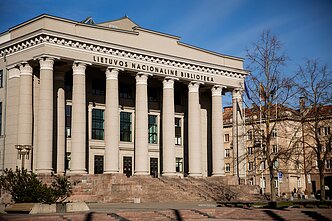
Several dozen people observed a minute’s silence at the opening of a ceremony in the Lithuanian parliament Seimas to commemorate the victims of the October 7 attack. Ambassadors, Lithuanian politicians and other guests were surrounded by a photography exhibition showing massacred Israeli communities near the Gaza Strip and burnt-out fields of the Nova music festival.
This was not a fight for freedom or resistance, Maya Parizer, one of the festival’s survivors, told the Seimas. “I’m for a two-state solution, but it’s not relevant to the subject. I lost family members and friends that day, and communities are shattered to this day,” she said.
Around 100 of the 251 abductees are still in captivity and it is not clear whether they are still alive.
Since the attack, which together with Israel’s response plunged the region into a war that has already claimed tens of thousands of lives, Lithuania has kept close to Tel Aviv. Just three days after the attack, and among the first in the world, the country’s parliament unanimously adopted a resolution condemning the Hamas attack. Later, on October 3 this year, the Seimas also adopted a resolution recognising Iran’s Islamic Revolutionary Guard Corps as a terrorist organisation.
“These are not just symbols, they draw a certain line for our country,” Viktorija Čmilytė-Nielsen, the speaker of the Seimas, who together with the Israeli embassy initiated the commemorative event, told LRT.lt. This line, she said, is based on democratic values and a response to the “axis of evil” between Russia, Iran, North Korea and other actors.

On the anniversary of the attack, world leaders, including French President Emmanuel Macron and US President Joe Biden, expressed solidarity with Israel, despite the growing protests against Tel Aviv’s operation in Gaza and Lebanon.
In their messages, however, they also called for a ceasefire in Gaza and urged all sides to move toward peace. This came in the wake of the Israeli operation that already saw the death of nearly 42,000 Palestinians in 12 months.
“One would have imagined that after the war crimes that were witnessed, and even filmed by IDF soldiers and posted on social media, Western governments would create costs for the violations committed by Israel. But this hasn’t happened,” Kelly Petillo, an expert at the European Council on Foreign Relations (ECFR) think tank, told LRT.lt.
Israel’s Ambassador to Lithuania Hadas Wittenberg Silverstein, who attended the event at the parliament, thanked Vilnius for its support.
“It is very much appreciated, we feel it from people, we feel it from the leadership, from resolutions of Seimas,” she told LRT.lt.

Together with their counterparts around the world, the Lithuanian Jewish Community (LŽB) has mobilised to help Israel. In Lithuania, the support was not as visible as for the Ukrainians, according to Faina Kukliansky, chairperson of the LŽB. Although around 90,000 Israelis have been forced to flee their homes, they mostly stayed inside the country, while Lithuania took in tens of thousands of Ukrainian refugees.
Kukliansky said the community fully supports Israel because of its right to defend itself.
“The Israeli response, as we understand it, is adequate, proportionate – there is a war going on,” said Kukliansky, “It shouldn’t be surprising that the Israeli army is entering Gaza to wage war, not to hug and kiss.”
Meanwhile, Ambassador Silverstein acknowledged that Tel Aviv is facing increasing criticism and questions.
“But it is a dialogue that we can run among friends – with Lithuania, with other Western societies,” she said. “I wouldn’t say that the support [in the West] has totally shifted, because it’s very clear what we are doing and why we are doing it. Of course, war is a tragedy for both sides, there is also suffering on the other side.”

Understanding Lithuania’s support for Israel
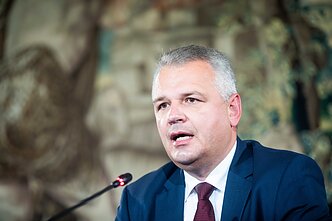
“Israel is seen as a rational player, even though most of the ruling coalition is made up of religious or political radicals. Criticism is answered with the question: does Israel have the right to exist?” said Ieva Koreivaitė, a lecturer at the Institute of International Relations and Political Science at Vilnius University and a doctor of political science.
“The answer is yes, but we need a different security strategy. For example, a two-state solution, which this [Tel Aviv] government does not agree with,” she added.
According to analysts and people interviewed by LRT.lt at the Seimas event, Lithuania’s public support for Israel is often associated with guilt stemming from Holocaust complicity.
“One of the Israeli government’s strategies is to tap into these feelings,” said Koreivaitė. “It is difficult to criticise Israel’s policies in Lithuania, and it is even equated with anti-Semitism. But criticising the policies of a nation-state is not anti-Semitism, there is no slippery slope or ambiguity, as they try to say.”
Another root of this support, according to Koreivaitė, is Lithuania’s strategic partnership with the United States.

The Lithuanian Foreign Ministry previously told LRT.lt that when voting at the United Nations, Vilnius “traditionally seeks to constructively abstain in order to reach a consensus and to take into account the position of its closest partners”. Although the closest partners were not named, Koreivaitė and other observers point at Washington.
“[We follow] the direction and logic of the US policy and Washington declares unconditional support for Israel. The difference is that in the US the discussion [on the future of Palestine] is happening,” said Koreivaitė. “In Lithuania, the debate is feared, and the discussion on the legality or morality of Israel’s actions is avoided, because this could unbalance strategic support.”
Israeli flags can often be seen in Vilnius hanging next to Ukraine’s blue and yellow. Since the October 7 attack, both in the public space in Lithuania and in Ukraine itself, the pain experienced by Israeli society has often been compared with the shock and terror in Ukraine after Russia’s invasion.
But it is a mistake to equate the Russian invasion of Ukraine with the Israeli conflict because Tel Aviv is in a position of power, according to political scientist Žilvinas Švedkauskas, a doctor of political science at the University of Tübingen.

“Especially in the US, there is a tendency to equate conflicts that are not directly related – Russia and Ukraine, Hamas and Israel, China and Taiwan,” he said.
These wars and conflicts “have been joined together in people’s minds” in the US after Washington adopted the joint support package for its three allies – Israel, Taiwan and Ukraine.
“We are seeing the same thing in Lithuania,” said Švedkauskas. “There is a general influence of the Western information space which the Lithuanian media and opinion makers are unquestionably repeating. That is why it is obvious that there is more support for Israel in Lithuania.”
According to the political scientist, Lithuanians are often presented with a simplified context of the Middle East region.
“We don’t have any basic knowledge of how Israel as a state was formed, how many occupied territories there are in Palestine, Syria or southern Lebanon,” said Švedkauskas.
“We also have an active Israeli embassy, which means that we only hear one side of the conflict,” he added. “This conflict in Gaza has also been a war of images, with attempts on both sides to prove that the other side is barbaric, that its crimes go beyond humanity and therefore warrant a response of even more force and violence.”

Because of the simplification, only the most extreme voices are being heard, according to Švedkauskas.
“When we see the conflict that is being created and escalated by the radicals on both sides – Hamas, the government of [Israeli Prime Minister Benjamin] Netanyahu – we don’t see the people who are in the middle, like those who are in the streets of Israel protesting against the constitutional reforms that are taking the country down Hungary’s path, we don’t see the Arabs and Jews who live in mixed families,” said Švedkauskas.
All this leads, according to Koreivaitė from Vilnius University, to an “inertia to support” Israel.
“Unfortunately, there is little knowledge about the Middle East, the Palestinian situation, the settlers, Zionist radicalism and Islamic radicalism, which is stereotyped and politicised, and permeated by what is called tribal thinking. The duality of ‘we are good’ and ‘they are bad’ is used, even when the ‘good ones’ behave identically to the ‘bad ones’,” Koreivaitė added.

Newsletter
Every Friday morning.