





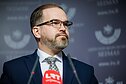


After lengthy negotiations, EC President Ursula von der Leyen announced her new Commission this week. Lithuania’s former prime minister Andrius Kubilius is entrusted with the newly created portfolio of Commissioner for Defence and Space.
Kubilius spoke about his responsibilities and challenges on LRT TV’s programme Topic of the Day.
Mr Kubilius, you have said there is much work to be done in European defence. If you are confirmed as the EU commissioner for defence and space, what would you like to do over the five-year term?
We must be clear that today, defence challenges are among the most pressing ones that Europe as a whole is facing. In our region, we are perhaps feeling it particularly painfully, Ukraine is suffering, and it is only natural that, in response, there’s a completely new position of commissioner for defence and space. The position comes with a huge responsibility.
Responsibility for ensuring that the EU and its member states have resources for their defence, that Putin wouldn’t dare to think of directing any aggression against EU and NATO countries.

While NATO and its members have defence plans, which is a very important instrument, a clear military leadership, the European Union certainly does not claim to have that, but it can help the member countries and NATO strengthen the resource foundations. This includes military equipment, logistics, military transit, also resources for the military industry which are particularly important against long-term aggression and long-term war, such as Ukraine is experiencing right now.
You said that we are ready for an overhaul. But are you and the European Commission as a whole capable of overhauling countries such as Hungary which are cosying up to Moscow?
First off, I used the term overhaul to quote Ursula von der Leyen, who used the term in a speech at one of the very important GLOBSEC conferences, where she set out clear reasons why the new Commission will give defence and security a very high priority. Defence and security will be one of the top two priorities, along with competitiveness, throughout the work of this Commission.
And she made it very clear in her statement that the European Union’s defence instruments, which can be used to support defence, need to be overhauled because they have been weak or dysfunctional. This is reflected in the situation of the European military industry, with only 20 percent of its production being purchased by EU countries. This shows that the European military industry as a resource is really in need of overhaul.

How that overhaul can be accomplished is another matter, but in the end, it all comes down to something that only the EU can do, which is to find a way to invest a lot of extra money into developing the military industry. We are talking about hundreds of billions of euros, Ursula von der Leyen herself recently mentioned the sum of 500 billion of additional investment in European defence capabilities over the next ten years. This is something that we’ll have to work on very seriously.
Last spring, French President Emmanuel Macron called on European countries to start a discussion on common defence and said that the cornerstone of that defence could be French nuclear weapons. Do you see the European Union going in that direction? And do you think that we need an EU army?
In fact, both France and Germany are taking care of their defence potential – we can recall here various statements besides Emmanuel Macron’s, such as the words of German Defence Minister [Boris] Pistorius, well known in Lithuania, who last spring that, according to German experts, Russia could be ready for military aggression against an EU or NATO country within six to eight years. Putting all this jigsaw puzzle together, it is clear that defence matters need special attention and urgency.
On the European nuclear umbrella, I would not like to go into deeper discussions now, because as I understand it, my responsibility is focusing on building up resources, leaving it up to other EU commissioners and leaders to think about the geopolitical aspects, such as the relationship with the US or even the nuclear weapon.

I am not going to discuss that here, because I believe it is actually very important for the EU to maintain transatlantic communion with the US, not least because only the US can provide an effective nuclear umbrella. We can think about how an EU nuclear umbrella could be developed in the future, but this will take a long time and everyone is aware of the resources that would be required. It might be important now to make sure that the EU strengthen its non-nuclear capabilities, and then other things could be considered.
There is also a debate on the European army, but at least for now the main focus is on strengthening the EU’s joint capabilities that could be used in international missions. There is certainly a lot of talk about this, and it may be that some steps will be taken in this direction in the near future.
Your portfolio also includes space. What’s the importance of space for the future of defence? Is already playing a role in current conflicts?
Well, I do follow the Lithuanian public debate, many people find it amusing that a Lithuanian will be in charge of space.
But it is actually a very serious matter, as you have rightly pointed out, because space technology – such as the GPS service, the monitoring of natural phenomena or even of military movements, the new communication technologies that use space satellites – is a really important, vital area. This infrastructure can also be the target of hostile forces.
Therefore my responsibility for space, for space technology, is also very important. And while in some areas of space technology the EU has been leading – for GPS services, as the experts say, the EU has the leading technology – in other areas, we are beginning to lose ground, in particular satellite launchers. What and how to find solutions will also be a very important responsibility.
Finally, your portfolio is a new one, it shows that the EU is paying more attention to defence and security. But have you received any assurances from the EC president that this area will be adequately resourced? The main criticism of this portfolio is that there are no budget allocations for it. Moreover, how will you coordinate with your Finnish and Estonian counterparts, who are also vice presidents of the European Commission and partly involved in security and defence?
I think we will find a good consensus with my Baltic counterparts, certainly about what the challenges are and what needs to be done, there will be no major disagreements. On the other hand, it is quite clear that Ursula von der Leyen considers defence and security to be very high priorities, and I, therefore, believe that her leadership in this area will be sufficient to find and agree on common actions.

The issue of resources will certainly be very important. It is also very clear that the EU can only have the resources that all member states agree to grant. Whether it is the EU budget or defence bonds, everything has to be agreed by the member states, these investments cannot come from elsewhere.
The question, then, is not only where the resources will come from, but also and above all how to get all the member states to agree that the threats are serious and very real. So that it is not only the Baltic countries and Central Europe that understand these threats. In this case, I see the need for politicians and parliamentarians from all countries to take joint initiatives and to discuss in various formats what threats we are facing today, how they should be approached and how we will deal with them. Only then will there be additional money.

Newsletter
Every Friday morning.