








Kazys Škirpa continues to be a controversial figure in Lithuania’s history. According to a June report by the state-funded Genocide and Resistance Research Centre (LGGRTC), Škirpa was not a Nazi collaborator. However, other historians are not so sure.
“He did not betray the independent state of Lithuania but sought ways to restore independence and to remove the consequences of the occupation and annexation by the Soviet Union in the summer of 1940. On the other hand, he was not an official of the local authorities of Nazi-occupied Lithuania. Therefore, he was not a collaborator,” reads the LGGRTC report.
According to the centre, Škirpa is considered by some to be a patriot, while others criticise him for his alignment with Nazi Germany and for anti-Semitic sentiments in the organisation he founded, the Lithuanian Activist Front (LAF).
LGGRTC also said that Škirpa is not responsible for the LAF brochure, which proclaimed that the restoration of Lithuania should entail “the complete separation of the Jews from the state and national body of Lithuania and the gradual elimination of Jews from Lithuania”.
The centre’s report discusses more anti-Semitic LAF statements, including the “need to make the Jews flee with the Russians” and that the “greatest collaborator of the enemy was a Jew”, which are attributed not to Škirpa, but to Bronys Raila, head of the LAF propaganda commission at the time.
LGGRTC also states that the LAF proposed to solve the “Jewish problem” not with genocide, but with expulsion. This notion of separating expulsion from genocide is heavily criticised by other historians.
The June report also includes the June 25, 1941 publication by the Lithuanian-American newspaper Draugas, which claimed that Škirpa had banned the persecution of Jews. However, no evidence is provided to back up the claim.
Additionally, the centre states that Škirpa was not involved in the 1941 massacre of Jews in Kaunas by the Lithuanian Nazi auxiliary unit, the National Labour Protection Battalion.
“Until the end of July 1941, the Kaunas TDA Battalion was subordinate to the German military administration, the German security police and the SD in Lithuania, SS-Standartenführer Karl Jäger, and the Kaunas City and County Commandant's Office. On the instructions and orders of Jäger on days 4, 6, 9 and 19 of July 1991, 3,027 persons (including 3,020 Jews) were killed. There is no evidence that Škirpa, who was in Berlin at the time, had anything to do with these massacres,” the report notes.
Finding a compromise
According to Saulius Sužiedelis, a historian and professor emeritus at the University of Pennsylvania in Millersville, United States, the new LGGRTC report echoes the same conclusions published by the centre in 2019. This time, according to Sužiedelis, the centre also aims to find a compromise.
“The current certificate justifiably asserts that Škirpa cannot be held personally responsible for the participation of the so-called National Labour Protection (TDA) and the Lithuanian police self-defence battalions in the process of extermination of the Jews,” the historian said.
However, important aspects of the LAF's political activities and ideology have been underestimated.
“Former members and leaders of the LAF active in the post-war diaspora, ie the organisation of the Friends of the Lithuanian Front, or the so-called Frontininkai in the diaspora, acknowledged that the programme of the organisation, which was founded in November 1940, “contained the then fashionable totalitarian tendencies with a leader and a hint of racism”. Indeed, anti-Semitism and communism were not “hints” or, as the reports say, “manifestations”, but essential, integral principles of the LAF's political-ideological programme. They constituted Škirpa's vision of the future Lithuania.
The text mentions Raila's brochure was the most radical expression of racism and fascism of some members of the Berlin LAF. I would like to stress that, as mentioned in the certificate, the “Jewish question” was to be solved by expelling all Jews from Lithuania and expropriating their property. Such ethnic cleansing, which is considered a crime against humanity, was one of the main points of the LAF's programme, not a manifestation of it,” said Sužiedėlis.
The historian is surprised that the authors of the certificate refer to an article that appeared in the Lithuanian-American newspaper Draugas in 1941, which claimed that Škirpa had banned the persecution of Jews.
“We do not find such a prohibition in any primary, archival sources or memoirs, nor could there have been one. Škirpa was under house arrest in Berlin at the time. Incidentally, in the contemporary issues of Draugas, we find a lot of “news” about the uprising that does not correspond to reality [like] “the rebellious Lithuanian army capturing Kaunas”, etc.
As far as I have read, Škirpa himself never mentioned the “ban”. Historians generally accept a certain hierarchy of sources. It is strange that the historians who signed the report, who have published a number of valuable academic monographs and articles on the Holocaust in Lithuania, did not pay attention to the obviously erroneous information published in Draugas,” said Sužiedėlis.
According to him, it is also necessary to assess how Škirpa envisioned Lithuania's independence and relations with Nazi Germany.
“[His] writings are striking in their suggestion of an alliance with the Third Reich and in their acknowledgement of a preference for a “New Europe” led by “Greater Germany”. At best, this meant turning Lithuania into Hitler's protectorate; at worst, it was the road to the colonisation and Germanisation of the country. In such a situation, there can hardly be any talk of a sovereign, independent Lithuanian state.
On July 11, 1941, Škirpa presented to a Reich official a draft of Lithuania's future close relations with Germany, which stressed that the country’s provisional government “is based on the Lithuanian Activist Front (LAF), which is very close to the noble ideas of National Socialism”.
“In publishing his story of the uprising, Škirpa deleted this sentence, as well as other discrediting texts that referred to the expulsion of Jews from Lithuania,” Sužiedėlis added.
Škirpa’s memory, according to the historian, shows that Lithuanian society is very strict about collaboration with the Soviet occupiers, but is lenient about the Nazis.

Collaborator or not?
When asked to evaluate the certificate prepared by the LGGRTC, historian Simonas Jazavita, who wrote and prepared his dissertation on Škirpą, said the centre presented some facts correctly, while some other information was debatable.
One such topic is the role of Škirpa in the anti-Semitic statements of the LAF. According to the historian, although Škirpa was not able to carry out any direct activities in Lithuania after the 1941 June Uprising – because he was arrested by the Germans – he continued to be a moral leader, which should be taken into account.
“A difficult question remains unanswered. [...] If we assume that Škirpa was not influential at the time, this would mean that his contribution to the uprising was also insignificant, [which would mean[ he was not involved in anti-Semitic sentiments either. But if we accept that Škirpa's activities at the time were significant in the uprising, then his responsibility [for the anti-Semitic statements] is also present,” said Jazavita.
Although the battalions of the National Labour Guard (TDA) were Škirpa's idea, he cannot be blamed for the 1941 massacre of Jews in Kaunas.
“It was his idea to create these units. However, in the run-up to the uprising in the spring of 1941, when he was in Germany, the TDA slipped out of Škirpa's control,” the historian concluded.
Škirpa later wrote himself that he only found out about the massacre at the beginning of 1942, but this is unlikely, according to the historian.
“There is no doubt that he could not have guessed it because he was in contact with high Reich officials who did not hide their anti-Semitic attitudes. He also had contacts with Lithuania,” Jazavita added.
The information published by the American-Lithuanian Draugas publication also does not add up – if Škirpa only found out about the massacres in 1942, he could not have banned them in 1941, the historian said.
However, Jazavita does not consider Škirpa to be a collaborator.
“There are letters in the archives in Berlin [where Škirpa] asked to be recognised as the prime minister of Lithuania, but he received no reply and was put under house arrest. The Germans thus showed their position,” Jazavita said.
When under arrest, Škirpa sought help in Germany. A high-ranking officer, Kurt von Tippelskirch, even wondered why such a “friend of Germany” was imprisoned, the historian said.
“This even attracted the attention of Gestapo chief Heinrich Müller, who asked the Foreign Office to clarify whether Škirpa was needed in Germany's interests,” said Jazavita.
The Gestapo was eventually informed that Škirpa was “an unprecedented anticommunist, a great Lithuanian nationalist, but that the interests of Lithuanians would always be more important to him than those of the German Reich”. This meant that the Germans themselves did not consider Škirpa a collaborator, Jazavita said.
Škirpa ended up in France and later moved to the US after the war.
“The Americans, the British and the French had no complaints against him,” Jazavita said. “The US embassy in France said that “his actions as a representative of a small country, amid the [wars of the] big countries and to preserve his country's independence, were understandable.”
According to Jazavita, the memory of Škirpa should be commemorated, but not without its controversial aspects.
“People don't have to be ideal, it is possible that if a certain historical personality is commemorated, one person will like it very much, while another will [not]. But this is democracy, this is the price of democracy, there is no need to hide history,” Jazavita said. “We should not be afraid to see mistakes and discuss them, only from such a history can we learn.”
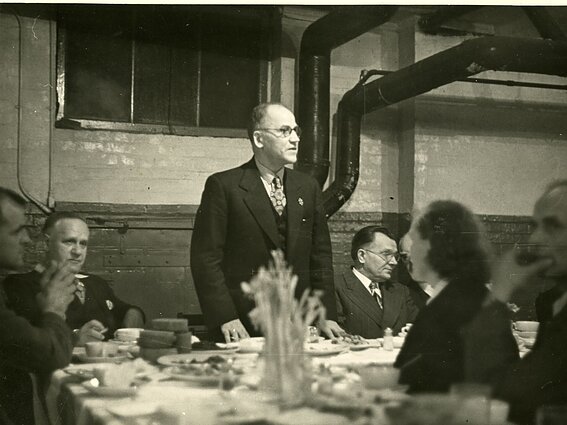
Does not show the dark side
Historian Valdemaras Klumbys said the LGGRTC report was not convincing, despite trying to present different sides of Škirpa's activities.
“In history, two plus two does not equal four. It's a humanitarian science and you choose some sources and not others. In this case, the choice is more likely to exonerate than to show the other side of Škirpa,” he said.
Although the LAF texts did not indicate that Škirpa was responsible for them, as the head of the organisation he must have been aware of the content, Klumbys said.
Meanwhile, Škirpa believed that Germany could help free Lithuania from the Soviet occupation and dreamt of an independent Lithuania, but this would have meant collaboration with Nazi Germany.
Klumbys argued that the same criteria should be applied to everyone when dealing with the subject of collaboration, whether we are talking about Nazi Germany or the Soviet Union.
He agreed that Škirpa was not directly involved in the massacre of the Jews, but criticised those who did not respect the tragic historical memory of this nation and thought that the occupation of Nazi Germany was the lesser evil.
Nearly 200,000 Lithuanians, mostly Jews, were murdered during the Nazi occupation, while the number of those who died in the Stalinist repressions is less than 100,000.
“Let's look at all the occupations in the same way, because when we say that one occupation is worse, it doesn't come out very nice. For me, Škirpa is a man who was clearly prepared to collaborate for the sake of Lithuania,” Klumbys said.
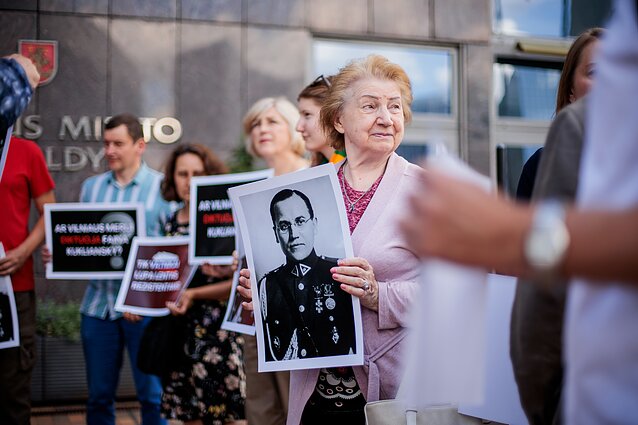
Attempts to justify Škirpa's actions
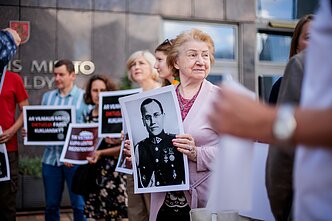
The Vilnius Municipality is due to decide on September 19 whether to put up a memorial plaque to Škirpa.
Meanwhile, the Lithuanian Jewish Community (LŽB) has called on the municipality to decide against it, saying that the LGGRTC centre is downplaying the role of Škirpa in the tragic events of 1941.
“The LŽB firmly believes that Škirpa, whose openly anti-Semitic statements and incitement to kill Jews led to the tragic atrocities, should not be celebrated. The monuments and plaques erected in his honour are a great insult to the memory of the thousands of Lithuanian Jews killed in the Holocaust and to their relatives.
All the more so since Lithuania has still not established a national memorial to the more than 200,000 victims of the Holocaust – our fellow citizens. Nor is there a memorial honouring the heroism of the Lithuanian Jewish rescuers who risked their lives and the lives of their families,” the Jewish community said in a statement.

Newsletter
Every Friday morning.