















The Defence Ministry proposes that Lithuanian citizens who also hold Russian or Belarusian citizenship should not be allowed to join the Lithuanian Riflemen’s Union (LRU).
“If it is found that a person has acquired or holds the citizenship of a foreign state that threatens national security, they would not be admitted to the Lithuanian Riflemen’s Union,” Defence Minister Laurynas Kasčiūnas has told BNS.
The proposal is part of amendments to the law on the Lithuanian Riflemen’s Union drafted by the ministry.
The amendments provide, among other things, that individuals whose characteristics, activities, or connections are incompatible with national security interests cannot become members of the paramilitary organisation.
The proposal would also prohibit individuals with citizenship from countries deemed a security threat to Lithuania from joining the LRU. The list of such countries would be drawn up by the government.
“This will make it possible to assess the activities, connections, links, or other related circumstances of the LRU members or those applying to become members that have or may have an impact on their credibility, loyalty to the state of Lithuania, vulnerability, or impeccable reputation, which poses a risk to the security of the Riflemen’s Union or cooperating institutions and national security interests,” Kasčiūnas told BNS.

Last January, the government approved a list of countries that military personnel and officials are banned from visiting due to national security concerns. The list includes Belarus, China, and Russia.
‘Hostile states watching our actions’
According to Lieutenant Colonel Gediminas Latvys, the LRU deputy commander, the organisation’s leadership supports these proposals.
The organisation has grown considerably, with around 2,000 people joining in the last year and a half alone, which necessitates “certain safeguards”, according to Latvys.
“When it comes to dual citizenship, we understand which states are hostile towards us, and we can hardly imagine Lithuanian citizens with citizenship from a hostile country serving in the LRU and participating in military training exercises. We are obviously talking about Russia and Belarus,” he told BNS.
Latvys declined to disclose whether there have already been cases where the loyalty of a member was questioned but confirmed that hostile states are interested in LRU activities.
“We are very useful to our state during peacetime and are becoming more integrated into the state’s crisis management and defence architecture. We are highly valued by the Crisis Management Centre and the military,” the deputy commander said.
“Undoubtedly, we are appreciated and noticed, so it is natural that hostile states are also watching our actions and our military training exercises and events, and I would certainly not rule out the possibility of that happening,” he said.
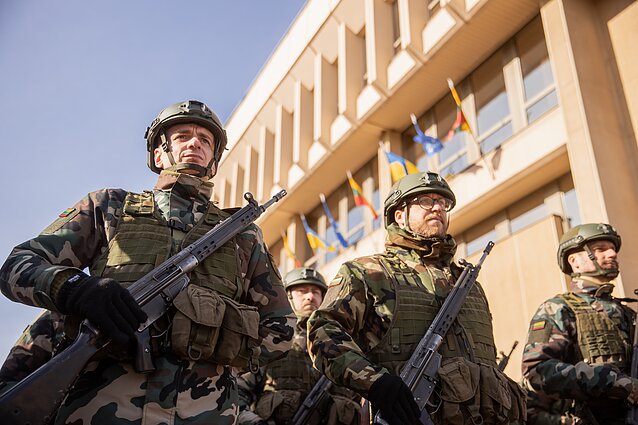
Latvys noted that if the amendments were passed, the State Security Department and the Second Investigation Department under the Defence Ministry would have to assist the LRU in vetting candidates for membership.
Specialised units
The draft legislation also provides for the establishment of specialised units within the LRU for logistics, cyber security, communications, medicine, liaison, search and rescue, evacuation, and other tasks.
“In the past two years, we have strengthened the LRU in areas such as unmanned aerial vehicle units, military engineering, information operations, psychological operations, and so on,” Latvys said.
He added that the proposed legislation seeks to formalise these specialisations and integrate them into state institutions and the armed forces.
Defence Minister Kasčiūnas also noted that the amendments would make it possible to pay higher salaries and material allowances for LRU members and simplify asset transfer procedures.
According to the Lithuanian Riflemen’s Union, it currently has over 16,000 members.

Newsletter
Every Friday morning.